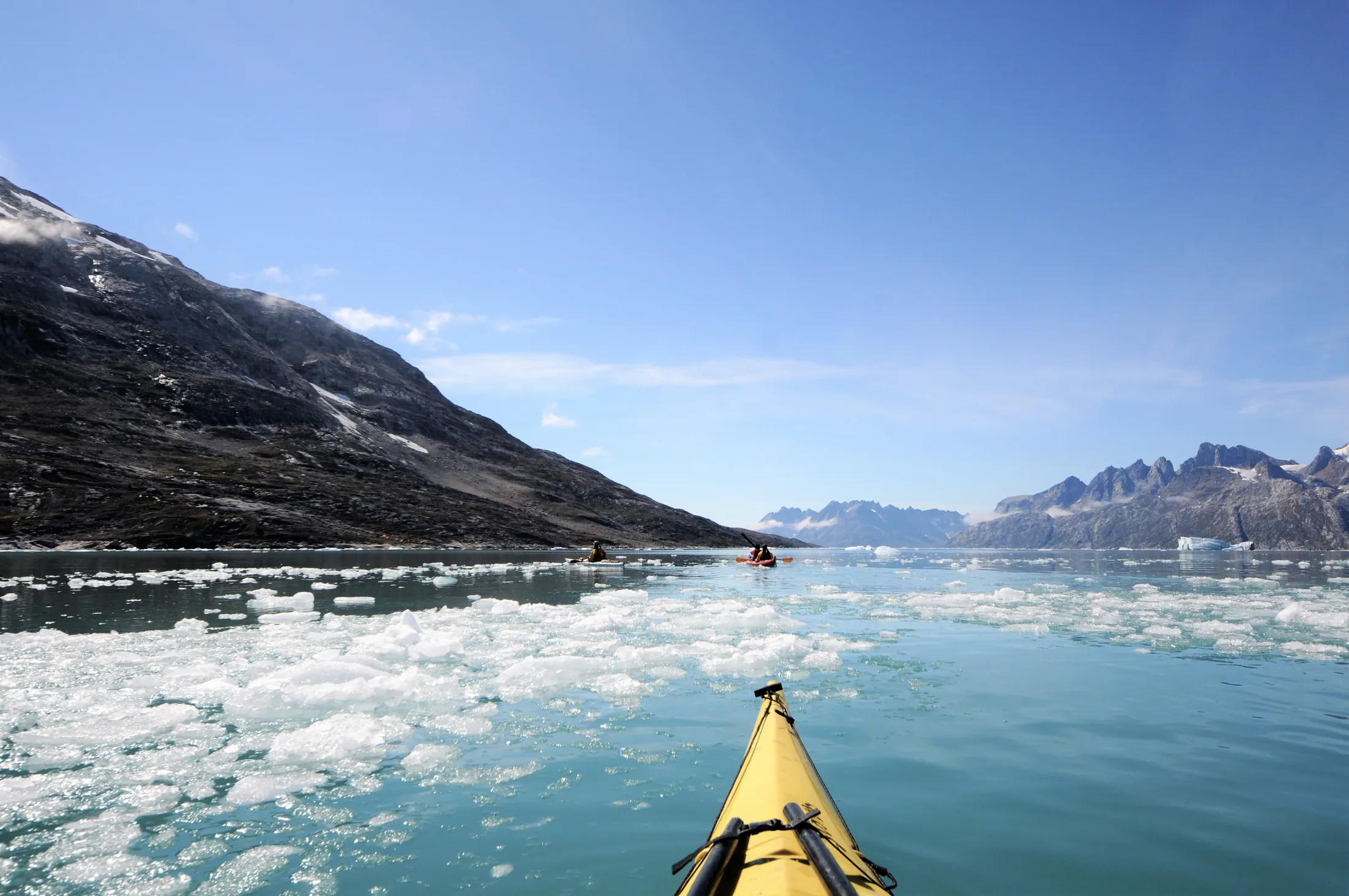
View from a yellow kayak paddling through light blue water filled with drift ice toward two other kayaks, surrounded by massive mountains under a clear blue sky.
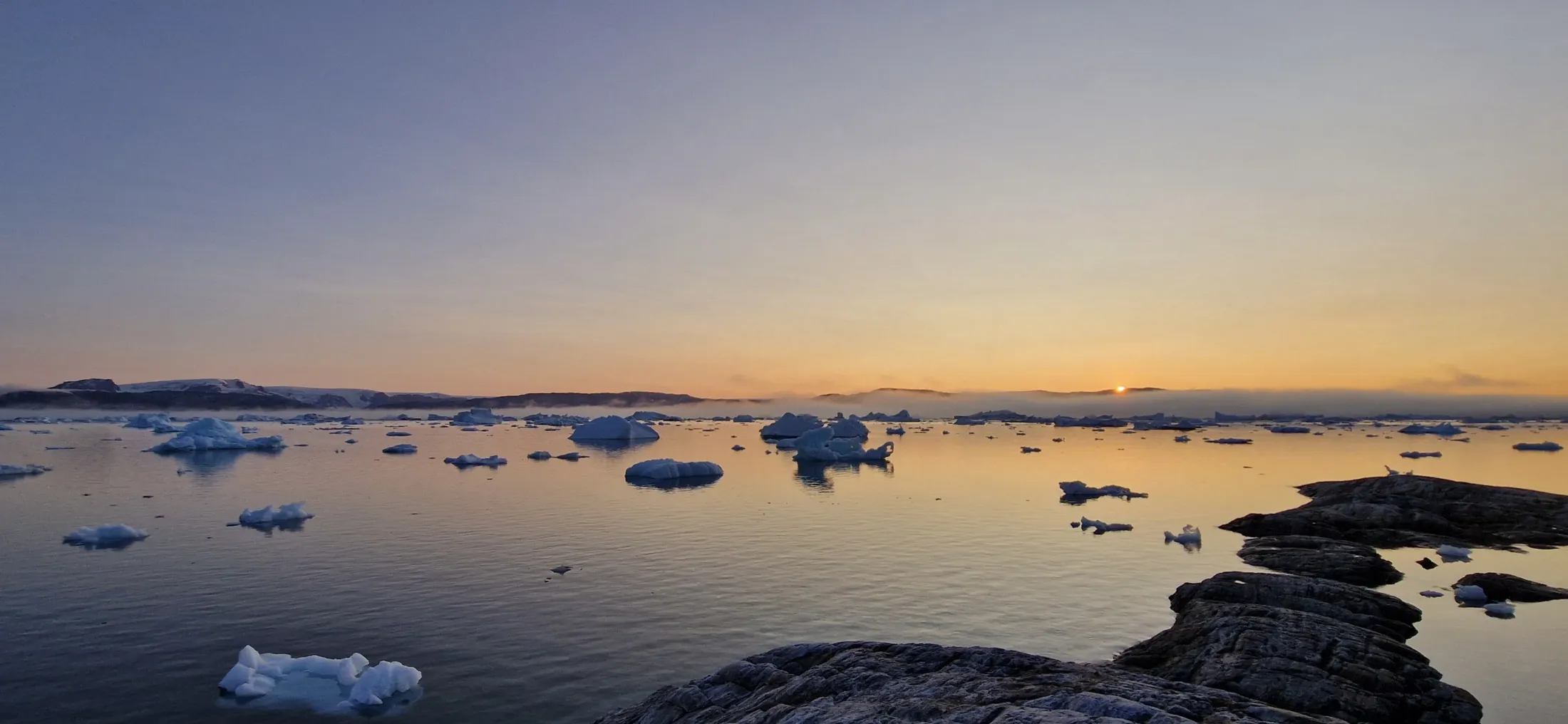
Icebergs float on a calm ocean during a golden sunset, with low fog hanging over mountains in the background and rocky terrain in the foreground.
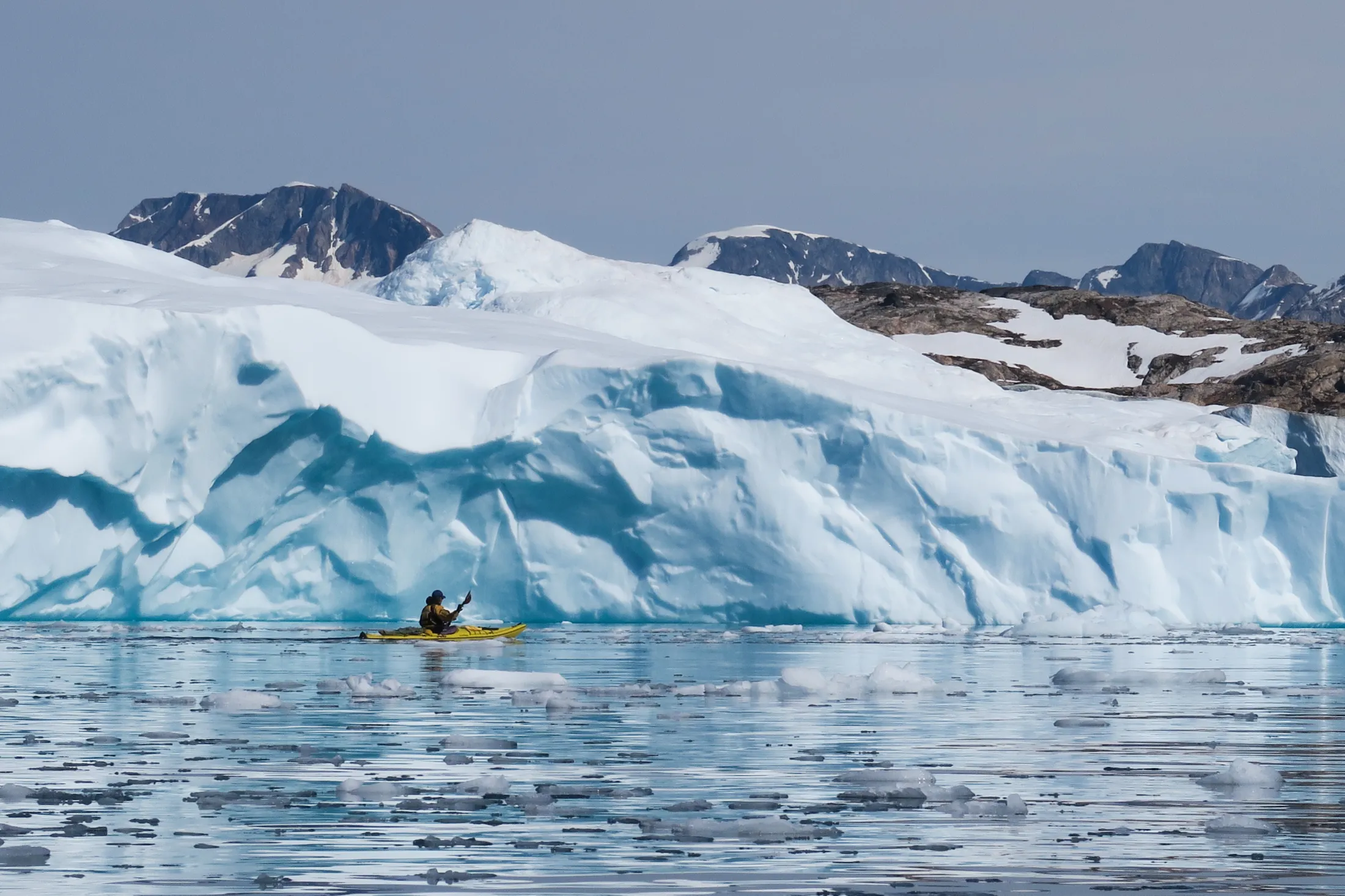
A person in a yellow kayak paddles on calm, ice-filled water in front of a massive, light blue ice wall with snow-dusted mountains in the background.
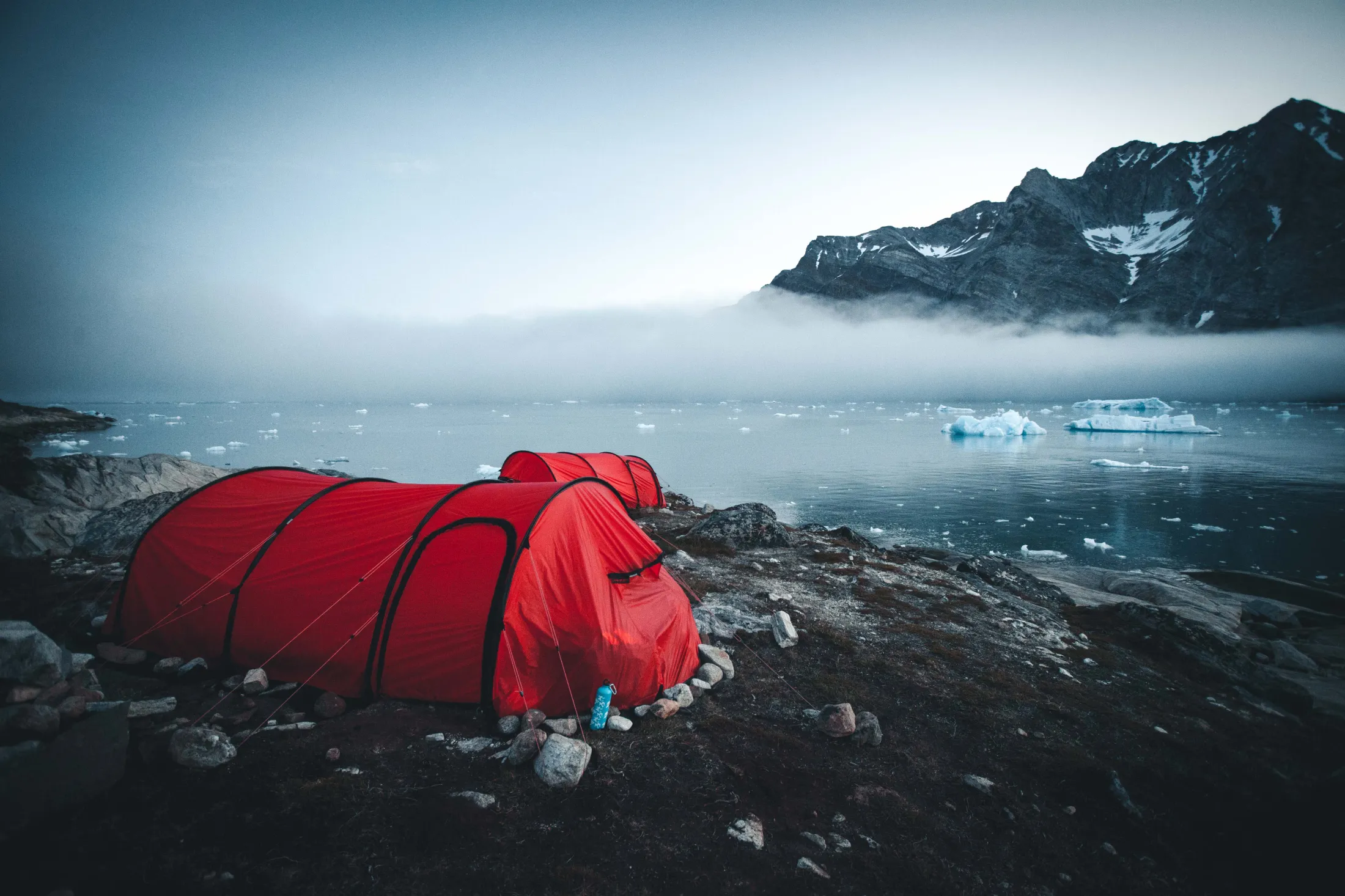
Two red tunnel tents are pitched on a rocky shoreline, overlooking an ocean filled with drift ice and low-hanging fog in front of dark mountains.

Kayak Adventure in Greenland

Along mountains and fjords

Kayak Adventure in Greenland

Along mountains and fjords

From USD 7204

The east coast of Greenland is a landscape of deep fjords, dramatic mountains, powerful glaciers and glittering icebergs. It's simple, it's exciting, it's unique. There will also be a visit to Tinit, overlooking the beautiful Sermilik Fjord, and spectacular boat trips. 

Hightlights

  • Kayaking in Greenland
  • Mighty icebergs 
  • Exotic hunting villages 

We start off by flying across the drift ice belt to Kulusuk on the east coast. Over the course of 6 days, we'll paddle into the spectacular fjords, where the icebergs can be up to 40-50 meters high. The day trips are not so long in distance, but we will spend the whole day in the kayaks with lunch on a beach or at a colorful fishing hut. When the kayak trip is over, we are transported by boat to a cabin at Tinit. From here we have a spectacular view of the Sermilikfjord, where the ice floats past in large quantities after calving from the glacier further into the fjord.

The trip ends with a night in charming Tasiilaq. On the last day we fly back to Reykjavik, where you can tavel back home with your chosen transport, or you can stay a few nights in Iceland to explore this beautiful island. 

10

6 - 8

NO/EN

3/6

1/6

3/6

Dates and booking

Mon 12. July - Wed 21. July 2027

USD 7204

Flight not included

Fully booked

Guaranteed departure

Can't find a date? We'll notify you when new trips open!

Plan it your way

Want this trip just for your group? Or got something different in mind? We've got you.

Make this a private trip

Opening hours Phone
Mon-Fri : 08-20
Sat-Sun : 14-17
Opening hours Chat
Mon-Fri : 07-23
Sat : 10-18
Sun : 13-21
CET

Day by day

Colorful wooden houses in blue and yellow with white window shutters stand close together under a cloudless, deep blue sky.

Day 1:Meeting in Reykjavik and flight to Kulusuk in East Greenland

We meet at Keflavik International Airport no later than 3:00 pm local time to check in for our flight to Kulusuk on Greenland. Here we are met by the guide who has traveled from Norway a few days before the group. We drive to the small village, Tasilaaq, where we will spend the night and get to know each other.
We meet at Keflavik International Airport no later than 3:00 pm local time to check in for our flight to Kulusuk on Greenland. Here we are met by the guide who has traveled from Norway a few days before the group. We drive to the small village, Tasilaaq, where we will spend the night and get to know each other.
Guest house

-,-,D

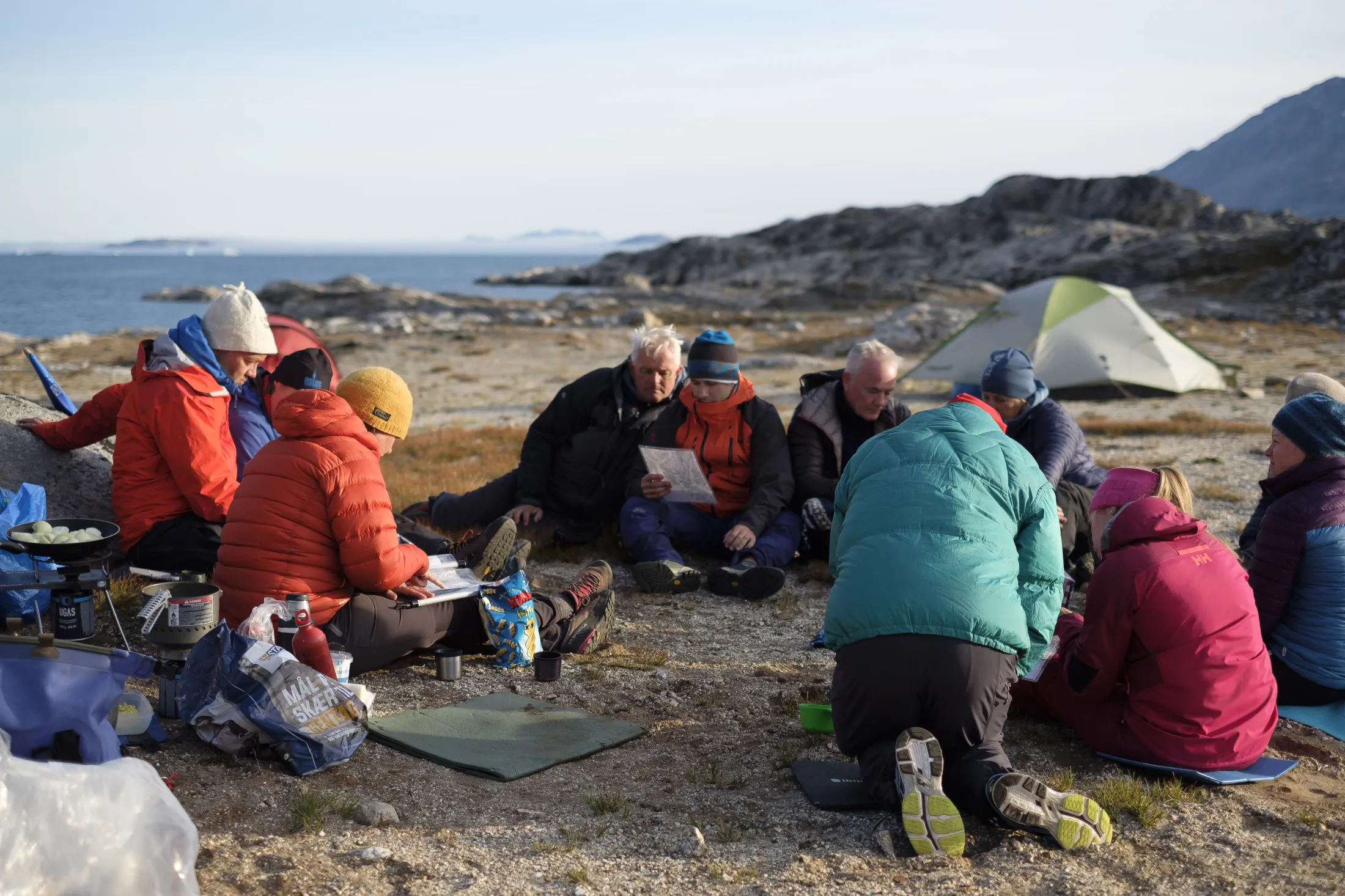
A group of hikers in warm clothing sits in a circle on the ground at a campsite studying maps, with the ocean and rocky terrain in the background.

Day 2:The Kayak adventure begins

After breakfast, we continue by boat for several hours to the starting point, a beach close to the hunting village of Sermiligaaq. From the boat, we get a good view of the fjord and our first encounter with glaciers. Once we arrive at the camp, we set up the tents and make dinner, and after dinner there is an introduction to safety routines, paddling techniques and packing the equipment in the kayak. It's an art, but with a little technique, it's amazing how much equipment we can fit in the kayaks.

After breakfast, we continue by boat for several hours to the starting point, a beach close to the hunting village of Sermiligaaq. From the boat, we get a good view of the fjord and our first encounter with glaciers. Once we arrive at the camp, we set up the tents and make dinner, and after dinner there is an introduction to safety routines, paddling techniques and packing the equipment in the kayak. It's an art, but with a little technique, it's amazing how much equipment we can fit in the kayaks.

Tent

B,L,D

2-3 hours

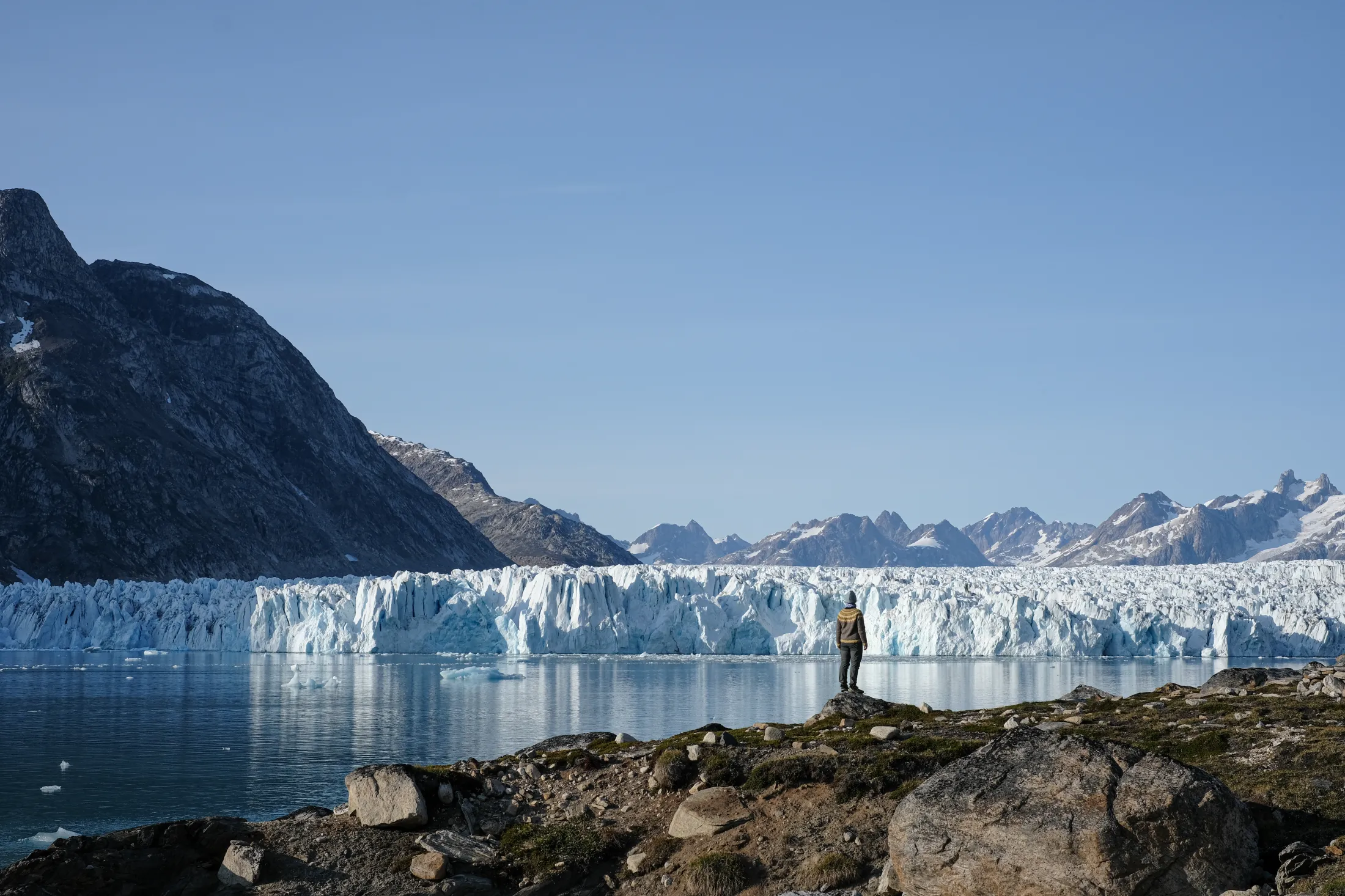
A person stands on a rocky ridge looking out over a massive, light blue glacier wall stretching across a calm fjord under a clear blue sky.

Day 3:To Knud Rasmussen glacier

After a good night's sleep in our sleeping bags, a hearty breakfast and the breaking of camp await us before we pack our kayaks and set off. The first paddling day is quite long, but we have a long lunch break to give us enough energy for the last leg of the day. In total, the trip today takes about 5 hours, before we end up at perhaps the most beautiful campsite in the north! We set up our tents in an area close to the Knud Rasmussen glacier; perhaps the most beautiful glacier of them all. The glacier front is enormous. The main wall is 3 km wide, and behind it you see 2,000 meter high mountain peaks. Even though we are almost 2 kilometers in front of the glacier wall, it seems incredibly close to us. The glacier is moving at high speed and calving continuously with great roars. The sights, sounds and colors are some of the greatest nature experiences you can get here as we sit with a panoramic view and enjoy a good dinner. The calming ambiance continues throughout the night as we lie in our tents and listen to the glacier calve and rumble.

After a good night's sleep in our sleeping bags, a hearty breakfast and the breaking of camp await us before we pack our kayaks and set off. The first paddling day is quite long, but we have a long lunch break to give us enough energy for the last leg of the day. In total, the trip today takes about 5 hours, before we end up at perhaps the most beautiful campsite in the north! We set up our tents in an area close to the Knud Rasmussen glacier; perhaps the most beautiful glacier of them all. The glacier front is enormous. The main wall is 3 km wide, and behind it you see 2,000 meter high mountain peaks. Even though we are almost 2 kilometers in front of the glacier wall, it seems incredibly close to us. The glacier is moving at high speed and calving continuously with great roars. The sights, sounds and colors are some of the greatest nature experiences you can get here as we sit with a panoramic view and enjoy a good dinner. The calming ambiance continues throughout the night as we lie in our tents and listen to the glacier calve and rumble.

Tent

B,L,D

5 hours

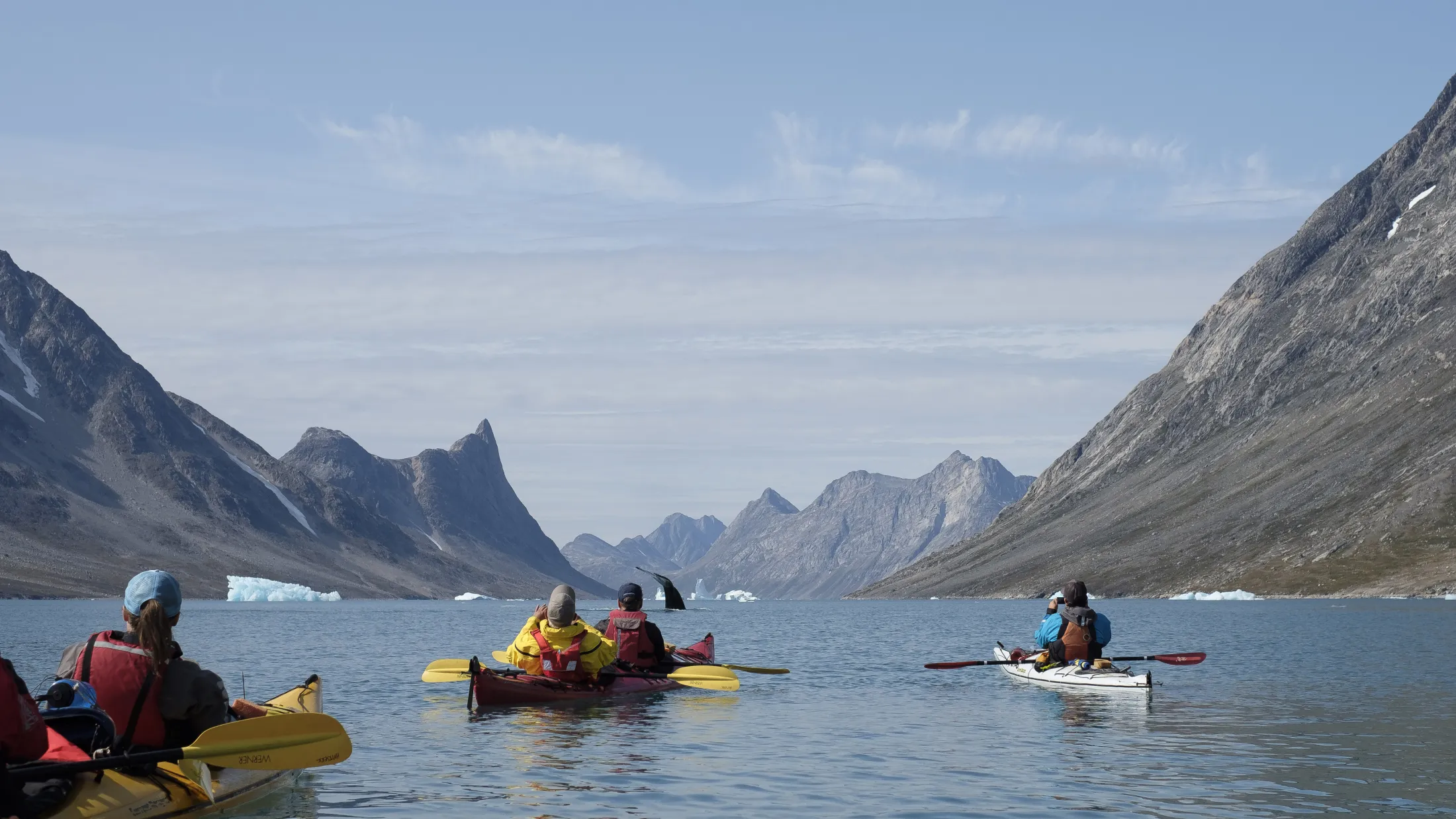
Several kayakers in a narrow fjord watch a whale tail breaking the surface of the water in the distance, surrounded by tall, steep mountains under a partly cloudy sky.

Day 4:To Kaarale glacier - close contact with ice glaciers

After a good night's sleep, we enjoy a good breakfast before taking a short walk to the glacier front. It's a great opportunity to stretch your legs in this majestic terrain, and for those who want to take the trip up the moraine ridge. It's a spectacular sight and makes for amazing photographs. Back at camp, we have lunch before packing the kayaks. Today's paddling leg goes into the Sermiligaaq fjord where we paddle close to the mighty Karale glacier. Here there are no less than five glaciers emerging from the same fjord, creating a tangle of icebergs and ice mazes that we paddle through. Karalebreen comes down from a fantastic mountain area with alpine, pointed peaks, most of which are unclimbed. The glacier itself has retreated far back, and the map no longer corresponds to reality. 360 degrees around us we see large glacier fronts and hanging glaciers, and after 3 - 4 hours of paddling we pull the kayaks up on a small sandy beach with a nice grassy area to set up camp. From the campsite we can see as many as 5 glaciers going all the way down to the fjord, and even more hanging on the mountainsides around us. It's am incredibly beautiful sight to behold.

After a good night's sleep, we enjoy a good breakfast before taking a short walk to the glacier front. It's a great opportunity to stretch your legs in this majestic terrain, and for those who want to take the trip up the moraine ridge. It's a spectacular sight and makes for amazing photographs. Back at camp, we have lunch before packing the kayaks. Today's paddling leg goes into the Sermiligaaq fjord where we paddle close to the mighty Karale glacier. Here there are no less than five glaciers emerging from the same fjord, creating a tangle of icebergs and ice mazes that we paddle through. Karalebreen comes down from a fantastic mountain area with alpine, pointed peaks, most of which are unclimbed. The glacier itself has retreated far back, and the map no longer corresponds to reality. 360 degrees around us we see large glacier fronts and hanging glaciers, and after 3 - 4 hours of paddling we pull the kayaks up on a small sandy beach with a nice grassy area to set up camp. From the campsite we can see as many as 5 glaciers going all the way down to the fjord, and even more hanging on the mountainsides around us. It's am incredibly beautiful sight to behold.

Tent

B,L,D

4 hours

9 km

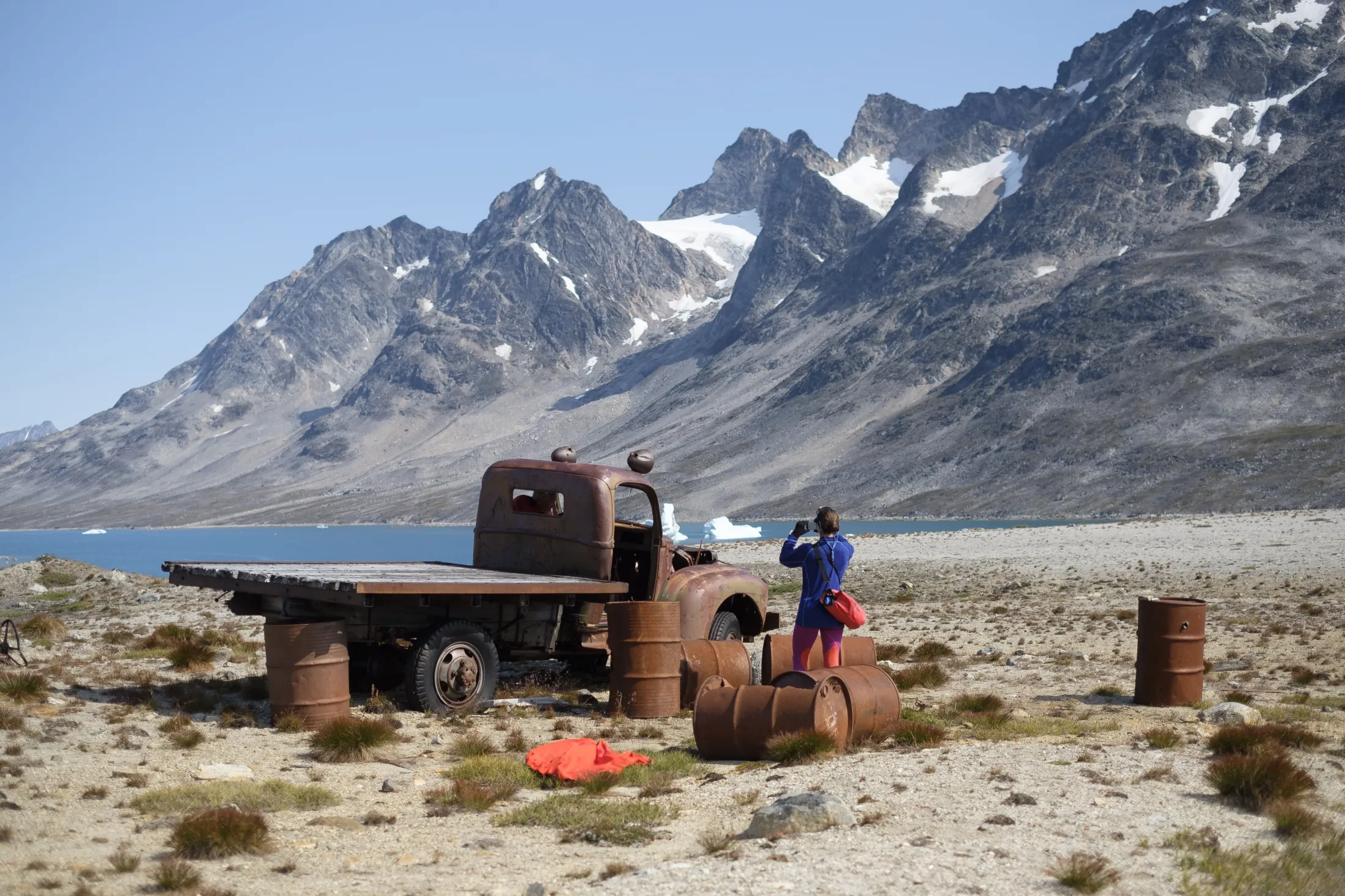
A person photographs an old, rusty truck wreck surrounded by rusty barrels on a plain, with a blue fjord and sharp, snow-dusted mountains in the background.

Day 5:Longer paddle day to Ikateq

For those who wish, and dare too, this is the place for a morning swim - before oatmeal and freshly brewed coffee await for breakfast. The destination for the day is a disused American base station. It was built by the Americans during World War II to conduct reconnaissance for submarines and German warships. After the war, it was abandoned without being cleaned up first, and today it is a graveyard of old oil drums, cars and a long airstrip. It's not aesthetic, but it's historical, and the Greenlanders have done the right thing by not getting the Americans to clean it up. They've turned it into a memorial and so it has to stay where it is. We disembark at the base, walk around and set up our camp. It's all a contrast to the rest of the trip, which is completely untouched!

For those who wish, and dare too, this is the place for a morning swim - before oatmeal and freshly brewed coffee await for breakfast. The destination for the day is a disused American base station. It was built by the Americans during World War II to conduct reconnaissance for submarines and German warships. After the war, it was abandoned without being cleaned up first, and today it is a graveyard of old oil drums, cars and a long airstrip. It's not aesthetic, but it's historical, and the Greenlanders have done the right thing by not getting the Americans to clean it up. They've turned it into a memorial and so it has to stay where it is. We disembark at the base, walk around and set up our camp. It's all a contrast to the rest of the trip, which is completely untouched!

Tent

B,L,D

6 hours

20 km

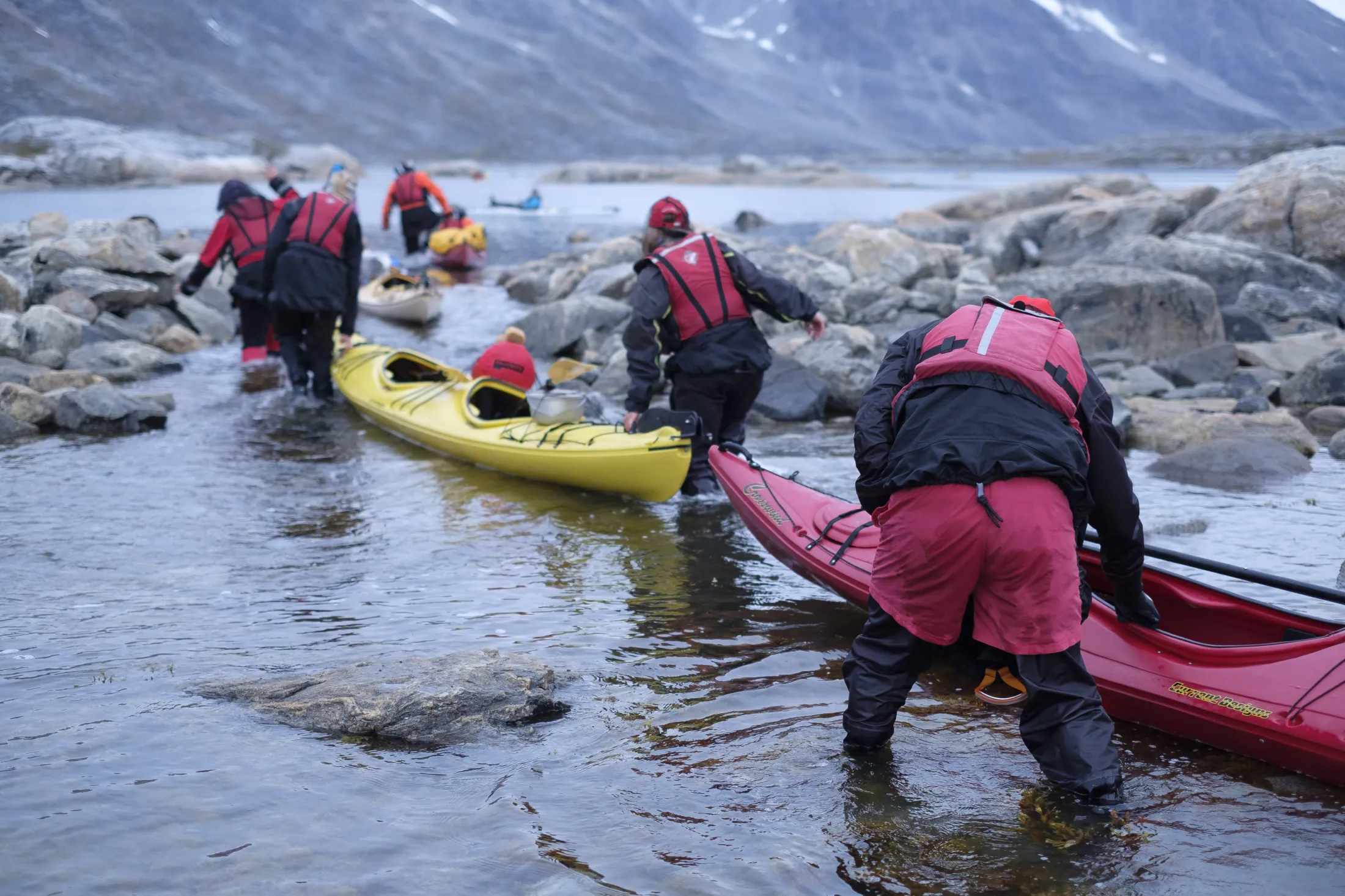
A group of kayakers in drysuits and life jackets work together to move their kayaks through a shallow, rocky channel.

Day 6:Tidal passage - to Tuno

As usual, we take a leisurely morning with plenty of time for breakfast and packing up camp, and the departure depends on the tide. There is a 3.6 meter tidal difference, which is of great importance for the highlight of the day: The highlight of the day is paddling through a narrow passage that is only possible at high tide! First we will paddle for about 10 km on "flat" water before we reach a small passage. Here we will take lie low and wait for the tide to rise. If we arrive too early, we will go ashore for lunch and if we have plenty of time, you might want to try your luck fishing for trout, or go for a walk? If there's too much ice and we don't get there in time, we'll just camp here and paddle through the passage the next day. It's weather and wind that prevails! If the tide comes in as planned, we will have a small experience of paddling in "flowing water" where we follow the tide through the passage. Once we pass through the passage, we'll find a lovely campsite where we'll pitch our tents and cook dinner. In the evening there are also good opportunities for fishing.

As usual, we take a leisurely morning with plenty of time for breakfast and packing up camp, and the departure depends on the tide. There is a 3.6 meter tidal difference, which is of great importance for the highlight of the day: The highlight of the day is paddling through a narrow passage that is only possible at high tide! First we will paddle for about 10 km on "flat" water before we reach a small passage. Here we will take lie low and wait for the tide to rise. If we arrive too early, we will go ashore for lunch and if we have plenty of time, you might want to try your luck fishing for trout, or go for a walk? If there's too much ice and we don't get there in time, we'll just camp here and paddle through the passage the next day. It's weather and wind that prevails! If the tide comes in as planned, we will have a small experience of paddling in "flowing water" where we follow the tide through the passage. Once we pass through the passage, we'll find a lovely campsite where we'll pitch our tents and cook dinner. In the evening there are also good opportunities for fishing.

Tent

B,L,D

10 km

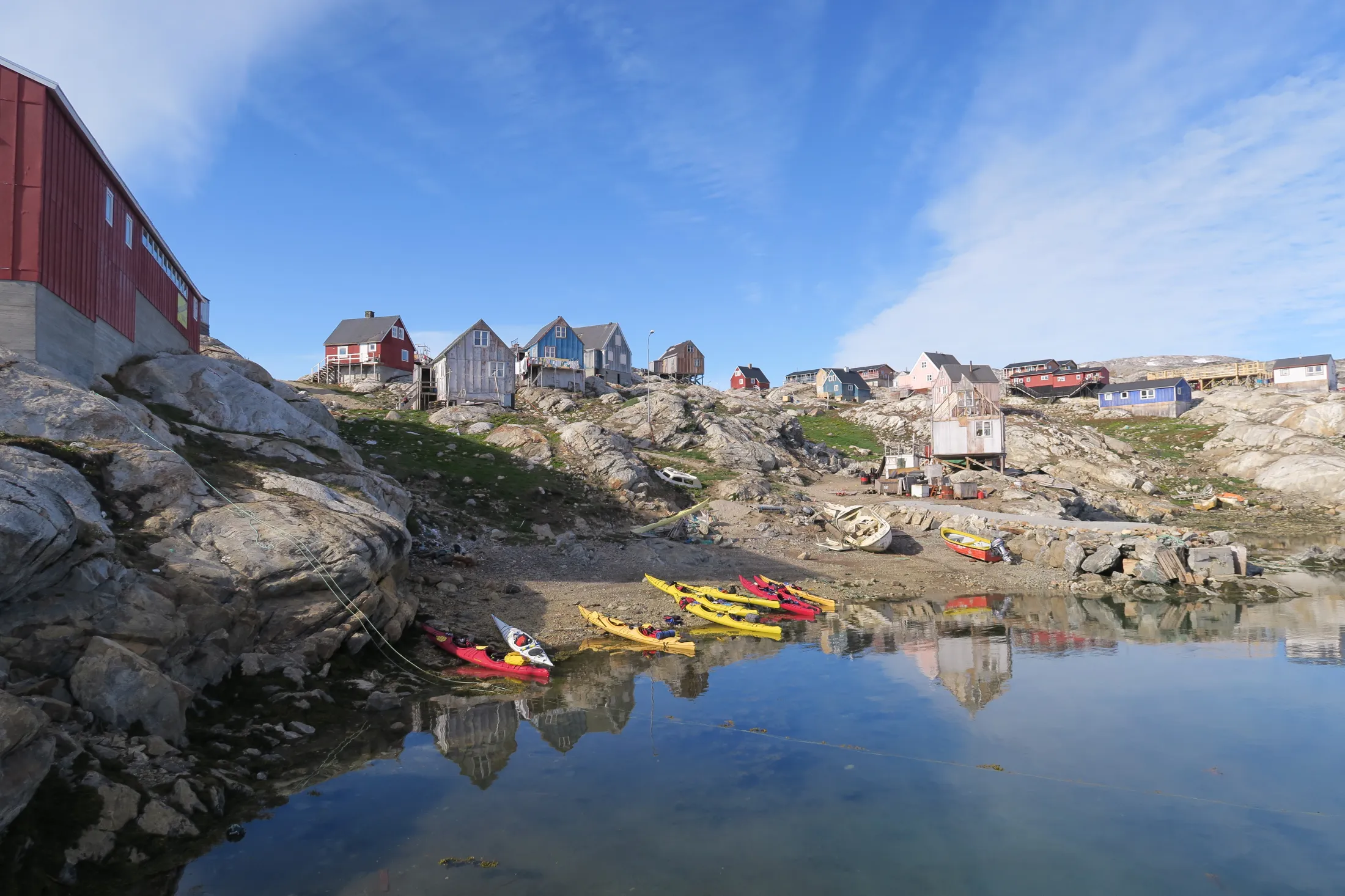
Several colorful kayaks rest on a sandy beach in a small cove in front of a Greenlandic settlement with scattered wooden houses on rocky hills under a blue sky.

Day 7:Last paddle day

This is our last day of paddling and if the current and wind are with us it will be a short day, and if it is against us we will have a slightly longer day. It's exciting to arrive in the small fishing village of Kummiiut (approx. 400 inhabitants) with kayaks at lunchtime. We buy some fresh food at the local shop before paddling to a nearby campsite. Here we make our last tent camp in Greenland. A delicious stew with fresh meat is often on the dinner menu. Or maybe someone has been fishing? Tonight we will repack the equipment, send the kayaks back to Tasiilaq by boat, and get ready for tomorrow. The day consists of roughly 18 km and 5 hours of paddling in good conditions.

This is our last day of paddling and if the current and wind are with us it will be a short day, and if it is against us we will have a slightly longer day. It's exciting to arrive in the small fishing village of Kummiiut (approx. 400 inhabitants) with kayaks at lunchtime. We buy some fresh food at the local shop before paddling to a nearby campsite. Here we make our last tent camp in Greenland. A delicious stew with fresh meat is often on the dinner menu. Or maybe someone has been fishing? Tonight we will repack the equipment, send the kayaks back to Tasiilaq by boat, and get ready for tomorrow. The day consists of roughly 18 km and 5 hours of paddling in good conditions.

Tent

B,L,D

5 hours

18 km

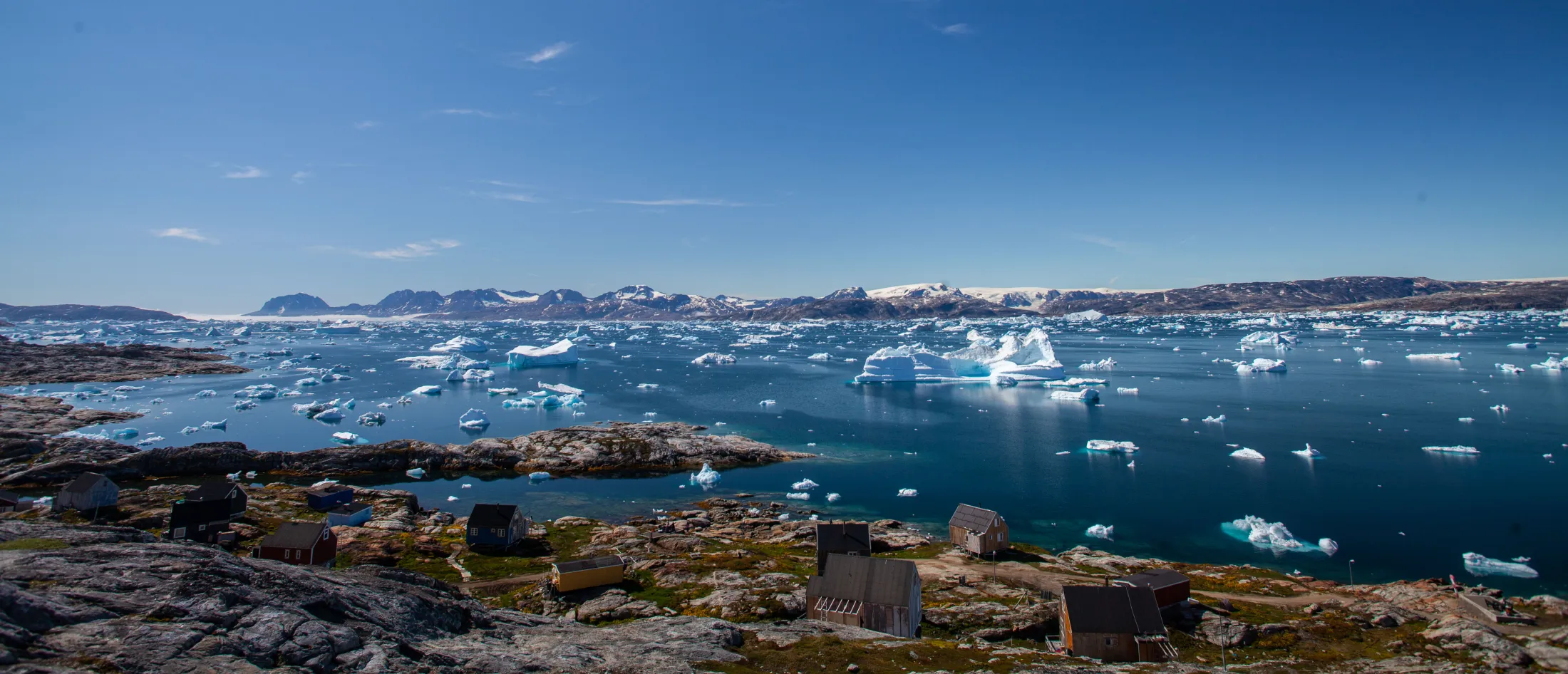
A high-angle view over a small settlement with scattered wooden houses by a deep blue fjord filled with countless icebergs, with snow-dusted mountains and a clear sky in the background.

Day 8:Last paddle leg and boat trip to Tinit

Since it's not just paddling that attracts us to Greenland, we'll be spending the next night in a cabin near Tinit. From here we have a spectacular view of the Sermilikfjord, where the ice flows past in large quantities after calving from the glacier further into the fjord. We also have a view of the Greenland ice sheet, and we are surrounded by blue-green sea and beautiful nature. We get some great sightseeing on the way here from the boat, and will have a nice dinner together on arrival at the cabin.

Since it's not just paddling that attracts us to Greenland, we'll be spending the next night in a cabin near Tinit. From here we have a spectacular view of the Sermilikfjord, where the ice flows past in large quantities after calving from the glacier further into the fjord. We also have a view of the Greenland ice sheet, and we are surrounded by blue-green sea and beautiful nature. We get some great sightseeing on the way here from the boat, and will have a nice dinner together on arrival at the cabin.

Cabin

B,L,D

10 km

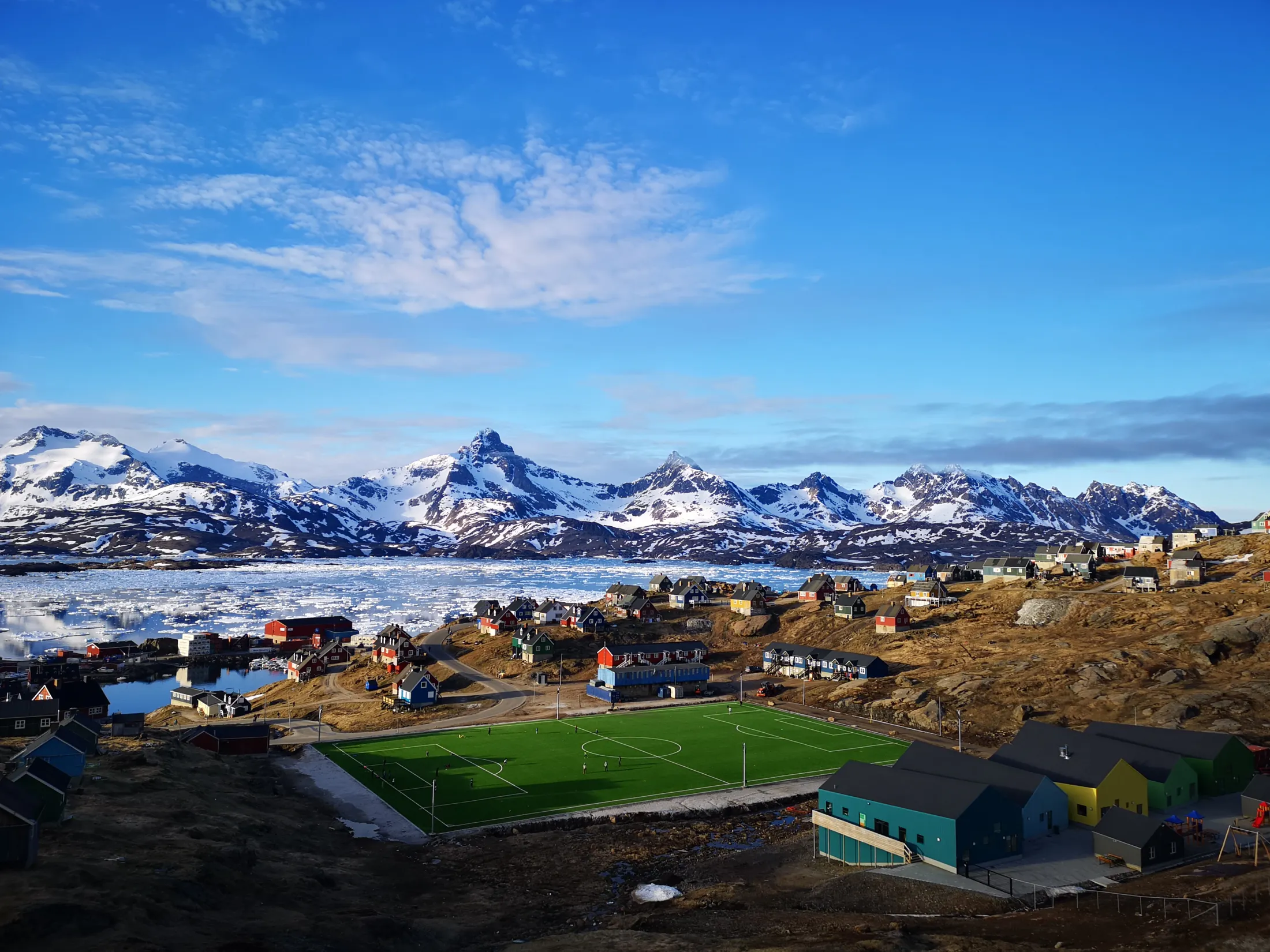
A green soccer field sits in the middle of a colorful Greenlandic settlement, with an ice-filled fjord and sharp, snow-covered mountains under a blue sky in the background.

Day 9:Boat trip to Tasiilaq and packing of equipment

We have a cosy breakfast and are picked up by boat for a nice trip back towards Tasiilaq. We might get lucky and see some whales during the boat trip. In Tasiilaq we have our warehouse, and will spend the day washing and packing the equipment from the paddle trip. In the afternoon, we enjoy a nice farewell dinner with our group.

We have a cosy breakfast and are picked up by boat for a nice trip back towards Tasiilaq. We might get lucky and see some whales during the boat trip. In Tasiilaq we have our warehouse, and will spend the day washing and packing the equipment from the paddle trip. In the afternoon, we enjoy a nice farewell dinner with our group.

Guest house

B,L,D

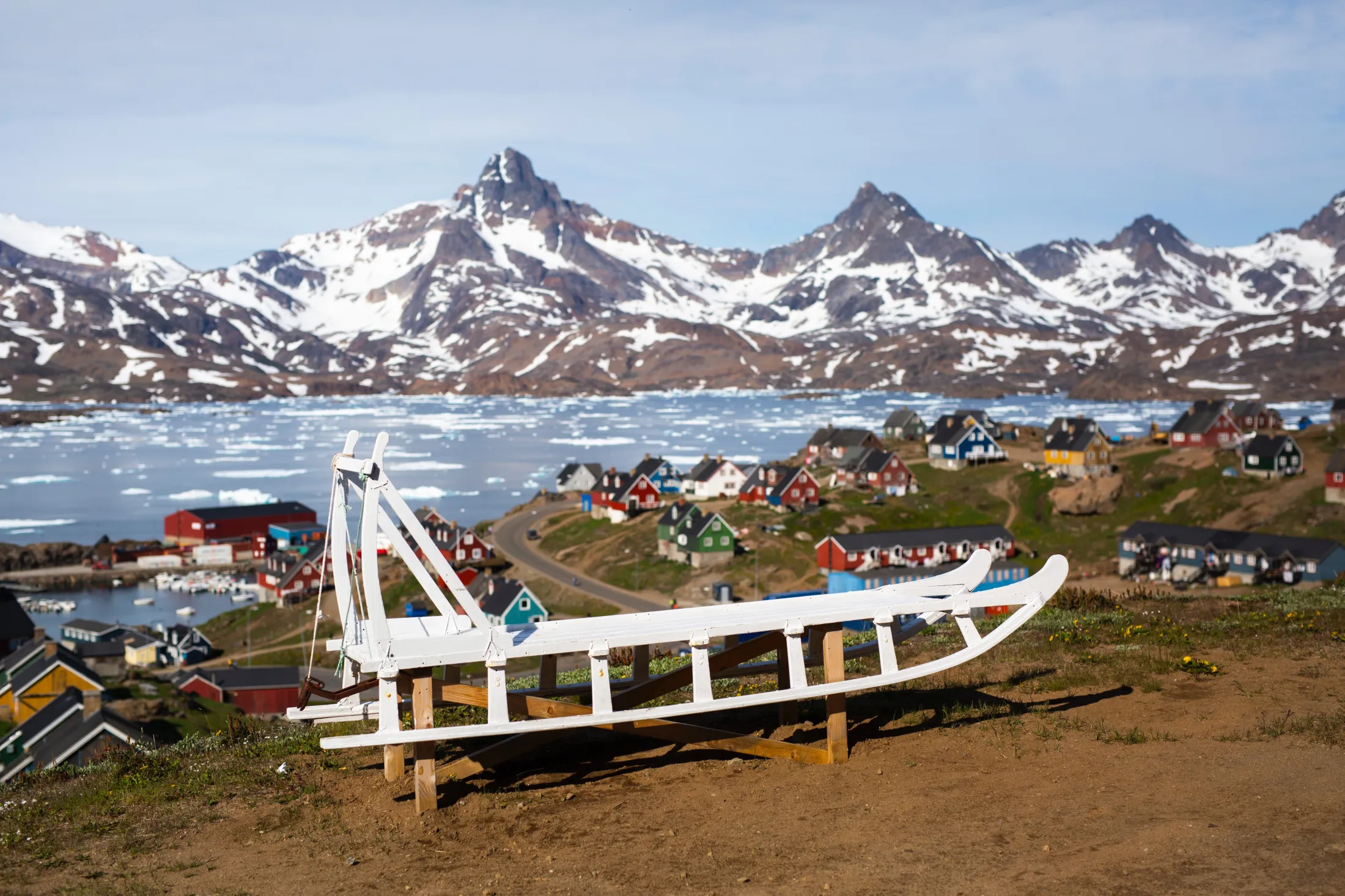
A white dog sled sits on a hill in the foreground overlooking a colorful Greenlandic settlement, with an ice-filled fjord and sharp, snow-covered mountains in the background.

Day 10:Return to Iceland

We have the day at leisure, before we say goodbye and head for Kulusuk airport in the afternoon. From Kulusuk we fly back to Iceland, where we will arrive late in the night. We say goodbye for now and hopefully we meet again somewhere, some place.

We have the day at leisure, before we say goodbye and head for Kulusuk airport in the afternoon. From Kulusuk we fly back to Iceland, where we will arrive late in the night. We say goodbye for now and hopefully we meet again somewhere, some place.

B,-,-

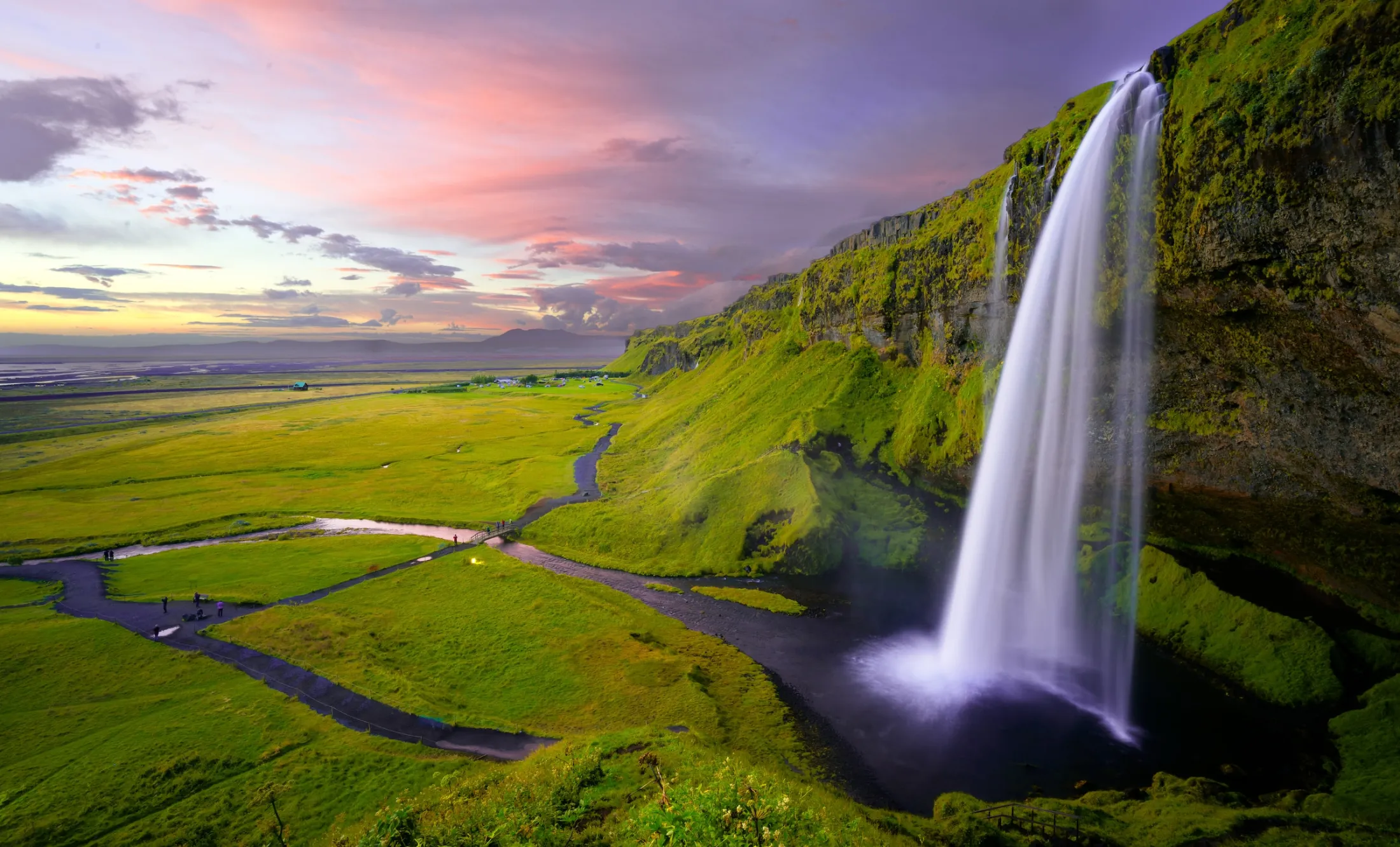
A powerful waterfall cascades down a lush green cliff into a pool next to an open plain under a colorful evening sky.

Day x:Experience Iceland?

If you wish to have a few days in Iceland before or after the trip, we are happy to help you with a suggestion. Visit the Blue Lagoon, experience the charming city center of Reykjavik or explore the Golden Circle.

If you wish to have a few days in Iceland before or after the trip, we are happy to help you with a suggestion. Visit the Blue Lagoon, experience the charming city center of Reykjavik or explore the Golden Circle.

We meet at Keflavik International Airport no later than 3:00 pm local time to check in for our flight to Kulusuk on Greenland. Here we are met by the guide who has traveled from Norway a few days before the group. We drive to the small village, Tasilaaq, where we will spend the night and get to know each other.
Guest house

-,-,D

After breakfast, we continue by boat for several hours to the starting point, a beach close to the hunting village of Sermiligaaq. From the boat, we get a good view of the fjord and our first encounter with glaciers. Once we arrive at the camp, we set up the tents and make dinner, and after dinner there is an introduction to safety routines, paddling techniques and packing the equipment in the kayak. It's an art, but with a little technique, it's amazing how much equipment we can fit in the kayaks.

Tent

B,L,D

2-3 hours

After a good night's sleep in our sleeping bags, a hearty breakfast and the breaking of camp await us before we pack our kayaks and set off. The first paddling day is quite long, but we have a long lunch break to give us enough energy for the last leg of the day. In total, the trip today takes about 5 hours, before we end up at perhaps the most beautiful campsite in the north! We set up our tents in an area close to the Knud Rasmussen glacier; perhaps the most beautiful glacier of them all. The glacier front is enormous. The main wall is 3 km wide, and behind it you see 2,000 meter high mountain peaks. Even though we are almost 2 kilometers in front of the glacier wall, it seems incredibly close to us. The glacier is moving at high speed and calving continuously with great roars. The sights, sounds and colors are some of the greatest nature experiences you can get here as we sit with a panoramic view and enjoy a good dinner. The calming ambiance continues throughout the night as we lie in our tents and listen to the glacier calve and rumble.

Tent

B,L,D

5 hours

After a good night's sleep, we enjoy a good breakfast before taking a short walk to the glacier front. It's a great opportunity to stretch your legs in this majestic terrain, and for those who want to take the trip up the moraine ridge. It's a spectacular sight and makes for amazing photographs. Back at camp, we have lunch before packing the kayaks. Today's paddling leg goes into the Sermiligaaq fjord where we paddle close to the mighty Karale glacier. Here there are no less than five glaciers emerging from the same fjord, creating a tangle of icebergs and ice mazes that we paddle through. Karalebreen comes down from a fantastic mountain area with alpine, pointed peaks, most of which are unclimbed. The glacier itself has retreated far back, and the map no longer corresponds to reality. 360 degrees around us we see large glacier fronts and hanging glaciers, and after 3 - 4 hours of paddling we pull the kayaks up on a small sandy beach with a nice grassy area to set up camp. From the campsite we can see as many as 5 glaciers going all the way down to the fjord, and even more hanging on the mountainsides around us. It's am incredibly beautiful sight to behold.

Tent

B,L,D

4 hours

9 km

For those who wish, and dare too, this is the place for a morning swim - before oatmeal and freshly brewed coffee await for breakfast. The destination for the day is a disused American base station. It was built by the Americans during World War II to conduct reconnaissance for submarines and German warships. After the war, it was abandoned without being cleaned up first, and today it is a graveyard of old oil drums, cars and a long airstrip. It's not aesthetic, but it's historical, and the Greenlanders have done the right thing by not getting the Americans to clean it up. They've turned it into a memorial and so it has to stay where it is. We disembark at the base, walk around and set up our camp. It's all a contrast to the rest of the trip, which is completely untouched!

Tent

B,L,D

6 hours

20 km

As usual, we take a leisurely morning with plenty of time for breakfast and packing up camp, and the departure depends on the tide. There is a 3.6 meter tidal difference, which is of great importance for the highlight of the day: The highlight of the day is paddling through a narrow passage that is only possible at high tide! First we will paddle for about 10 km on "flat" water before we reach a small passage. Here we will take lie low and wait for the tide to rise. If we arrive too early, we will go ashore for lunch and if we have plenty of time, you might want to try your luck fishing for trout, or go for a walk? If there's too much ice and we don't get there in time, we'll just camp here and paddle through the passage the next day. It's weather and wind that prevails! If the tide comes in as planned, we will have a small experience of paddling in "flowing water" where we follow the tide through the passage. Once we pass through the passage, we'll find a lovely campsite where we'll pitch our tents and cook dinner. In the evening there are also good opportunities for fishing.

Tent

B,L,D

10 km

This is our last day of paddling and if the current and wind are with us it will be a short day, and if it is against us we will have a slightly longer day. It's exciting to arrive in the small fishing village of Kummiiut (approx. 400 inhabitants) with kayaks at lunchtime. We buy some fresh food at the local shop before paddling to a nearby campsite. Here we make our last tent camp in Greenland. A delicious stew with fresh meat is often on the dinner menu. Or maybe someone has been fishing? Tonight we will repack the equipment, send the kayaks back to Tasiilaq by boat, and get ready for tomorrow. The day consists of roughly 18 km and 5 hours of paddling in good conditions.

Tent

B,L,D

5 hours

18 km

Since it's not just paddling that attracts us to Greenland, we'll be spending the next night in a cabin near Tinit. From here we have a spectacular view of the Sermilikfjord, where the ice flows past in large quantities after calving from the glacier further into the fjord. We also have a view of the Greenland ice sheet, and we are surrounded by blue-green sea and beautiful nature. We get some great sightseeing on the way here from the boat, and will have a nice dinner together on arrival at the cabin.

Cabin

B,L,D

10 km

We have a cosy breakfast and are picked up by boat for a nice trip back towards Tasiilaq. We might get lucky and see some whales during the boat trip. In Tasiilaq we have our warehouse, and will spend the day washing and packing the equipment from the paddle trip. In the afternoon, we enjoy a nice farewell dinner with our group.

Guest house

B,L,D

We have the day at leisure, before we say goodbye and head for Kulusuk airport in the afternoon. From Kulusuk we fly back to Iceland, where we will arrive late in the night. We say goodbye for now and hopefully we meet again somewhere, some place.

B,-,-

If you wish to have a few days in Iceland before or after the trip, we are happy to help you with a suggestion. Visit the Blue Lagoon, experience the charming city center of Reykjavik or explore the Golden Circle.

What's included in the price

Included

Reykjavik - Greenland round-trip.

All transportation as specified in the program.

Shared double room in Greenland, and a three-person tent (two and two) on the kayaking trip.

Meals as specified in the program.

Not included

You must book your own round-trip flight tickets between your hometown and Reykjavik. It is important to check our website to confirm that the departure is guaranteed before booking your plane tickets and hotel in Reykjavik for the trip. For each trip, we require a minimum number of confirmed participants before the departure can be guaranteed.

Terms and Conditions 

We reserve the right to change prices. The day by day program is indicative and changes may occur. We also refer to our general travel conditions.

Travel Insurance

On all our trips, we require you to have full travel and accident insurance, which must also cover potential medical repatriation. Read more about travel insurance.

Highlights

Reviews

Rated
-
- reviews
(-)
(-)
(-)
(-)
(-)

Safety & Grading

Read more

For departures with Norrøna Adventure guides:

  • 24-hour emergency response
  • Guides trained in first aid in the field
  • Basic first aid equipment available
  • Cooperation with Turlegen.no for medical advice

On our trips, it is important to understand that we often will be traveling far off the beaten track. We will, of course, do everything we can to assist if anything should happen, but a potential rescue operation can be demanding. It is therefore extremely important that all participants arrive well-prepared and ready to handle unforeseen situations.

Physical level

3/6 Physical

Some segments of the journey may prove challenging. It's essential to possess a solid level of fitness prior to departure. Persistence will be required in reaching the trip's goal.

Comfort level

1/6 Comfort

We overnight in tents. On these trips, the participants take part in camp routines such as setting up camp and cooking meals.

Risk level

3/6 Risk

Activities/trips with some risk. Certain incidents may occur, and they may be of such a nature that they may require professional help.

Training and Preparations

It is an advantage if you have paddled somewhat before the trip, and we recommend that you have an intro course or basic course in sea paddling (wet license). The longest day is about 6 hours, and in double kayaks it's not too tiring. What can slow us down is if there is a lot of ice in the fjords. The sea kayaks are steady and easy to paddle. In calm water, we can quickly reach 4 kilometers per hour and travel 20-25 kilometers per day.

On this trip we are way off the beaten track. We will set up/take down camp every day, and we will prepare all the meals in the camp. You as a participant must contribute to this work. There may be polar bears in the area when we are there, and we must therefore expect to be on polar bear watch at night. The guide sets up watch lists so that the distribution is even. Being on polar bear watch is a great experience. The light and colors in the sky are constantly changing, and you get the peace and quiet to enjoy the mighty nature.

Visas, Vaccinations and Health

Before embarking on our journey together, we kindly remind all trip participants to check their respective country's visa status and vaccination requirements. Ensuring your travel documents are in order is a crucial step in guaranteeing a smooth and hassle-free adventure. 

Norwegian citizens do not need a visa for Iceland and Greenland, but bring a passport and a copy of the passport. See also the current entry and visa regulations on the Ministry of Foreign Affairs' country pages.

If you are over 67 years old, you should have a thorough medical check-up before your trip. Make your doctor aware that this is a trip involving physical exertion and moving off the beaten track.

It is important that you complete all parts of the registration form (especially where we ask for information about health and allergies), and let us know if there is anything we need to be aware of prior to and during the trip. Relevant health information that may affect the trip should also be communicated to the guide at the start of the trip. *Note* - If you are on regular medication, have known allergies or anything similar, you must always bring your personal medication with you.

See the overview on FHI´s pages on travel health advice. For vaccination and guidance, please contact Sentrum Reisemedisin: Reisemedisin.no.

Additional Information

It is important to check whether the departure is guaranteed or not before booking your transport for the trip. On each departure, we must have a minimum number of confirmed participants before we can guarantee the departure.

Everyone must make their own way to Reykjavik, as round-trip flights to Reykjavik are not included. The round-trip flight between Iceland and Greenland will be taken together as a group, and this flight is included. The guide will meet the group in Greenland due to the need for planning days in Greenland ahead of time. Meeting and departure will be at the Reykjavik airport.

On the paddle trip, we stay in spacious and high-quality three-person tents (two people in each tent). In Tinit and Tasiilaq we stay in guest houses in a shared double room in a modest hotel.

The kayaking season is short in East Greenland. There are only about 6 weeks when it is possible to paddle in the fjords due to ice. The days can be good and warm with temperatures around 15-20°C (60-70°F). At night it is colder, with temperatures down to around 0°C (32°F) degrees. The weather changes quickly in East Greenland, and it can be very windy, so tents need to be properly guyed.

It is not always easy to get hold of gluten-free wholemeal bread, lactose-free alternatives or to accommodate other food preferences. If you have any allergies, please let us know in the registration form and we will try to accommodate you as best we can. However, we would still recommend that anyone with special dietary needs bring some alternatives in the form of, for example, a packet of crispbread, energy bars or similar that you know you can eat.

Guides

Equipment list

This list is intended as a guideline, so that we have what we need regardless of the weather we get on the trip. Remember that you can also get used outdoor equipment that works perfectly. Get in touch if you have any questions. TIP: We recommend that you have the most important equipment in your hand luggage, for example hiking boots and gore-tex jacket/trousers.

Obligatory

Clothing

Not too thick, bring more layers if necessary. Top and bottom.

Wool or synthetic. Avoid cotton. 

We recommend thin wool.

Fleece or wool. 

Down or synthetic insulation.

Gore-Tex or similar. Must have a decent hood, and hold out wind and rain. Should have space for midlayers underneath. Ventilation under the arms is recommended. 

Gore-Tex or similar. Must hold out wind and rain. Ventilation zippers along the legs is recommended.

Hat or headband

To keep warm and comfortable on your hands while paddling, mittens will be the warmer choise.

Footwear

Neoprene boots, above the ankle. Large enough to fit comfortable over the drysuit socks + wool socks.

Equipment

Comfort temperature down to -10 degrees (C).

Personal medicines and, for example, band-aids, blister plaster, sports tape, throat lozenges, nasal drops, Paracetamol/Ibuprofen, stomach regulators, etc.
We need to know about all medicines you are taking, in case something happens. 

Tooth brush, tooth paste, small towel, ear plugs, wet wipes, biodegradable soap, etc.

Toilet paper, antibac, and waste bags for the paper. Remember leave no trace.

You should be able to bring 2-3 litres of water.

Compact and light.

Preferably a spoon with a long handle if you are going to eat freeze dried food.

Passport, tickets, bank card, proof of vaccination andproof of insurance. Remember to have a copy of important documents on your phone and/or somewhere in your bag. 

Robust, waterproof pack bags, important to keep your clothes, electronics and sleepingbag dry. Different sizes and colours is practical. It is important that they are made of strong material so that they do not tear to pieces during the trip.

Personal Flotation Device for paddling.

Recommended

Clothing

We recommend wool underwear for both men and women. Wool sportstop is recommended for women.

Thin, ultra light.

For warmer days, and as a hat when sleeping.

Small and light.

Or bike gloves. For comfort, protection against blisters.

Footwear

Bring waterproof shoes/boots that you are familiar with.

Equipment

Use to carry equipment from kayak to camp.

Light. Have to be foldable or telescope.

Remember new/extra batteries.

For head/face protection.

Light and compact.

Very useful to have in the kayak for drying up water along the way.

Packing Tips

Paddle gloves/mittens is mandatory, neoprene is good. Pogies/muffs may be considered in addition if your fingers get cold easily.

Cutlery for the paddle trip: Bring along cutlery/spoon/plate/cup for use on the paddle trip. 

Sleeping bag: It is an advantage if it is small and lightweight so that it fits easily in the kayak.

Waterproof packing: All your clothes and gear must be packed 100% waterproof in dry bags.

The kayaking season is short in East Greenland. There are only about 6 weeks when it is possible to paddle in the fjords due to ice. The days can be good and warm with temperatures around 15-20 °C (60-70°F). At night it is colder, with temperatures down to around 0 °C (32°F). The weather changes quickly in East Greenland, and it can be very windy, so tents need to be properly guyed.

Testimonial

Unforgettable trip! Well planned, good and friendly guides, steady kayaks, great day trips and magnificent scenery!

– Morten, 2021

Testimonial

A fantastic trip and a memory for life. An unforgettable nature experience, great guides and friendly participants.

– Vibeke, 2021