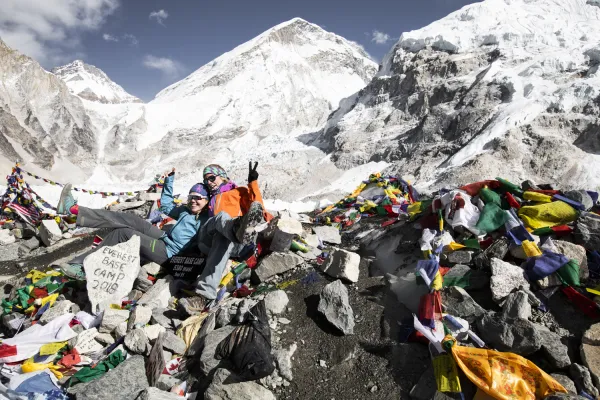
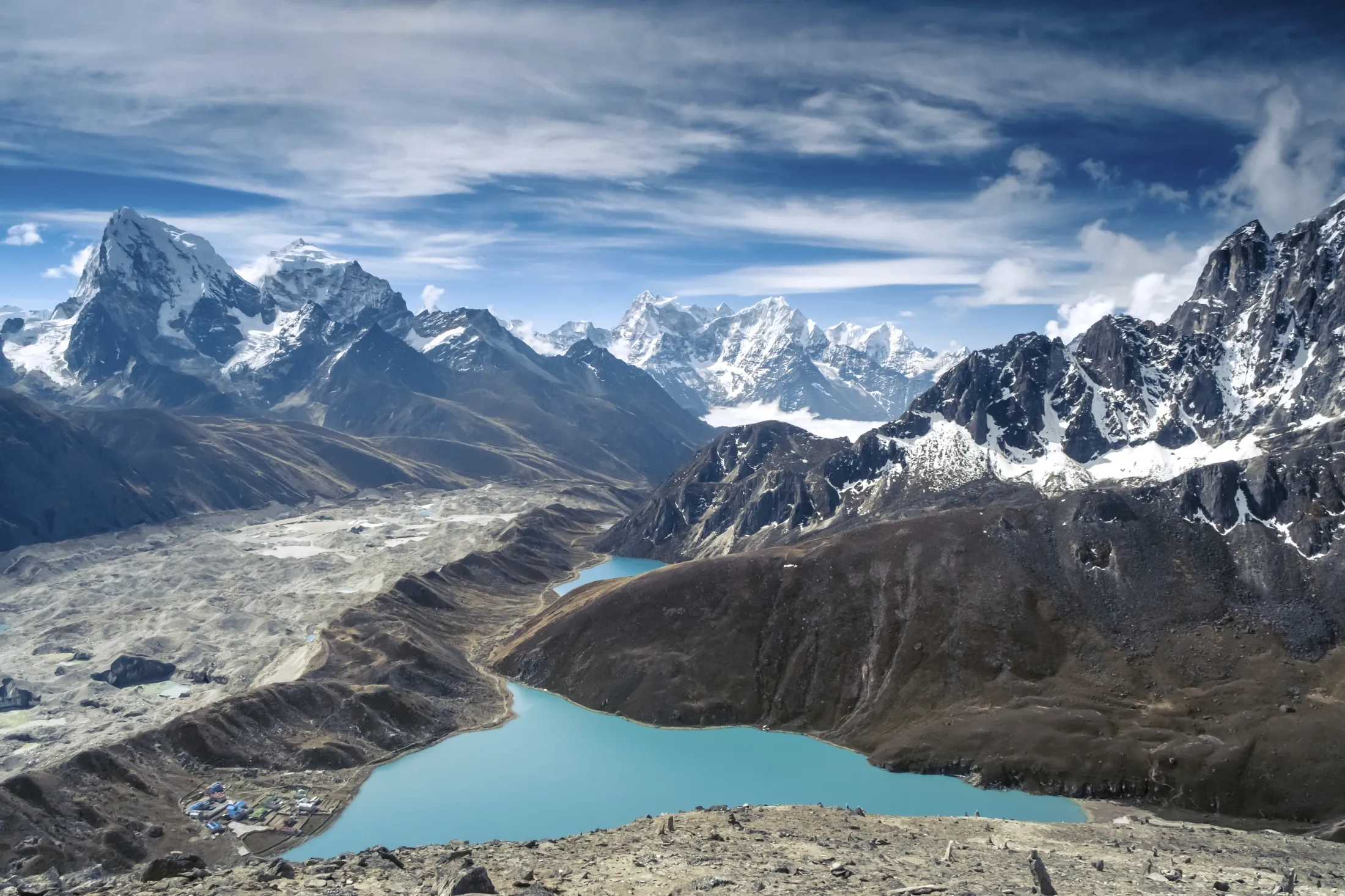
A breathtaking high-altitude view reveals a vibrant turquoise glacial lake nestled in a rugged mountain valley, surrounded by dramatic moraines, a tiny lakeside village, and towering snow-capped Himalayan peaks under a blue sky with streaky clouds.
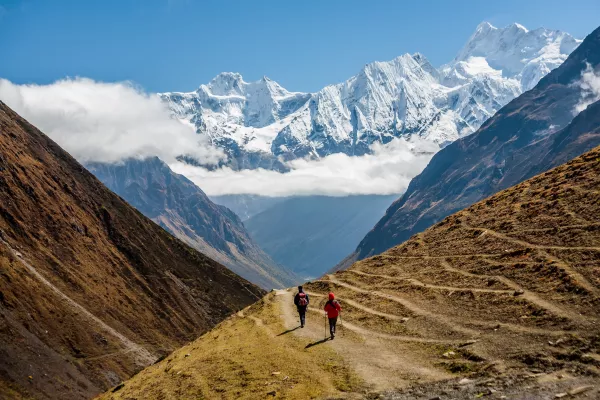
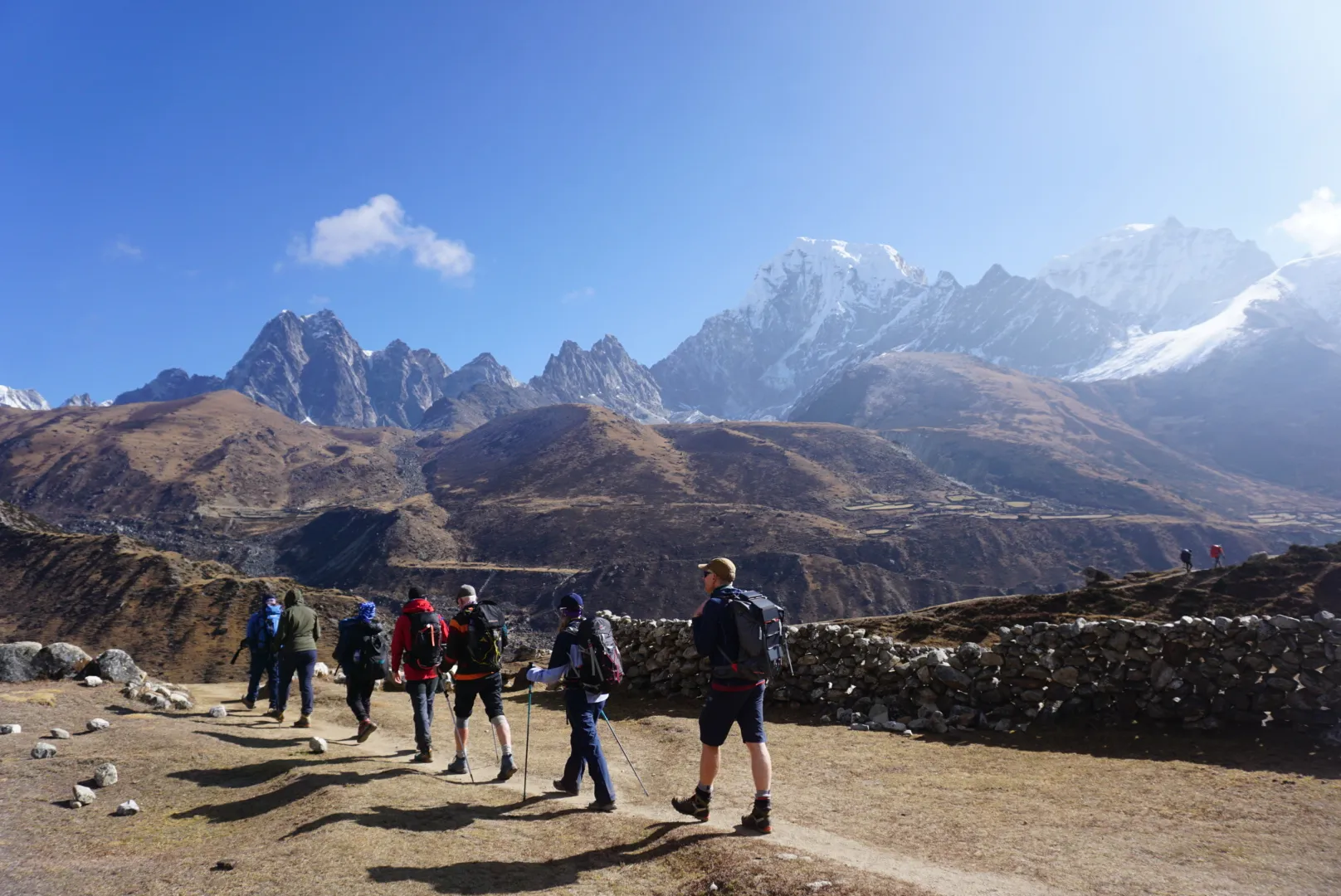
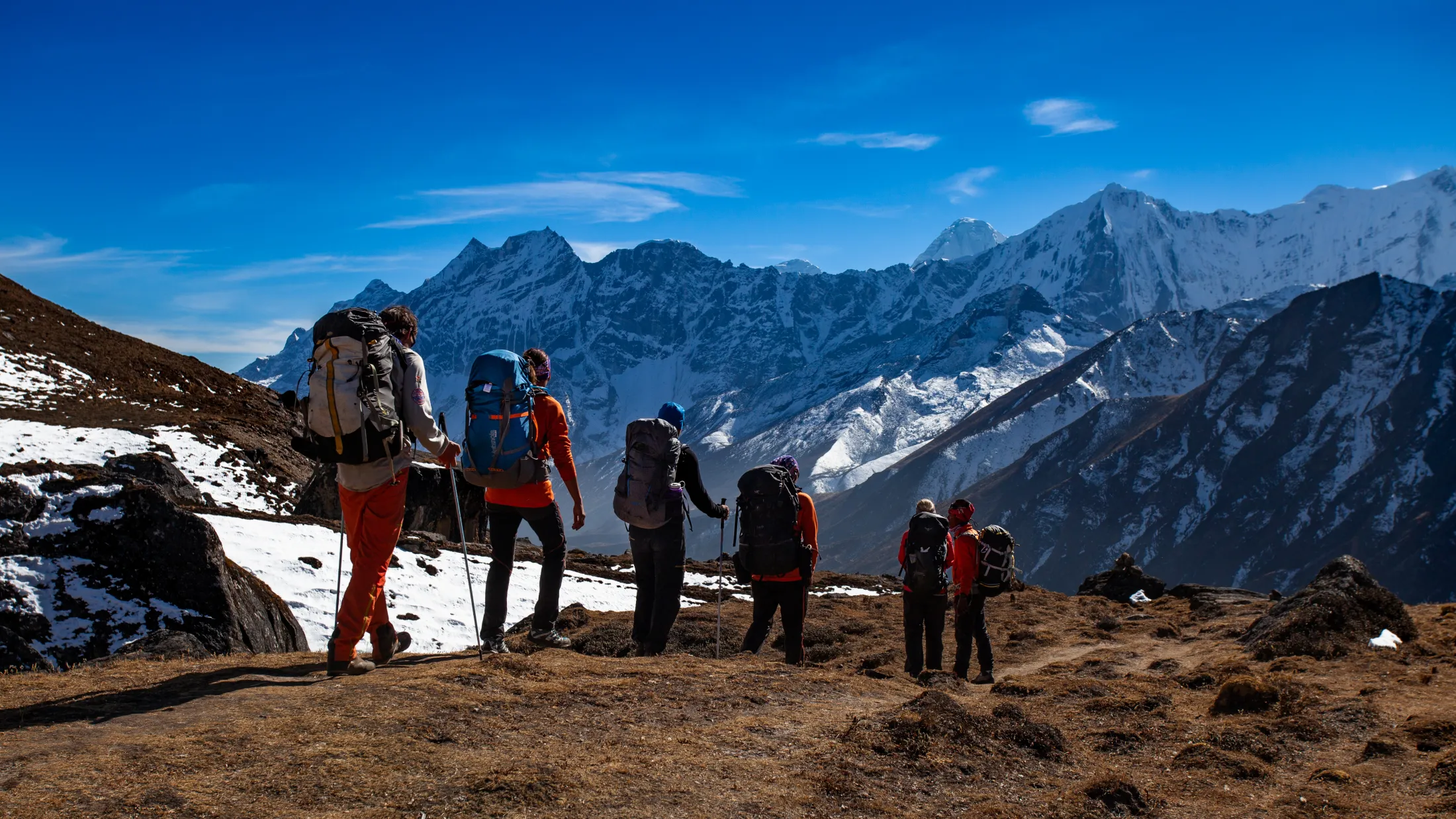
A group of hikers with large backpacks stands on a barren, high-altitude trail, looking out at a massive, snow-covered mountain range under a vibrant blue sky.
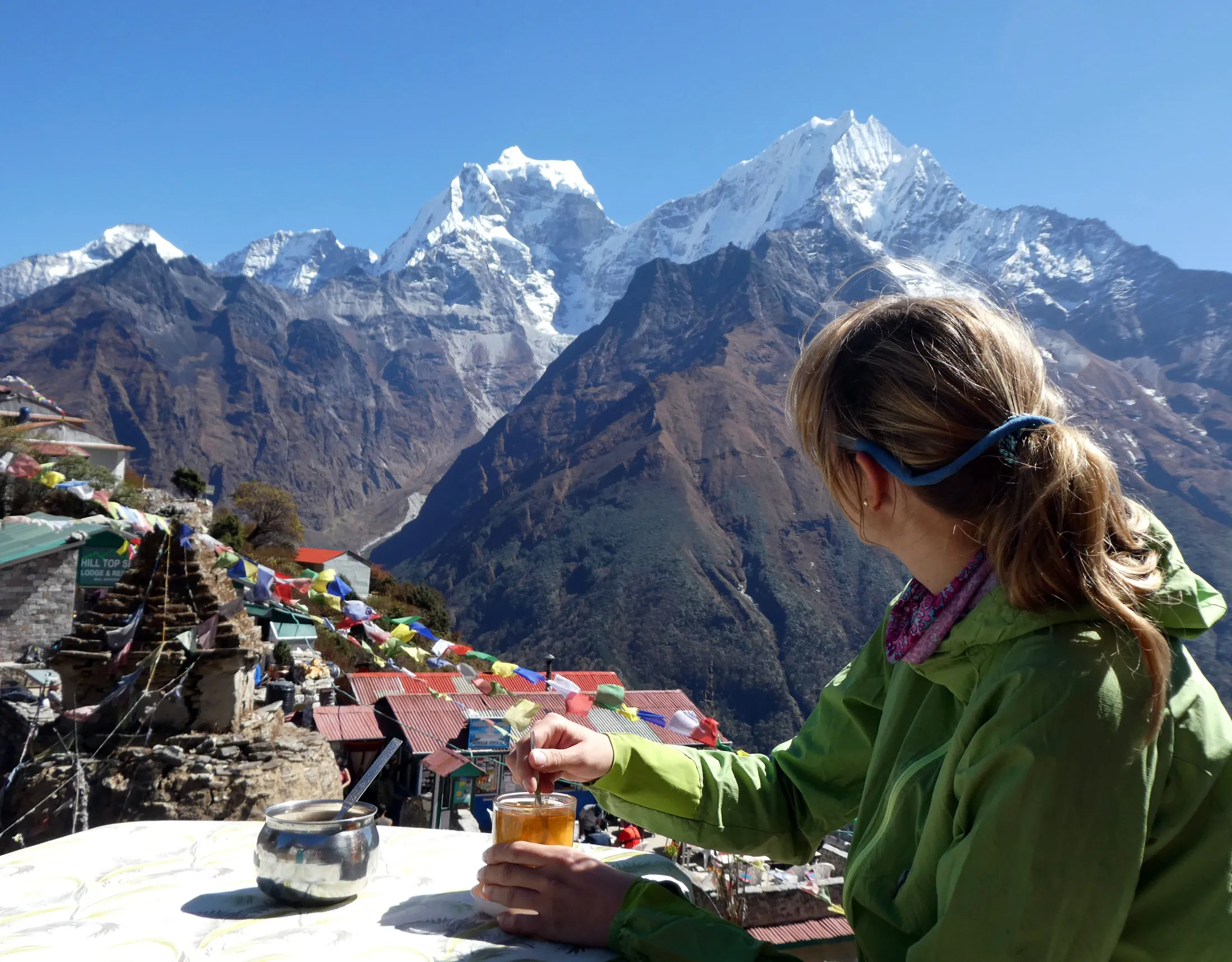
A woman in a green jacket sits at an outdoor table stirring a hot beverage, looking out over a mountain village adorned with prayer flags toward a spectacular view of massive, snow-capped peaks under a clear blue sky.

Gokyo Ri and Renjo La Pass (5357 m)

With one of the best viewpoints of Mount Everest

Gokyo Ri and Renjo La Pass (5357 m)

With one of the best viewpoints of Mount Everest

Do you dream of a hike in the Khumbu Valley in the Himalayas with fewer tourists? On this trek in Nepal, you’ll be taken on a journey into a majestic landscape surrounded by the world’s highest mountains and a unique culture. On this wonderful round-trip, we avoid the crowds and enjoy the natural experience to the fullest, with unique views of the world’s highest mountain, Mount Everest, turquoise lakes, and beautiful valleys. NB! We still have available spots for the autumn trip in 2026, but no more pre-reserved flight tickets. Please feel free to contact us before booking, and we will check the availability and price of flight tickets for you.

Highlights

  • Kathmandu
  • See the largest glacier in the Himalayas
  • Gokyo Ri (5357 m)
  • Renjo La Pass (5340 m)

The sparkling turquoise lakes near Gokyo are a sight to behold! These lakes form the highest freshwater system in the world at this altitude (5000 meters above sea level). We’ll go on a summit hike, experience the Himalayas’ largest glacier, hike through the Sherpa village of Khumjung, and get a glimpse into how they live here. We are constantly surrounded by 8000-meter peaks towering above us. This is a great trip for those who want to test themselves at high altitude for the first time.

We’ll reach an altitude of 5300 meters and enjoy, among other things, one of the very best viewpoints of Mount Everest above us and turquoise-blue lakes below us.

19

10 - 16

NO/EN

4/6

3/6

4/6

Dates and booking
There are no departures on this trip.
Can't find a date? We'll notify you when new trips open!

Plan it your way

Want this trip just for your group? Or got something different in mind? We've got you.

Make this a private trip

Opening hours Phone
Mon-Fri : 08-20
Sat-Sun : 14-17
Opening hours Chat
Mon-Fri : 07-23
Sat : 10-18
Sun : 13-21
CET

Day by day

Plane wing in the sky over the clouds.

Day 1:Departure

Airfare is not included on this trip, so you are responsible for getting to and from Nepal on your own. The first day is not scheduled, so you are free to depart from your country throughout the day. Arrival in Kathmandu according to your itinerary during day 2.

Airfare is not included on this trip, so you are responsible for getting to and from Nepal on your own. The first day is not scheduled, so you are free to depart from your country throughout the day. Arrival in Kathmandu according to your itinerary during day 2.

-,-,-

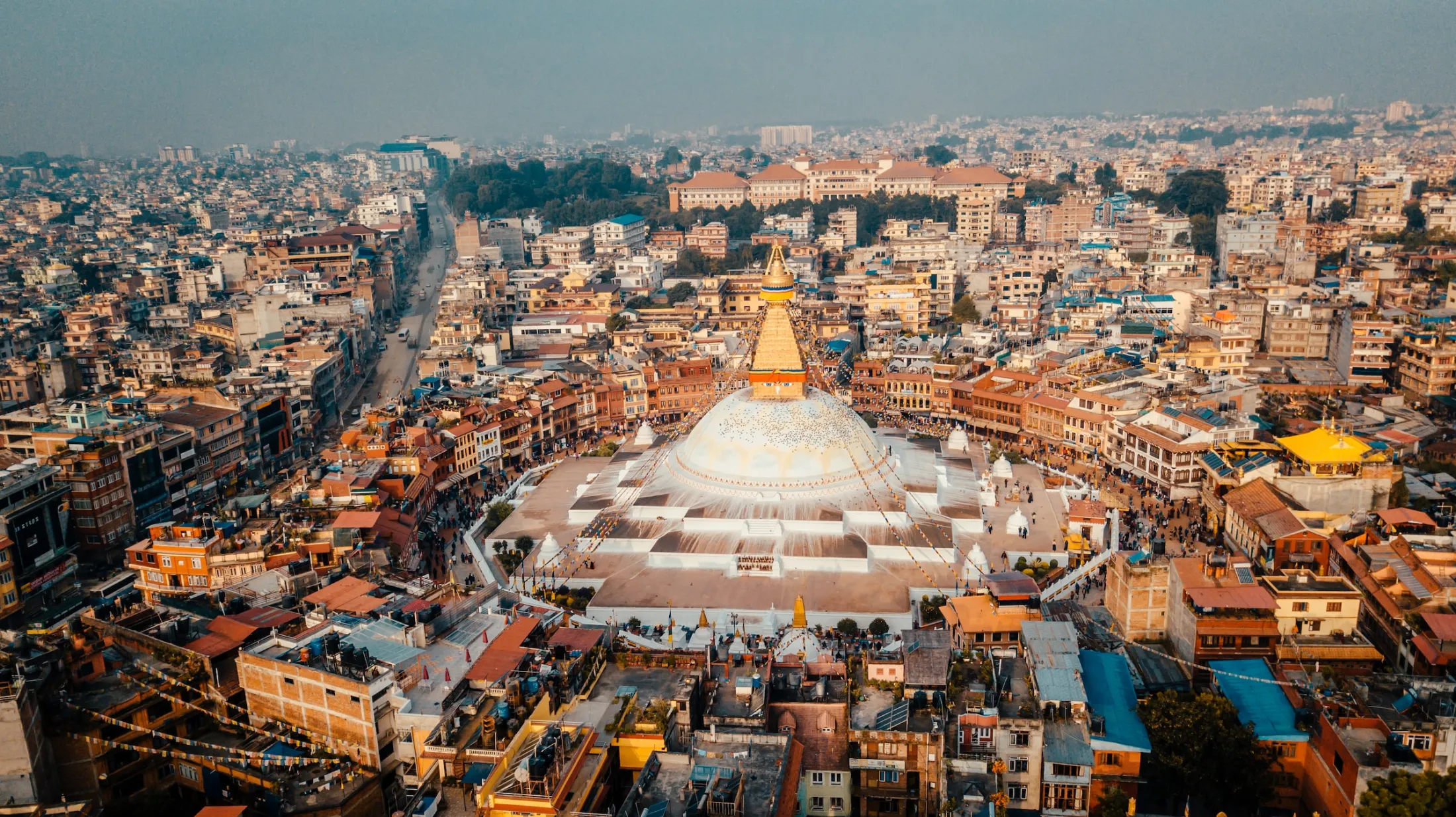
An aerial view shows a massive, white dome stupa with a golden spire standing at the center of a densely packed, bustling city with countless brick buildings stretching toward the horizon.

Day 2:Culture shock in Kathmandu (1350 m)

Arrival in Kathmandu during the day. You are responsible for making your own way to the hotel, centrally located hotel in Kathmandu. Check in and take a short rest at the hotel or go for a stroll in the neighborhood before meeting up with the group and exploring Kathmandu further with our tour guide. Kathmandu is an explosion of colors, sounds, people, animals, temptations, culture, and experiences. For shopaholics, Kathmandu is also a shopping mecca. Everything you need, didn’t know you needed, or don’t need at all can be bought within walking distance of the hotel. Few places offer better value for money, few places have a more varied selection, and few places make haggling more fun! After we’ve gotten lost in the many back alleys and found our way back again, we can meet for dinner at a local restaurant.

Arrival in Kathmandu during the day. You are responsible for making your own way to the hotel, centrally located hotel in Kathmandu. Check in and take a short rest at the hotel or go for a stroll in the neighborhood before meeting up with the group and exploring Kathmandu further with our tour guide. Kathmandu is an explosion of colors, sounds, people, animals, temptations, culture, and experiences. For shopaholics, Kathmandu is also a shopping mecca. Everything you need, didn’t know you needed, or don’t need at all can be bought within walking distance of the hotel. Few places offer better value for money, few places have a more varied selection, and few places make haggling more fun! After we’ve gotten lost in the many back alleys and found our way back again, we can meet for dinner at a local restaurant.

Hotel

-,-,-

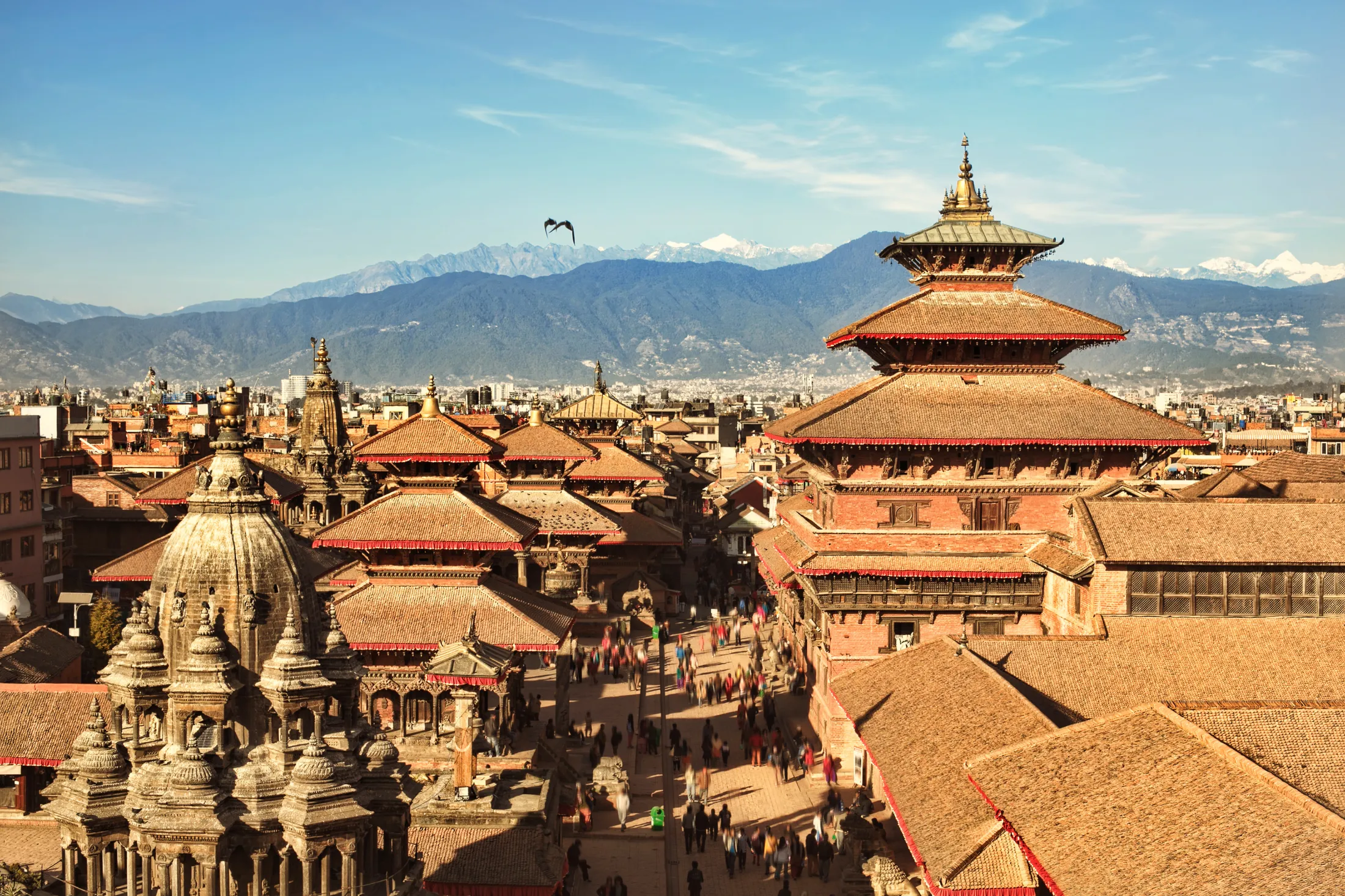
An elevated view shows a bustling public square filled with people walking among intricate, multi-tiered traditional pagodas and temples, with a grand backdrop of rolling hills and snow-capped mountain peaks under a clear blue sky.

Day 3:Kathmandu and Sightseeing

A lazy day, serious shopping, or sightseeing? It’s up to you. We’ve planned a sightseeing tour of the Boudhanath Stupa, Pashupatinath Temple, and Durbar Square with a local guide. We’ll have an early dinner at one of Kathmandu’s many restaurants, because tomorrow we’re setting off for Lukla at the crack of dawn.

A lazy day, serious shopping, or sightseeing? It’s up to you. We’ve planned a sightseeing tour of the Boudhanath Stupa, Pashupatinath Temple, and Durbar Square with a local guide. We’ll have an early dinner at one of Kathmandu’s many restaurants, because tomorrow we’re setting off for Lukla at the crack of dawn.

Hotel

B,-,-

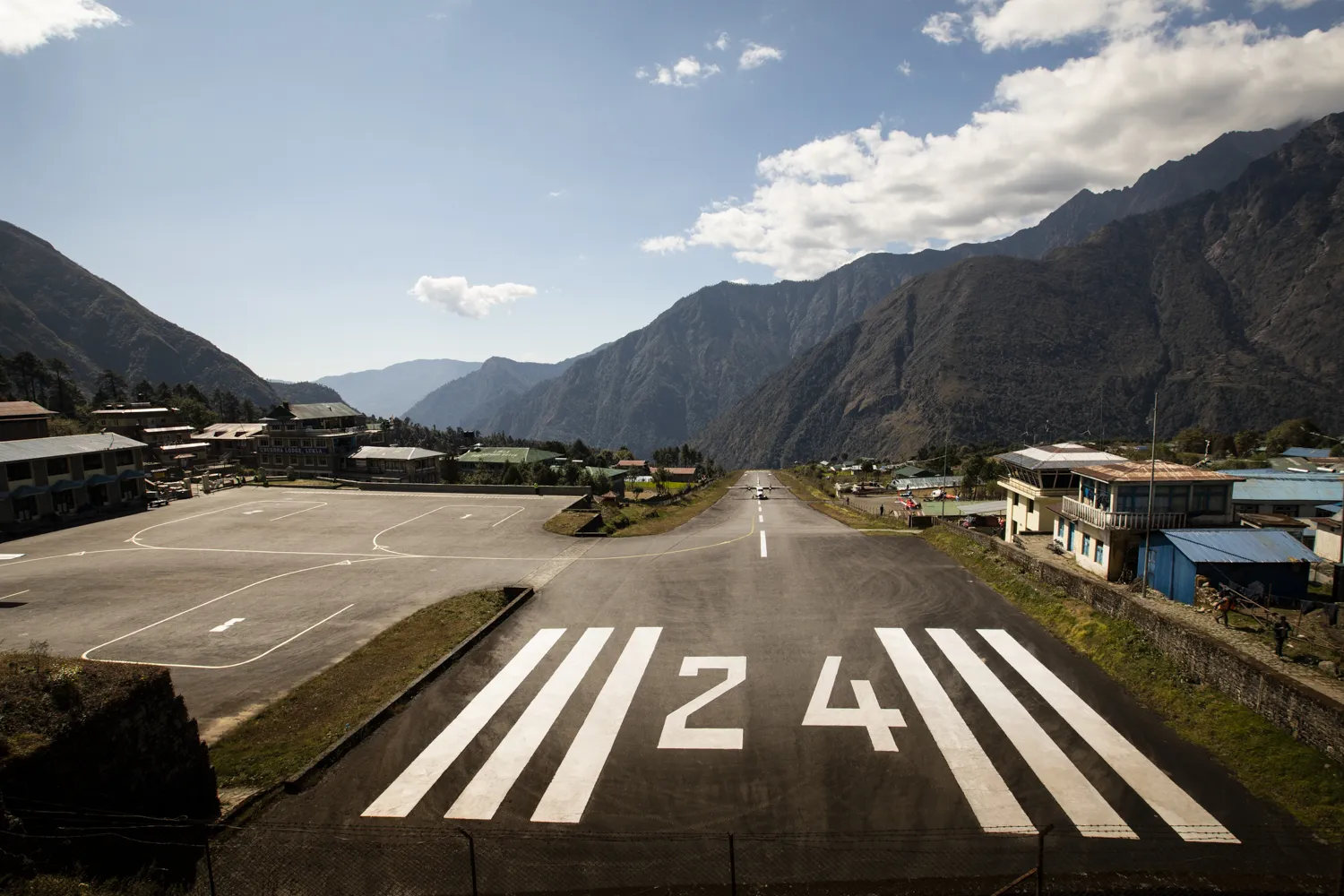
A high-angle view down a short, sloping asphalt runway marked with the number 24 reveals a small airplane at the far end, surrounded by mountain buildings and steep, towering peaks under a partly cloudy sky at Lukla Airport.

Day 4:A spectacular flight to Lukla (2900 m) and trek to Phakding (2600 m)

We leave Kathmandu early in the morning to drive to Ramechap, where a spectacular flight to Lukla (2,860 m) awaits us. The drive takes about 4–5 hours on somewhat bumpy roads, so it’s a good idea to be prepared for that. The flight takes just over half an hour, but transports us to a completely different world. Here we meet our own local Sirdar (“the local head guide”), the Sherpas, the cooks, the kitchen helpers, and the yak herders who will take care of our luggage along the way. After a bit of organizing our gear and luggage, we’re ready to go. The first stage is an easy walk into Phakding. The terrain is lush with a mix of conifers (and in the spring, vibrant flowers). We’re led back and forth across suspension bridges, up and down the terrain. Today’s destination, the village of Phakding, is actually 200 meters lower than Lukla. We are still at a relatively high altitude, so we walk at a leisurely pace and spend the day relaxing. We’re served lunch along the way and arrive at the lodge in the afternoon. This makes for a hike of about 4–5 hours, including lunch. If we have time, we’ll visit the old monastery in Phakding before spending our first night of the trip in a sleeping bag.
We leave Kathmandu early in the morning to drive to Ramechap, where a spectacular flight to Lukla (2,860 m) awaits us. The drive takes about 4–5 hours on somewhat bumpy roads, so it’s a good idea to be prepared for that. The flight takes just over half an hour, but transports us to a completely different world. Here we meet our own local Sirdar (“the local head guide”), the Sherpas, the cooks, the kitchen helpers, and the yak herders who will take care of our luggage along the way. After a bit of organizing our gear and luggage, we’re ready to go. The first stage is an easy walk into Phakding. The terrain is lush with a mix of conifers (and in the spring, vibrant flowers). We’re led back and forth across suspension bridges, up and down the terrain. Today’s destination, the village of Phakding, is actually 200 meters lower than Lukla. We are still at a relatively high altitude, so we walk at a leisurely pace and spend the day relaxing. We’re served lunch along the way and arrive at the lodge in the afternoon. This makes for a hike of about 4–5 hours, including lunch. If we have time, we’ll visit the old monastery in Phakding before spending our first night of the trip in a sleeping bag.
Guesthouse

B,L,D

5-6 hours

5-6 hours

-200m

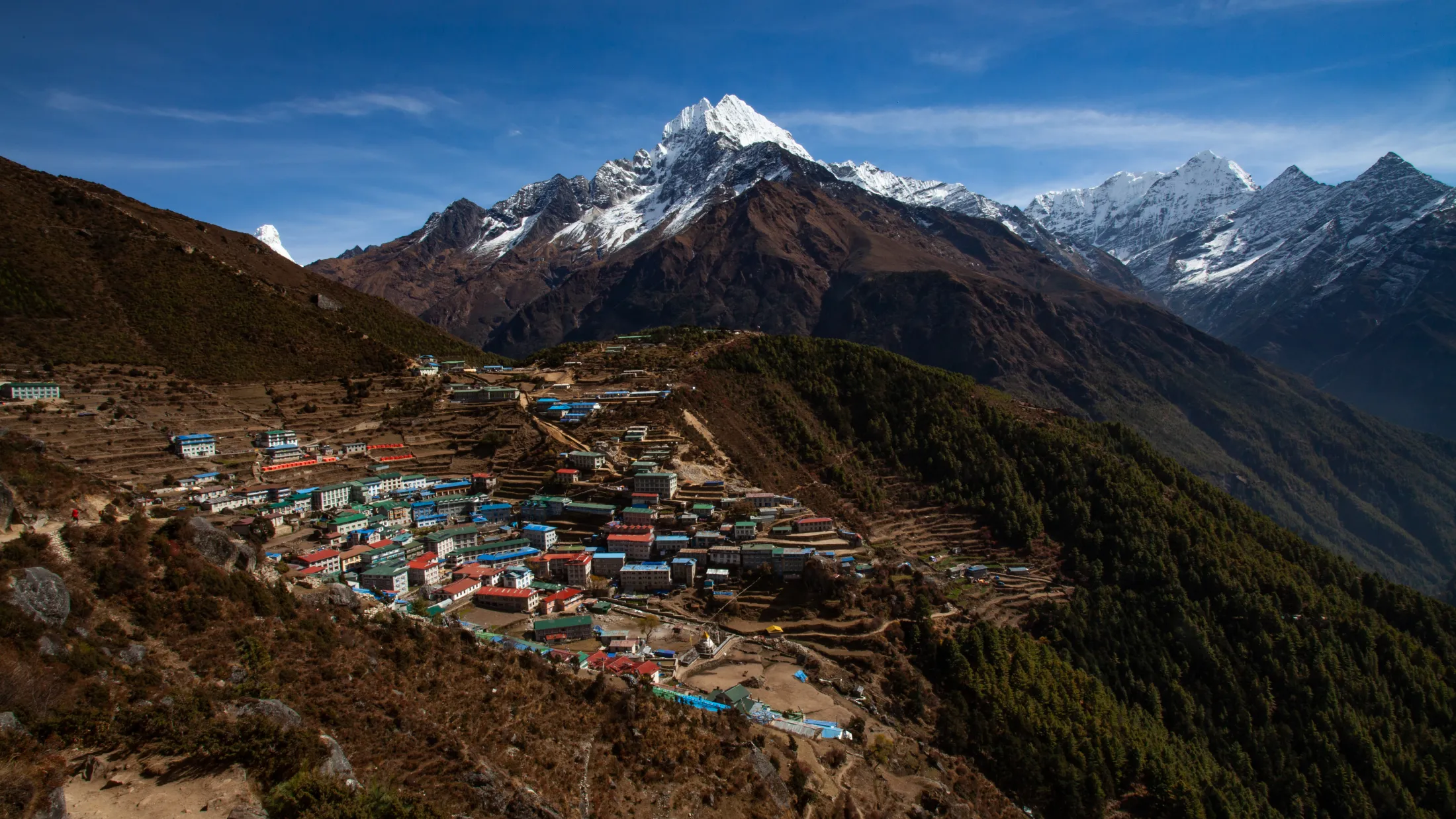
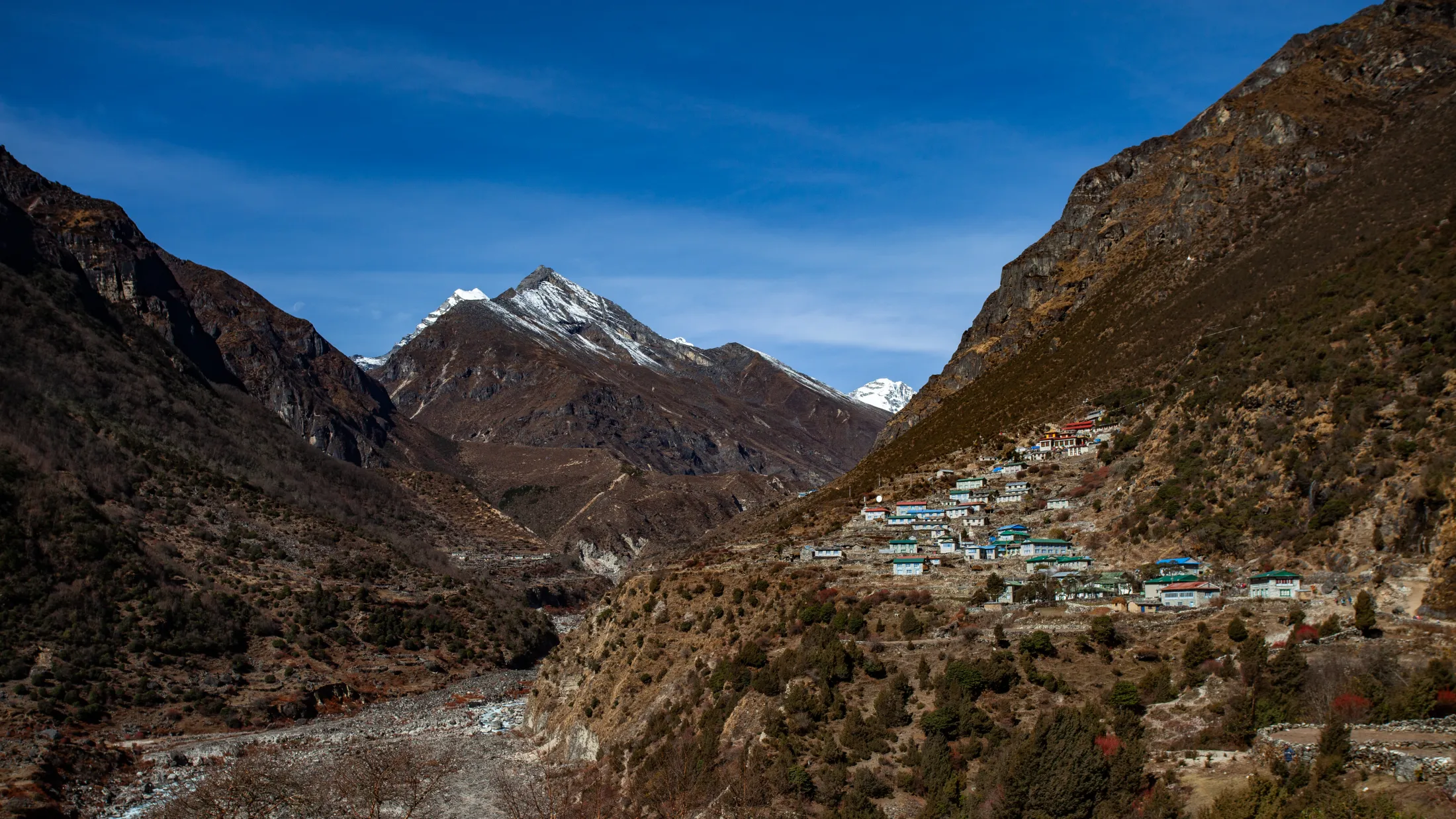
A vibrant hillside village with colorful roofs sits nestled on a mountain slope, with a massive, snow-capped peak rising majestically into the blue sky in the background.

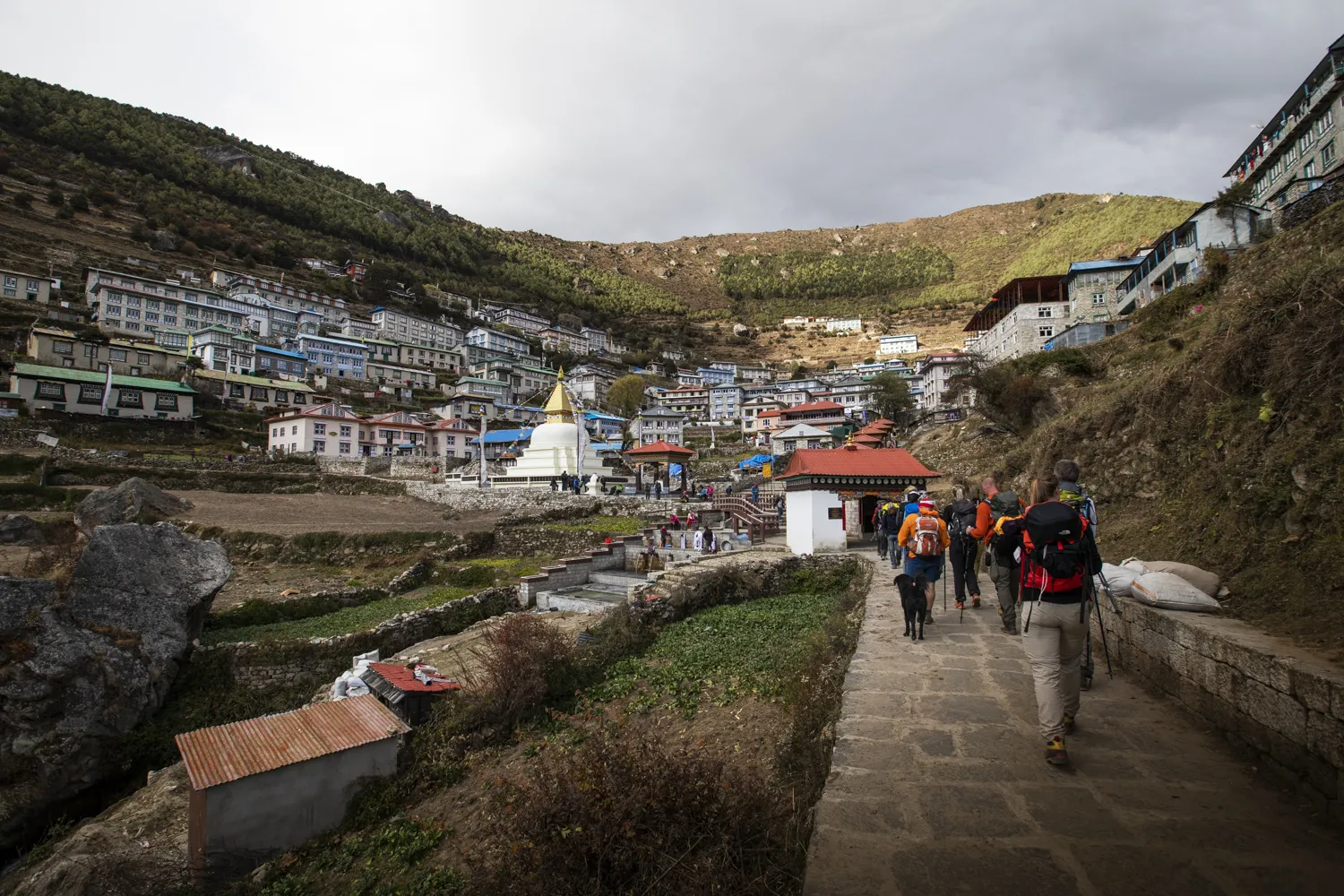
Day 5:The Sherpa capital - Namche Bazaar (3440 m)

After a leisurely start with a nutritious breakfast, we begin our hike. Along the way, we pass through small villages and cross the Dudhi Kosi River on even more spectacular suspension bridges, before arriving at the entrance to Sagarmatha National Park (Sagarmatha is the Nepali name for Mt. Everest) after a couple of hours. Here, we must check in at the national park before heading down to the river again and crossing more suspension bridges. Then the actual ascent toward Namche Bazaar begins. Here, a leisurely pace is key as we climb 700 meters in elevation. We walk at a relaxed pace, stopping countless times to take photos, drink, or simply enjoy the surroundings. Along the way on today’s stage, we catch our first glimpse of Mt. Everest through the treetops. Today’s destination, Namche Bazaar, is the capital of the Sherpas and the hub of the Khumbu Valley. This small town of 400 inhabitants clings to the mountainside with its colorful houses. Merchants from Tibet arrive here with goods after a 9-day trek with their yaks.

After a leisurely start with a nutritious breakfast, we begin our hike. Along the way, we pass through small villages and cross the Dudhi Kosi River on even more spectacular suspension bridges, before arriving at the entrance to Sagarmatha National Park (Sagarmatha is the Nepali name for Mt. Everest) after a couple of hours. Here, we must check in at the national park before heading down to the river again and crossing more suspension bridges. Then the actual ascent toward Namche Bazaar begins. Here, a leisurely pace is key as we climb 700 meters in elevation. We walk at a relaxed pace, stopping countless times to take photos, drink, or simply enjoy the surroundings. Along the way on today’s stage, we catch our first glimpse of Mt. Everest through the treetops. Today’s destination, Namche Bazaar, is the capital of the Sherpas and the hub of the Khumbu Valley. This small town of 400 inhabitants clings to the mountainside with its colorful houses. Merchants from Tibet arrive here with goods after a 9-day trek with their yaks.

Guesthouse

B,L,D

7-8 hours

+1000m

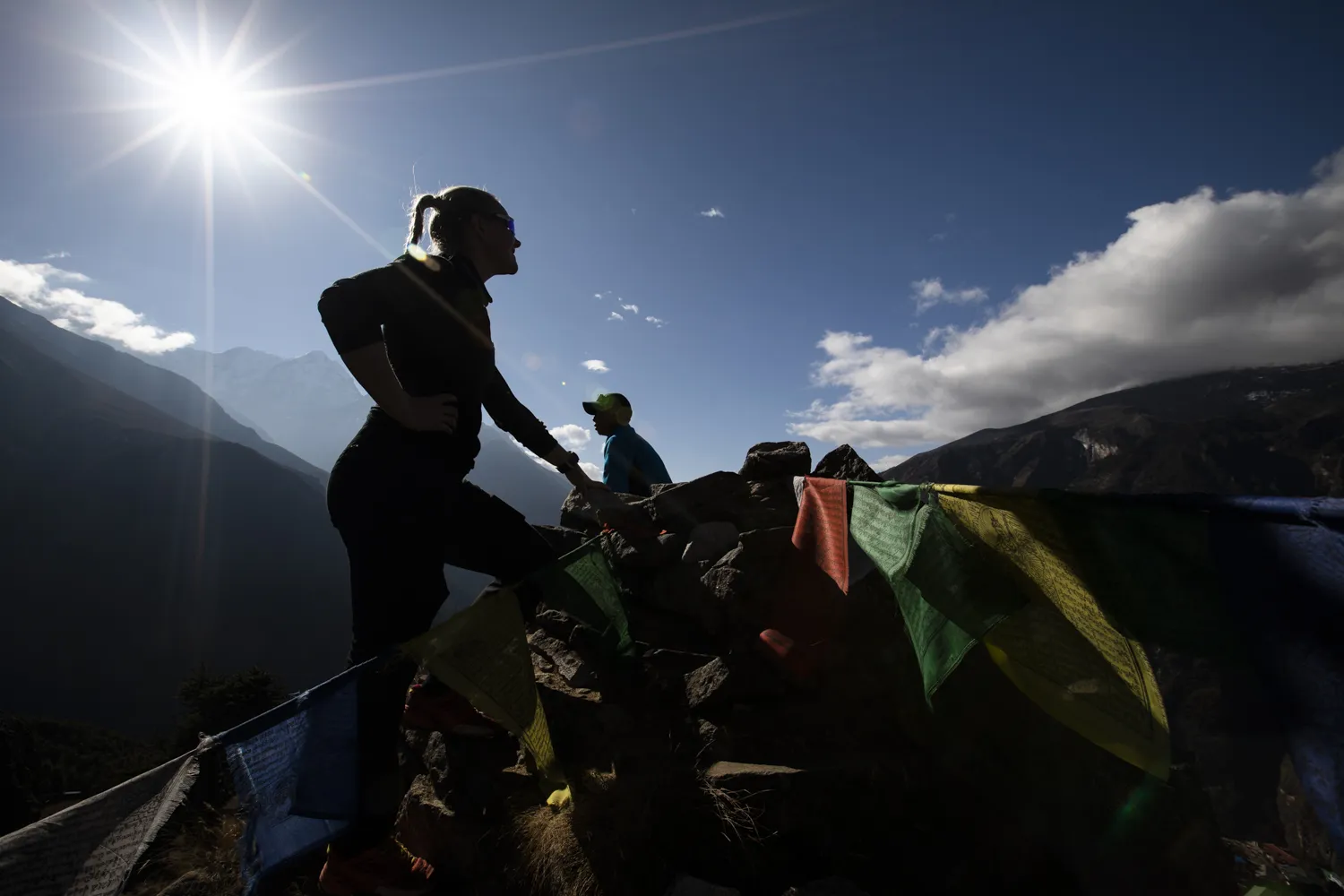
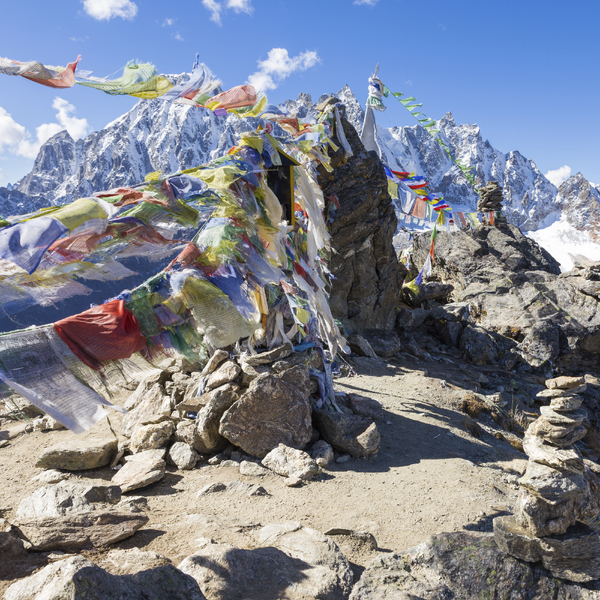
A low-angle silhouette captures a female hiker standing on a rocky ridge beside colorful Tibetan prayer flags, looking out at mountain ranges under a bright, sun-drenched blue sky.

Day 6:Acclimatization day (3800 m)

Today is an acclimatization day. But we won’t be lying still in our sleeping bags all day. To get the most out of the acclimatization, we’ll head higher up and then return to Namche Bazaar in the morning. After a hearty breakfast, we’ll begin today’s hike. Our destination is the Everest View Hotel (3,880 m), a one-and-a-half-hour hike. From the hotel, you’ll have a fantastic view of the Himalayas and get to see Ama Dablam for the first time—the mountain said to be the most beautiful in the world. If the weather is nice, we’ll take time for a cup of tea on the terrace before continuing back to Namche. If we have time, we’ll also stop by the Sherpa Museum. It’s interesting and educational, and gives us a good insight into Sherpa culture and daily life. Back in Namche Bazaar, we’ll have time to relax a bit before evening. The town has many shops, internet cafes, and bakeries (with delicious apple pie!). At dinner, we’ll gather to review today’s events and prepare for tomorrow’s stage.

Today is an acclimatization day. But we won’t be lying still in our sleeping bags all day. To get the most out of the acclimatization, we’ll head higher up and then return to Namche Bazaar in the morning. After a hearty breakfast, we’ll begin today’s hike. Our destination is the Everest View Hotel (3,880 m), a one-and-a-half-hour hike. From the hotel, you’ll have a fantastic view of the Himalayas and get to see Ama Dablam for the first time—the mountain said to be the most beautiful in the world. If the weather is nice, we’ll take time for a cup of tea on the terrace before continuing back to Namche. If we have time, we’ll also stop by the Sherpa Museum. It’s interesting and educational, and gives us a good insight into Sherpa culture and daily life. Back in Namche Bazaar, we’ll have time to relax a bit before evening. The town has many shops, internet cafes, and bakeries (with delicious apple pie!). At dinner, we’ll gather to review today’s events and prepare for tomorrow’s stage.

Guesthouse

B,L,D

4-5 hours

440m/440m

4 km

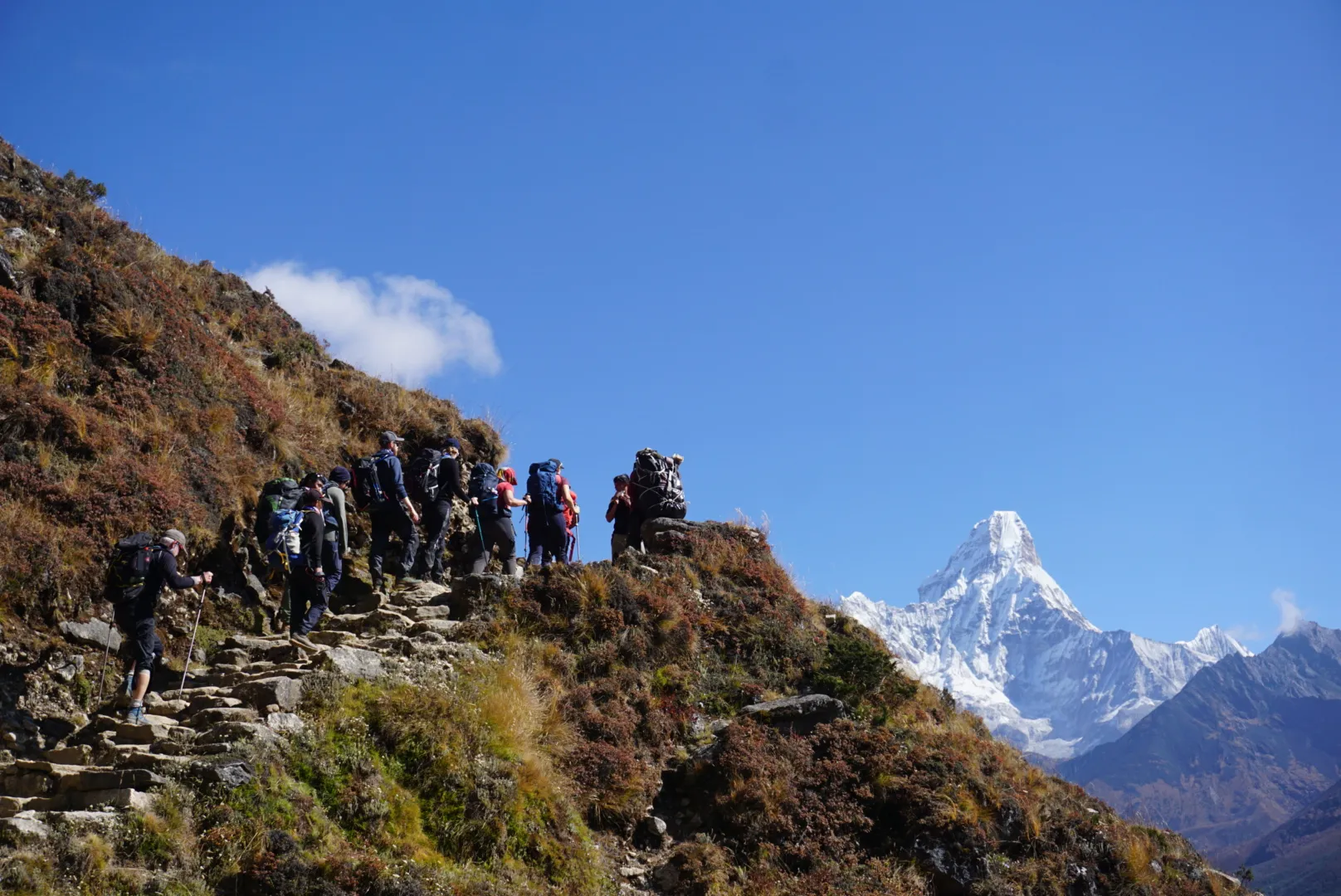
A line of hikers carrying backpacks climbs a rocky stone staircase up a grassy hillside, with a striking, sharp snow-capped mountain peak towering in the distance under a clear blue sky.

Day 7:Namche - Phortse Thanga (3680 m)

We’ll be walking on beautiful trails between Namche and Phortse Tenga. The trail is well-maintained, but this is done through private initiative and is not funded by the government. Therefore, there is an opportunity to donate a small amount to the people who keep this trail in good condition for tourists, porters, and animals. Throughout the day, we’ll enjoy spectacular views of Ama Dablam, Mount Everest, Thamserku, and many other mountains. Just remember to look up!

We’ll be walking on beautiful trails between Namche and Phortse Tenga. The trail is well-maintained, but this is done through private initiative and is not funded by the government. Therefore, there is an opportunity to donate a small amount to the people who keep this trail in good condition for tourists, porters, and animals. Throughout the day, we’ll enjoy spectacular views of Ama Dablam, Mount Everest, Thamserku, and many other mountains. Just remember to look up!

Guesthouse

B,LD

5-6 hours

5,7 km

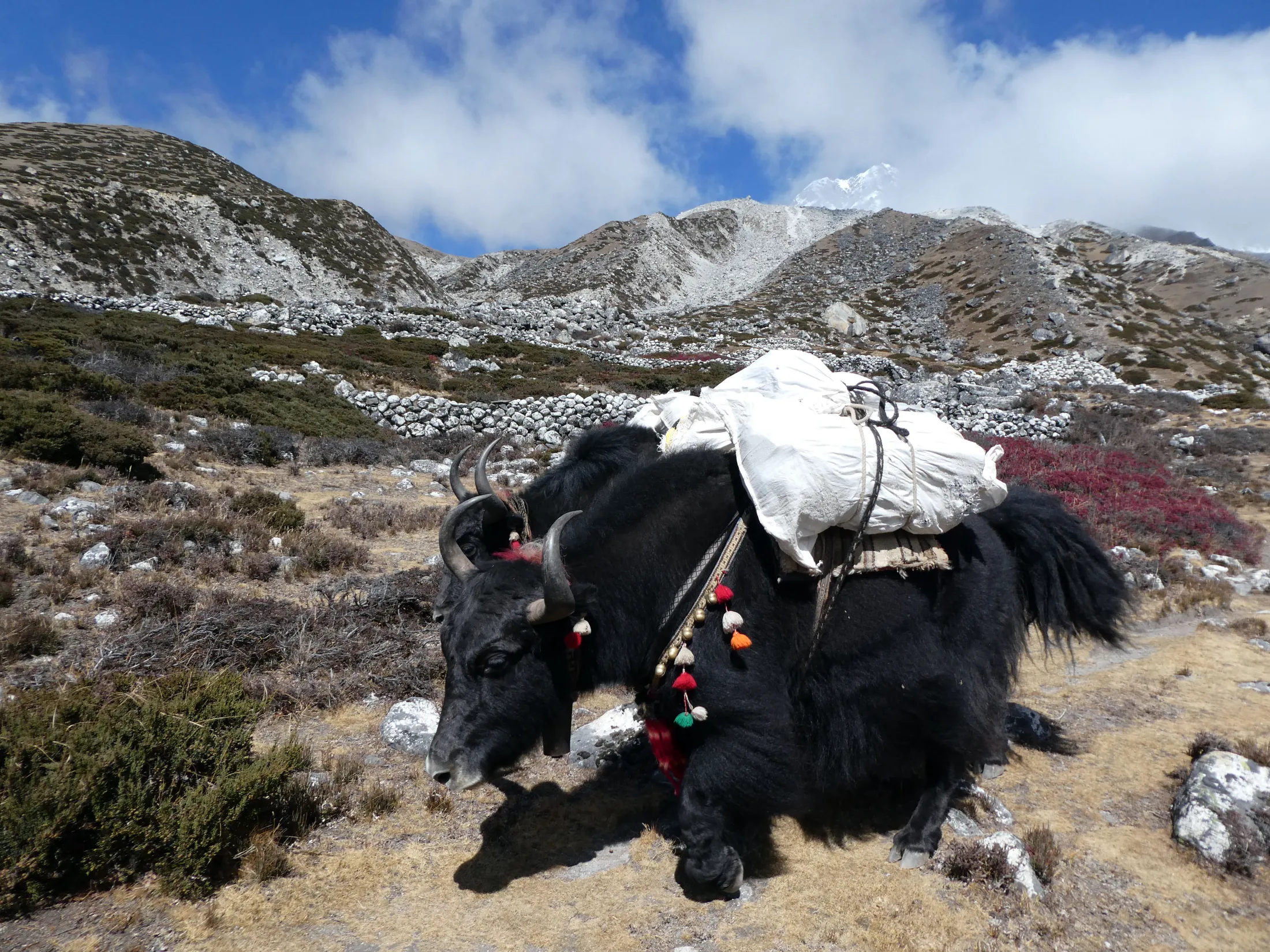
A large, shaggy black yak laden with large white cargo sacks walks along a dry, barren mountain trail, with rocky slopes and a snow-capped peak partially visible behind clouds under a blue sky.

Day 8:Up to Dole (4000 m)

Now we’re really on our way, and we can feel the mountains calling us. In the morning, we’re woken up with tea or coffee served right at the edge of our sleeping bags, giving us a peaceful start before breakfast. Then we’re ready for today’s stage. We’re heading on to Dole, and the trail climbs steeply in places. On the way up, we enjoy the beautiful surroundings, passing stupas and eat dinner together and discuss the day’s experiences.

Now we’re really on our way, and we can feel the mountains calling us. In the morning, we’re woken up with tea or coffee served right at the edge of our sleeping bags, giving us a peaceful start before breakfast. Then we’re ready for today’s stage. We’re heading on to Dole, and the trail climbs steeply in places. On the way up, we enjoy the beautiful surroundings, passing stupas and eat dinner together and discuss the day’s experiences.

Guesthouse

B,L,D

2-3 hours

+520m

4 km

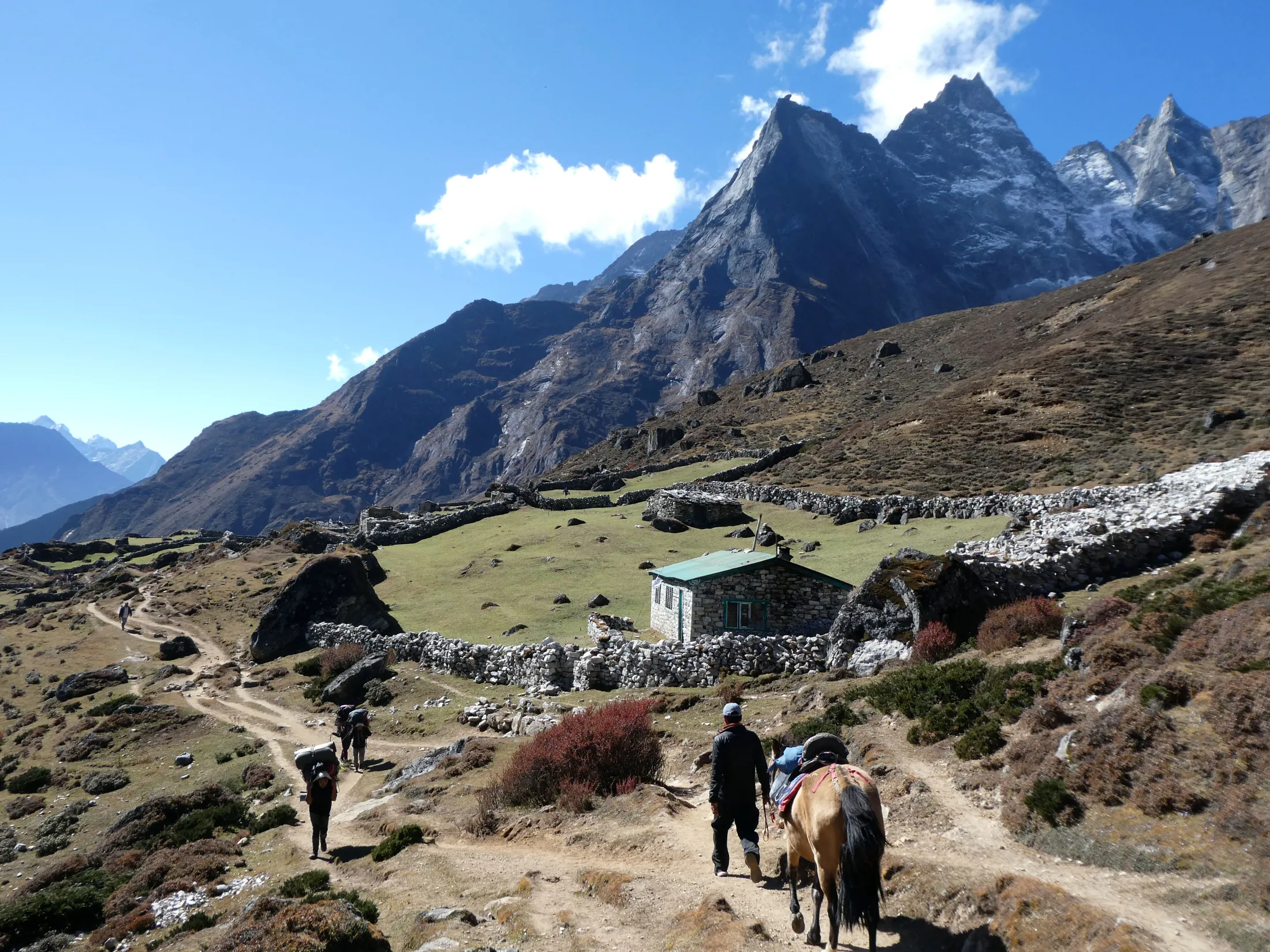
A man leads a pack horse down a dirt mountain trail toward a small stone cottage surrounded by low stone walls and green pastures, while towering, jagged rock peaks rise dramatically in the background under a blue sky.

Day 9:Dole - Machhermo (4470 m)

We start off with a steep climb today on a scenic trail, going up and up past juniper thickets, but with no trees in sight. We’re above the tree line, after all. The views keep getting better and better, and eventually Cho Oyu comes into view ahead of us—one of the famous 8,000-meter peaks. We arrive at camp in the afternoon and get some rest before we have dinner together in the evening.

We start off with a steep climb today on a scenic trail, going up and up past juniper thickets, but with no trees in sight. We’re above the tree line, after all. The views keep getting better and better, and eventually Cho Oyu comes into view ahead of us—one of the famous 8,000-meter peaks. We arrive at camp in the afternoon and get some rest before we have dinner together in the evening.

Guesthouse

B,L,D

4-5 hours

450m/110m

5 km

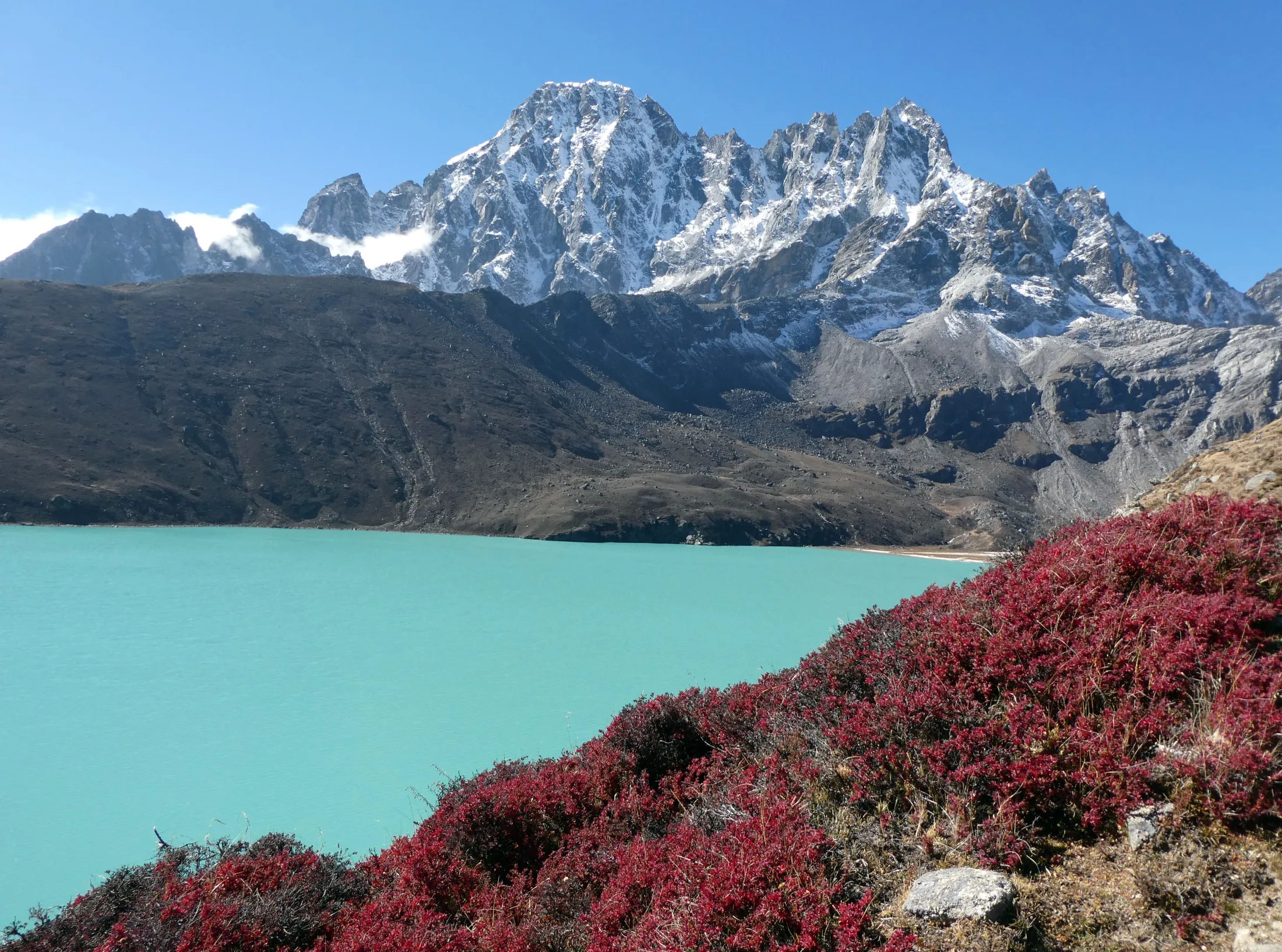
A striking field of deep red autumn shrubs in the foreground lines a vibrant turquoise alpine lake, with dark scree slopes and a massive, snow-dusted rocky mountain peak rising sharply in the background under a clear blue sky.
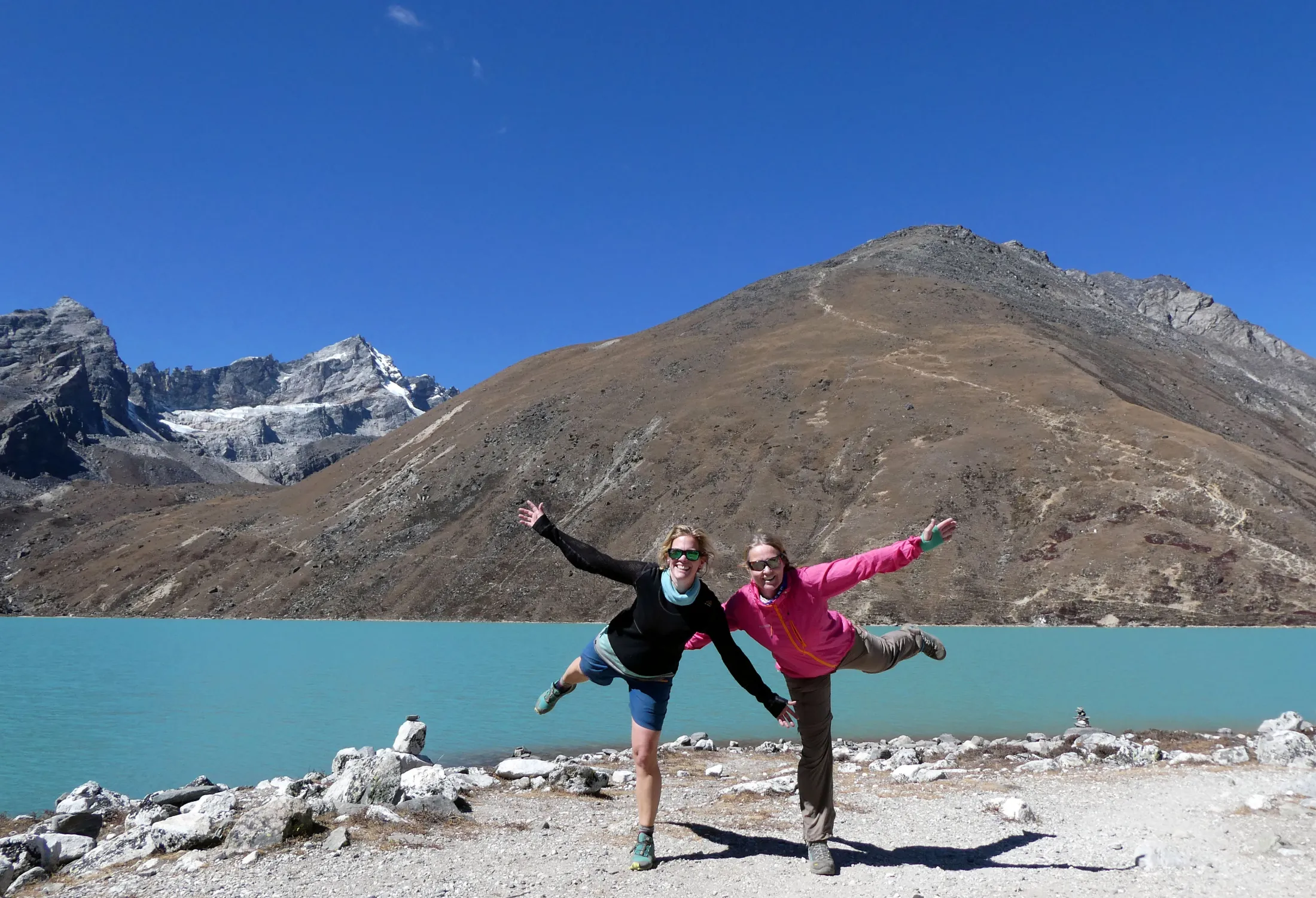
English: Two smiling women in hiking clothes joyfully strike an airplane pose on one leg along a rocky shore, with a vibrant turquoise alpine lake and massive barren mountains under a clear blue sky behind them.

Day 10:To Gokyo and the turquoise lakes (4800 m)

Today’s hike is, on the whole, a bit less steep than the previous days. As we leave Macchermo, the trail climbs up a hill overlooking Kangtega, before we enter a slightly narrower valley and then descend toward the Dudh Koshi River. From here, there is a steep climb up to the first of the six lakes in Gokyo. Maybe we’ll spot some “Golden Ducks”? The trail is worn in many places, mainly due to yak traffic in the summer. Eventually, a wide valley opens up with Cho Oyu at the head, a massive glacier towering over us and the village of Gokyo just above Lake Number Three. In the middle of the view, you can see a rocky slope with a path leading up; that is the way to Gokyo Ri and our destination for the next morning! We spend the afternoon resting, exploring the town, and perhaps taking a stroll to one of the other lakes. Mainly, we’ll rest and recharge for the next morning’s summit hike!

Today’s hike is, on the whole, a bit less steep than the previous days. As we leave Macchermo, the trail climbs up a hill overlooking Kangtega, before we enter a slightly narrower valley and then descend toward the Dudh Koshi River. From here, there is a steep climb up to the first of the six lakes in Gokyo. Maybe we’ll spot some “Golden Ducks”? The trail is worn in many places, mainly due to yak traffic in the summer. Eventually, a wide valley opens up with Cho Oyu at the head, a massive glacier towering over us and the village of Gokyo just above Lake Number Three. In the middle of the view, you can see a rocky slope with a path leading up; that is the way to Gokyo Ri and our destination for the next morning! We spend the afternoon resting, exploring the town, and perhaps taking a stroll to one of the other lakes. Mainly, we’ll rest and recharge for the next morning’s summit hike!

Guesthouse

B,L,D

4-5 hours

470m/100m

7 km

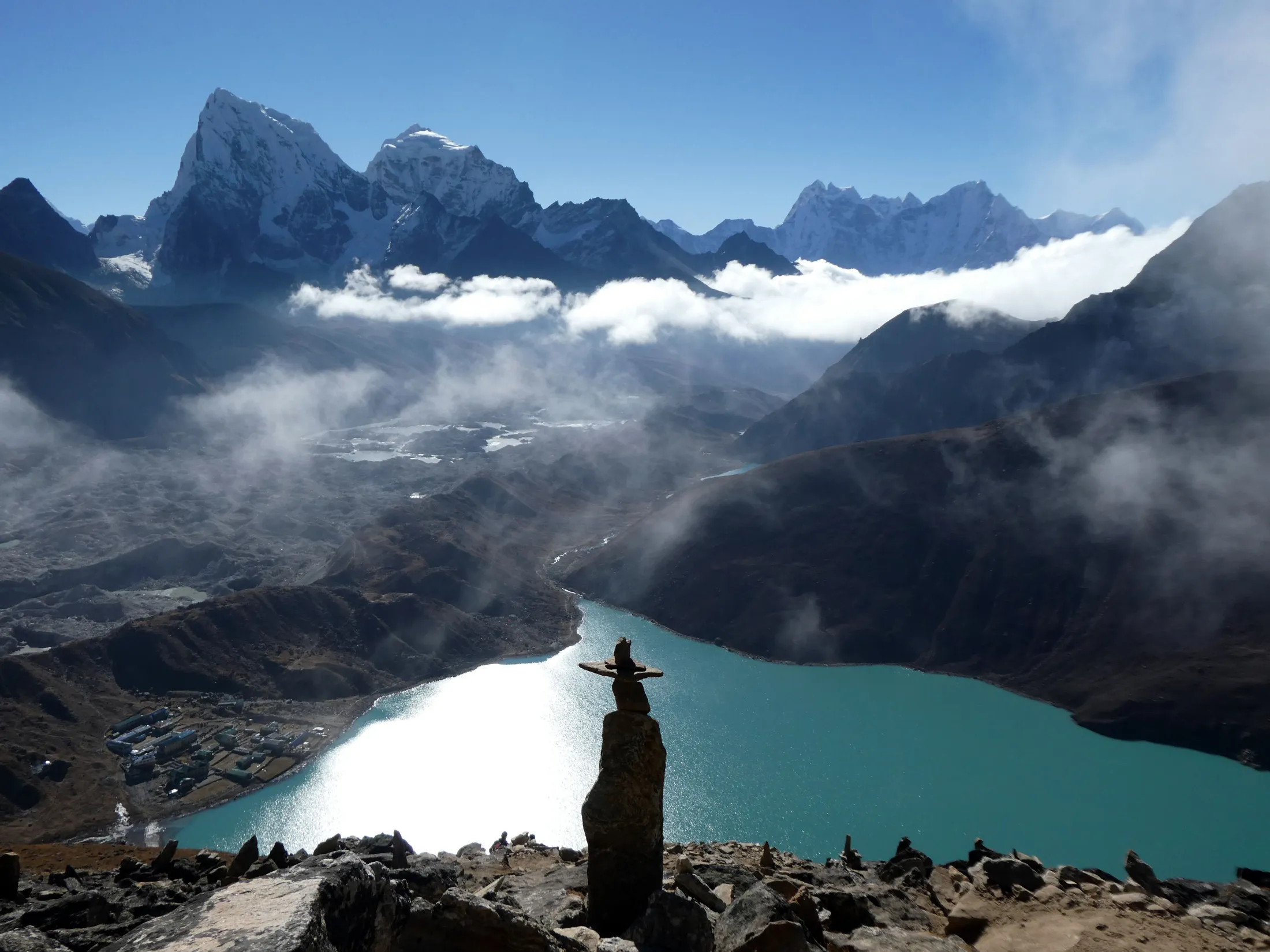
A stone cairn stands on a rocky peak in the close foreground, overlooking a brilliant turquoise alpine lake with a glint of sunlight reflecting off the water, surrounded by swirling low clouds and a majestic backdrop of snow-capped mountain peaks.

Day 11:Up to Gokyo Ri (5357 m)

We get up at the crack of dawn to catch the sunrise from Gokyo Ri. It’s something to look forward to. It takes us about 2.5 hours to reach the summit, and the view that awaits us is well worth the early start. We take in the mountain peaks towering all around us and the turquoise lakes below, savoring the moment. At a leisurely pace, we make our way back down to Gokyo, where we enjoy a well-deserved breakfast and spend the rest of the day relaxing.

We get up at the crack of dawn to catch the sunrise from Gokyo Ri. It’s something to look forward to. It takes us about 2.5 hours to reach the summit, and the view that awaits us is well worth the early start. We take in the mountain peaks towering all around us and the turquoise lakes below, savoring the moment. At a leisurely pace, we make our way back down to Gokyo, where we enjoy a well-deserved breakfast and spend the rest of the day relaxing.

Guesthouse

B,LD

3-4 hours

560m/560m

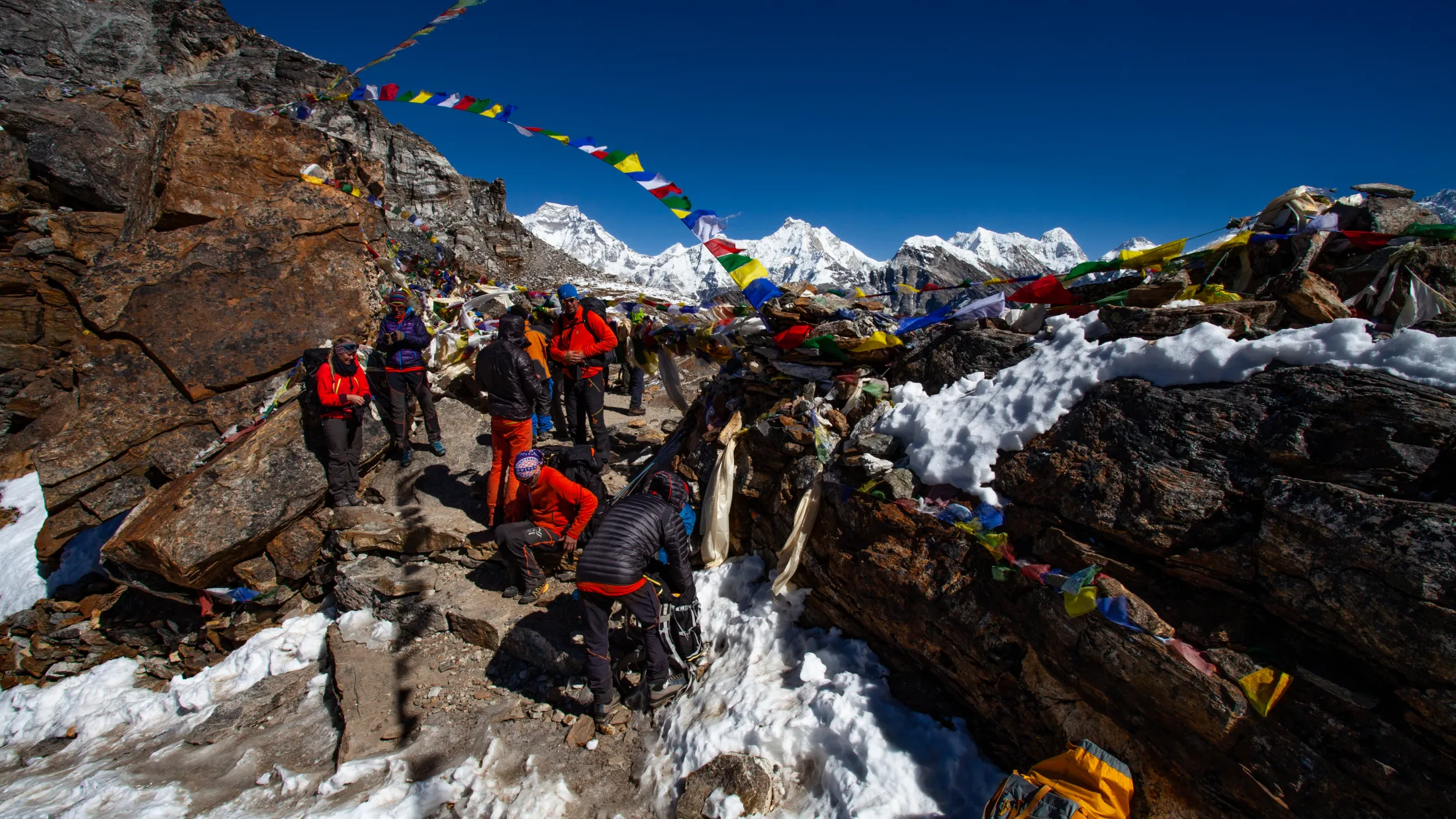
A group of mountaineers rests on a snowy, rocky high-altitude pass draped in colorful Buddhist prayer flags, with a breathtaking panoramic view of snow-capped Himalayan peaks under a deep blue sky behind them.

Day 12:To Lungden via Renjo La pass (5360 m)

Today we’re heading out on a long hike with quite a bit of climbing, all the way up to the Renjo La Pass at 5,360 meters above sea level. We’ll take it easy and enjoy the scenery along the way. Even though it can be tough, it’s important to remember how lucky we are to be able to hike through this unique mountain landscape. We’ll descend through the Bhote Khosi Valley and eventually arrive at our stop for the night, Lungden, a small mountain village for hikers. We’ll be served a hearty dinner and enjoy a cozy evening.

Today we’re heading out on a long hike with quite a bit of climbing, all the way up to the Renjo La Pass at 5,360 meters above sea level. We’ll take it easy and enjoy the scenery along the way. Even though it can be tough, it’s important to remember how lucky we are to be able to hike through this unique mountain landscape. We’ll descend through the Bhote Khosi Valley and eventually arrive at our stop for the night, Lungden, a small mountain village for hikers. We’ll be served a hearty dinner and enjoy a cozy evening.

Guesthouse

B,L,D

7-8 hours

600m/1000m

A small mountain village with colorful roofs clings to a steep, rugged hillside above a rocky riverbed, set against a backdrop of massive, brown mountain peaks under a clear blue sky.

Day 13:Lungden to Thame (3950 m)

Thame is probably the village with the best Everest climbers, and it is home to several Sherpas who hold Everest records. We’ll visit Thame’s historic temple, and if we’re lucky, we might even catch a small ceremony. We’ll have the chance to learn about Sherpa culture and hear about what life is like up here at high altitude. We’ll hike for 5–6 hours, have lunch along the way, and gather for a group dinner in the evening.

Thame is probably the village with the best Everest climbers, and it is home to several Sherpas who hold Everest records. We’ll visit Thame’s historic temple, and if we’re lucky, we might even catch a small ceremony. We’ll have the chance to learn about Sherpa culture and hear about what life is like up here at high altitude. We’ll hike for 5–6 hours, have lunch along the way, and gather for a group dinner in the evening.

Guesthouse

B,L,D

5-6 hours

-500m

10,5 km

Gorak Shep is the starting point for two major highlights. Yesterday we visited “Everest View Point”/Everest Base Camp. Today, our destination is Kala Pattar. The summit itself is a pile of gravel that takes 3 hours to climb, so we start early in the morning. Often, that means we start in the dark with a headlamp as our light source and a down jacket to keep warm. The elevation gain from Gorak Shep is 380 meters, so you might have to dig deep to find the strength. But the view that greets you when you stand at the summit is breathtaking. The mundane pile of gravel has suddenly transformed into a fantastic vantage point. Now we have a panoramic view of the entire Himalayas, and towering around us are the 8,000-meter peaks of Lhotse, Nuptse, and Mt. Everest. Ama Dablam is also beautifully situated down in the valley. After a short while, we turn around and head back to Gorak Shep. Here we have breakfast before lacing up our boots again and hiking all the way back to Pangboche. Tonight, it’s another tired but enthusiastic group gathering around the dinner table to share their experiences.

Day 14:Back to Namche Bazaar (3440 m)

The lower we go, the easier it feels to walk. The air feels thick as butter, and we keep turning around to soak in the last impressions of this incredible mountain world. How many pictures can you really take of mountains? Even though we’re looking forward to pizza and fresh baked goods in Namche Bazaar, it’s also a little bittersweet that the trek is coming to an end. We’ll have lunch along the way and return to the Sherpa capital in the afternoon. Here we’ll have time to wander through shops, markets, and the bakery before gathering for dinner.

The lower we go, the easier it feels to walk. The air feels thick as butter, and we keep turning around to soak in the last impressions of this incredible mountain world. How many pictures can you really take of mountains? Even though we’re looking forward to pizza and fresh baked goods in Namche Bazaar, it’s also a little bittersweet that the trek is coming to an end. We’ll have lunch along the way and return to the Sherpa capital in the afternoon. Here we’ll have time to wander through shops, markets, and the bakery before gathering for dinner.

Guesthouse

B,L,D

5-6 hours

-500m

10 km

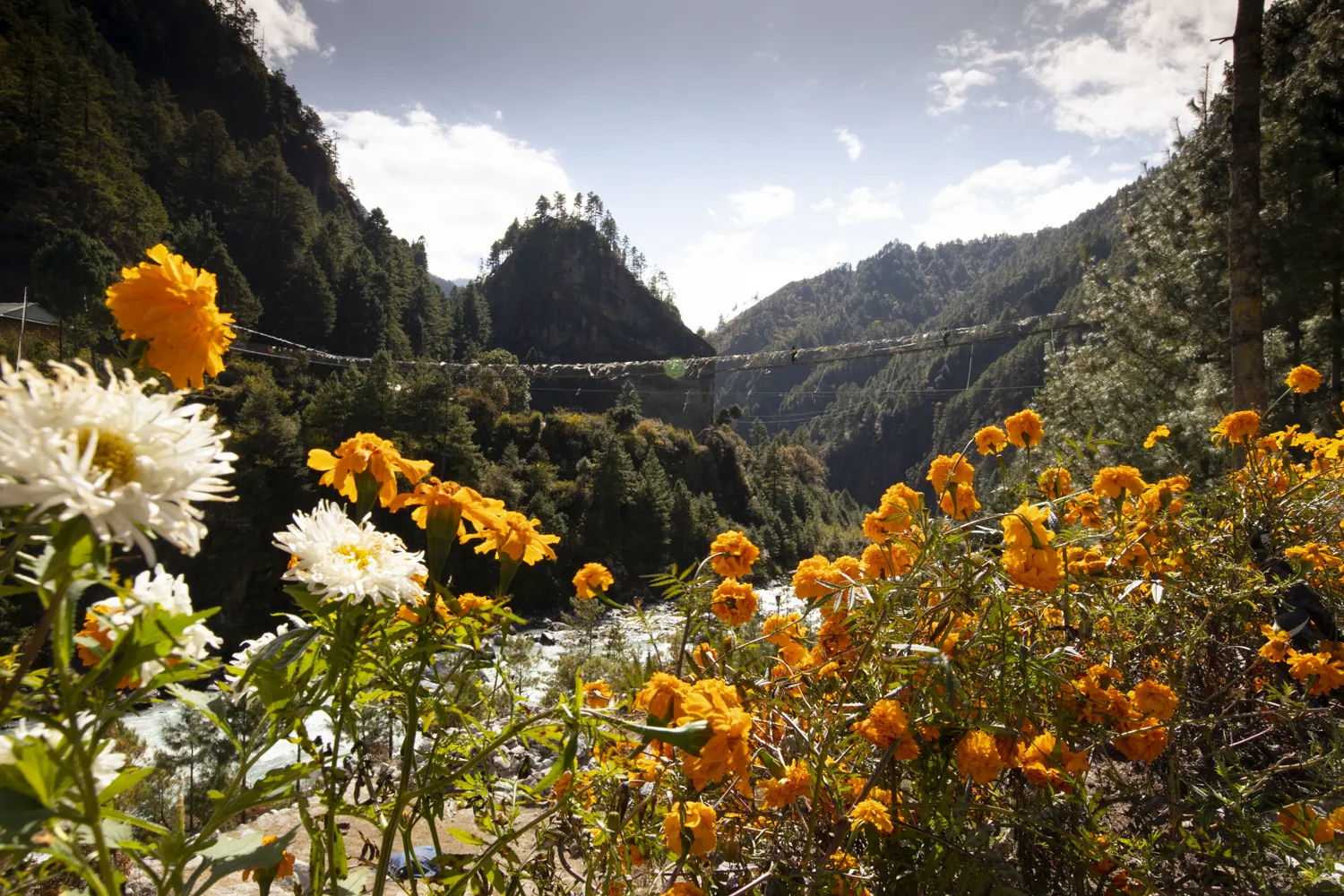
Vibrant orange and white marigold flowers in the close foreground frame a long suspension bridge stretching across a deep, forested river valley beneath a partly cloudy sky.

Day 15:Last day in the mountains and down to Lukla (2900 m)

We say goodbye to Namche Bazaar and set off on the final scenic leg of our trek. We catch one last glimpse of the majestic mountains through the treetops and continue back along the same route we took on the way here - across suspension bridges and through small villages. This will be our last night at the lodge, sleeping in sleeping bags. Tomorrow, Kathmandu awaits.

We say goodbye to Namche Bazaar and set off on the final scenic leg of our trek. We catch one last glimpse of the majestic mountains through the treetops and continue back along the same route we took on the way here - across suspension bridges and through small villages. This will be our last night at the lodge, sleeping in sleeping bags. Tomorrow, Kathmandu awaits.

Guesthouse

B,L,D

7-8 hours

-540m

15 km

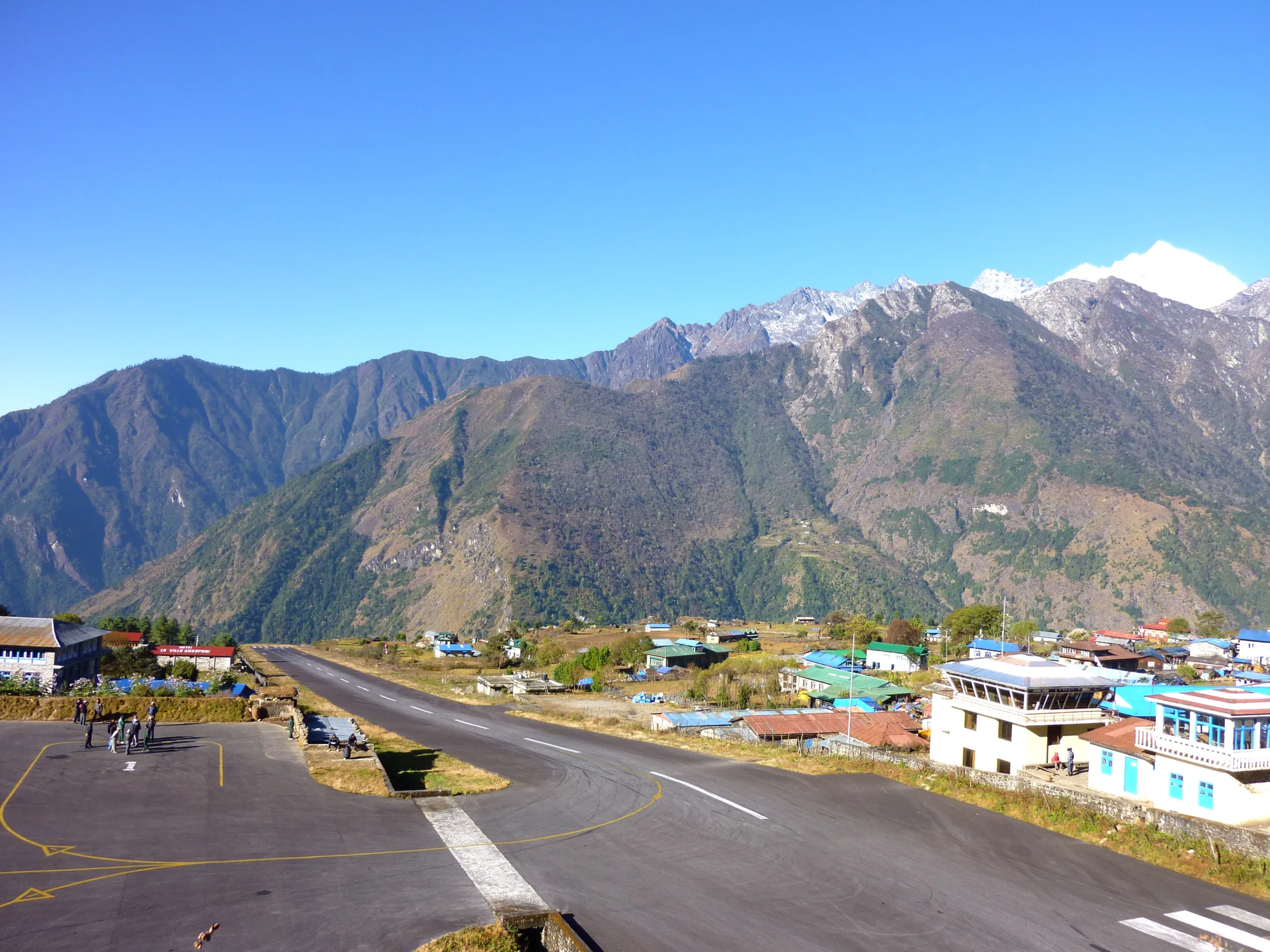
high-angle view looks down the short, sloped asphalt runway of Lukla Airport, surrounded by a mountain village and towering green hillsides under a clear blue sky.

Day 16:Back to Kathmandu

We’re up before the rooster crows. For flights to and from Lukla, the early morning hours offer the best flying conditions. Our luggage is packed, we’ve said goodbye to our local friends, and we’re on our way back to Kathmandu. From the quiet, peaceful mountain world to chaotic, mysterious Kathmandu. We fly back to Ramechap and drive the 4–5 hours back to Kathmandu. The rest of the day is yours to explore this exciting city on your own. It’s easy to be captivated by Kathmandu, and you should take the time to wander through the back alleys and follow the flow of people. Perhaps a foot or aromatherapy massage sounds tempting? If you enjoy shopping for affordable and fun items, Kathmandu is a paradise! Hotel life slowly but surely brings us back to our usual routines. A shower, a comfortable bed, TV, shops, and other everyday comforts initially feel like a luxury.

We’re up before the rooster crows. For flights to and from Lukla, the early morning hours offer the best flying conditions. Our luggage is packed, we’ve said goodbye to our local friends, and we’re on our way back to Kathmandu. From the quiet, peaceful mountain world to chaotic, mysterious Kathmandu. We fly back to Ramechap and drive the 4–5 hours back to Kathmandu. The rest of the day is yours to explore this exciting city on your own. It’s easy to be captivated by Kathmandu, and you should take the time to wander through the back alleys and follow the flow of people. Perhaps a foot or aromatherapy massage sounds tempting? If you enjoy shopping for affordable and fun items, Kathmandu is a paradise! Hotel life slowly but surely brings us back to our usual routines. A shower, a comfortable bed, TV, shops, and other everyday comforts initially feel like a luxury.

Hotel

B,-,-

4-5 hours

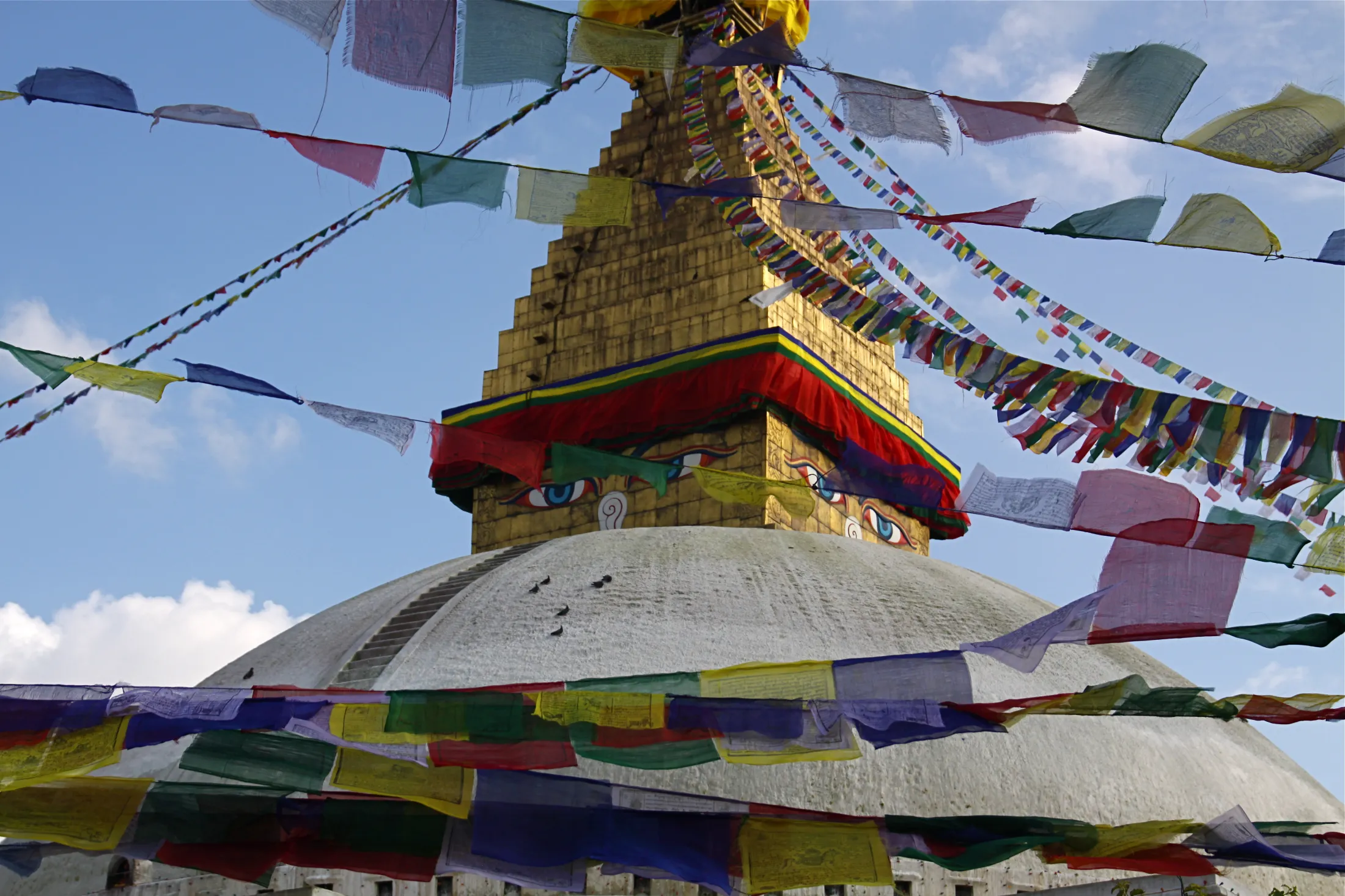
A close-up view of a large white stupa with the painted eyes of the Buddha on its golden spire, crisscrossed by numerous colorful Buddhist prayer flags under a partly cloudy blue sky.

Day 17:Kathmandu

Explore Kathmandu on your own, go shopping, sightseeing, or relax at the hotel. One thing is certain - you’ll never get bored in this lively city! We’ll have a group farewell dinner in the evening.

Explore Kathmandu on your own, go shopping, sightseeing, or relax at the hotel. One thing is certain - you’ll never get bored in this lively city! We’ll have a group farewell dinner in the evening.

B,-,D

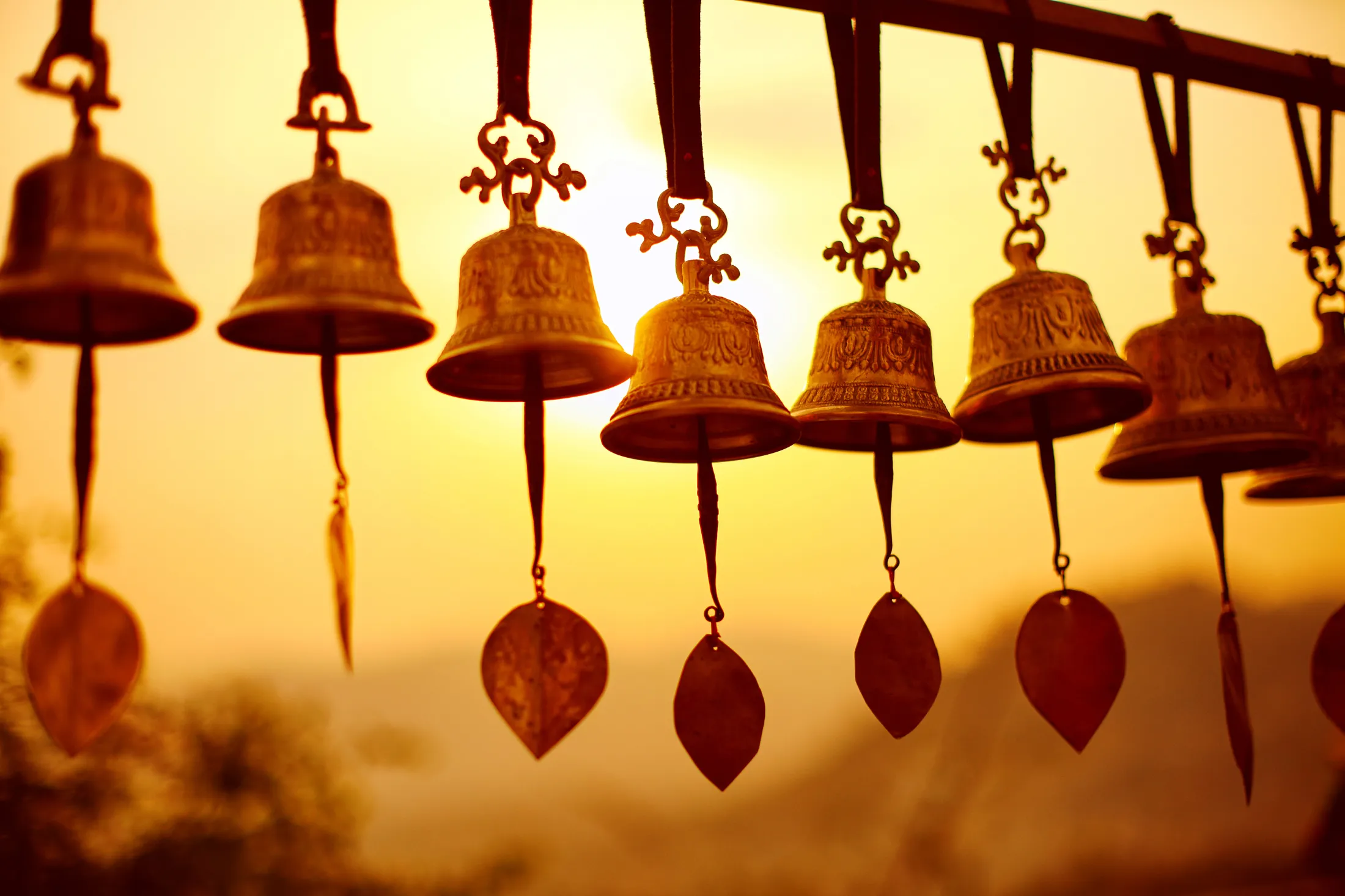
A row of ornate bronze wind bells with leaf-shaped clappers hangs from a wooden bar, beautifully backlit by a warm, golden sunset over a blurred mountainous landscape.

Day 18:Kathmandu and the return journey

After breakfast, we say goodbye to Nepal and all the new friends we have made along the way. The participants are now free to head for the airport for their return journey, or to extend their stay in this exciting country.

After breakfast, we say goodbye to Nepal and all the new friends we have made along the way. The participants are now free to head for the airport for their return journey, or to extend their stay in this exciting country.

B,-,-

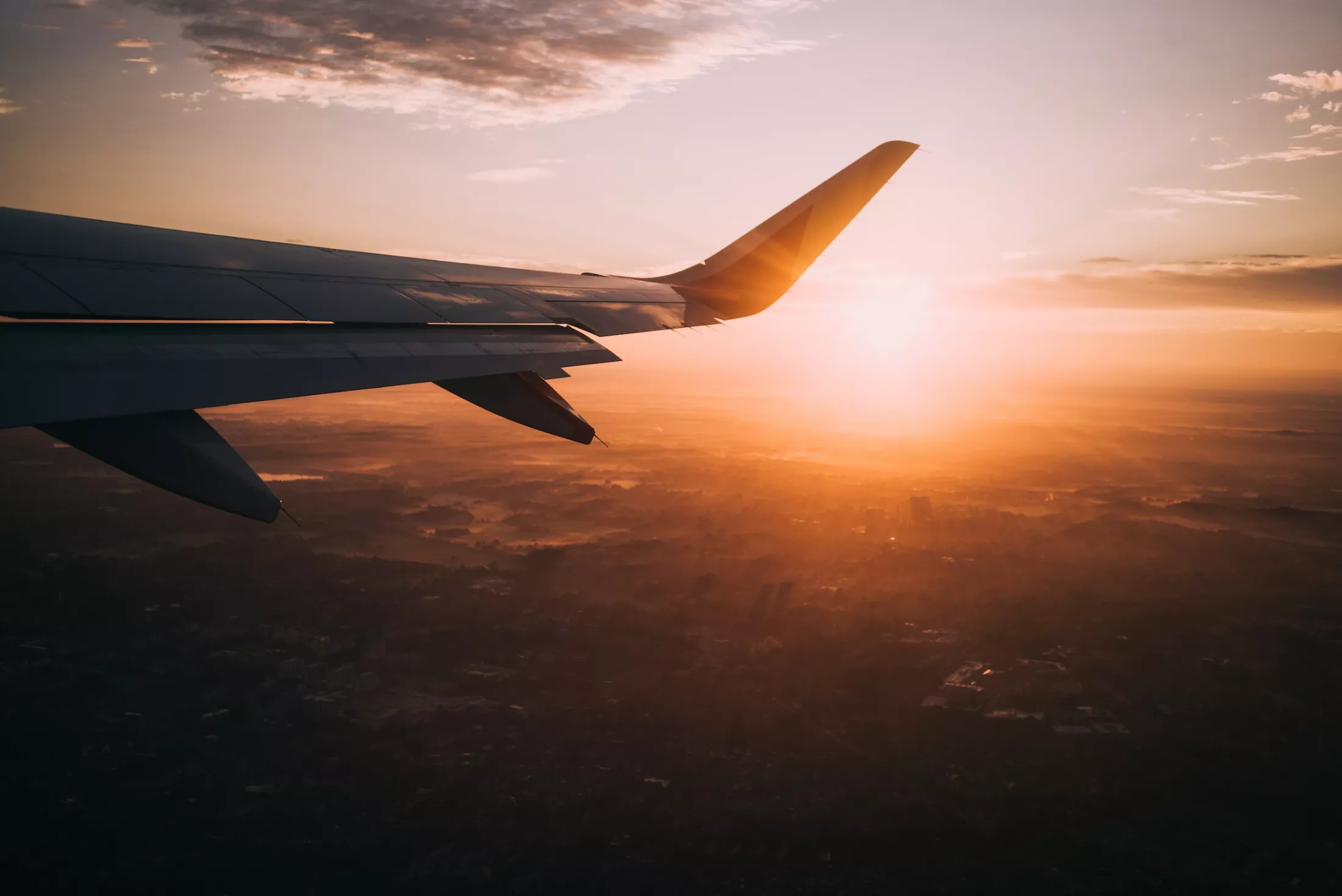
Plane wing in the sky during sunset.

Day 19:Arrival back home

For Norwegian travellers, this is the day we arrive at Oslo Lufthavn.

For Norwegian travellers, this is the day we arrive at Oslo Lufthavn.

Airfare is not included on this trip, so you are responsible for getting to and from Nepal on your own. The first day is not scheduled, so you are free to depart from your country throughout the day. Arrival in Kathmandu according to your itinerary during day 2.

-,-,-

Arrival in Kathmandu during the day. You are responsible for making your own way to the hotel, centrally located hotel in Kathmandu. Check in and take a short rest at the hotel or go for a stroll in the neighborhood before meeting up with the group and exploring Kathmandu further with our tour guide. Kathmandu is an explosion of colors, sounds, people, animals, temptations, culture, and experiences. For shopaholics, Kathmandu is also a shopping mecca. Everything you need, didn’t know you needed, or don’t need at all can be bought within walking distance of the hotel. Few places offer better value for money, few places have a more varied selection, and few places make haggling more fun! After we’ve gotten lost in the many back alleys and found our way back again, we can meet for dinner at a local restaurant.

Hotel

-,-,-

A lazy day, serious shopping, or sightseeing? It’s up to you. We’ve planned a sightseeing tour of the Boudhanath Stupa, Pashupatinath Temple, and Durbar Square with a local guide. We’ll have an early dinner at one of Kathmandu’s many restaurants, because tomorrow we’re setting off for Lukla at the crack of dawn.

Hotel

B,-,-

We leave Kathmandu early in the morning to drive to Ramechap, where a spectacular flight to Lukla (2,860 m) awaits us. The drive takes about 4–5 hours on somewhat bumpy roads, so it’s a good idea to be prepared for that. The flight takes just over half an hour, but transports us to a completely different world. Here we meet our own local Sirdar (“the local head guide”), the Sherpas, the cooks, the kitchen helpers, and the yak herders who will take care of our luggage along the way. After a bit of organizing our gear and luggage, we’re ready to go. The first stage is an easy walk into Phakding. The terrain is lush with a mix of conifers (and in the spring, vibrant flowers). We’re led back and forth across suspension bridges, up and down the terrain. Today’s destination, the village of Phakding, is actually 200 meters lower than Lukla. We are still at a relatively high altitude, so we walk at a leisurely pace and spend the day relaxing. We’re served lunch along the way and arrive at the lodge in the afternoon. This makes for a hike of about 4–5 hours, including lunch. If we have time, we’ll visit the old monastery in Phakding before spending our first night of the trip in a sleeping bag.
Guesthouse

B,L,D

5-6 hours

5-6 hours

-200m

After a leisurely start with a nutritious breakfast, we begin our hike. Along the way, we pass through small villages and cross the Dudhi Kosi River on even more spectacular suspension bridges, before arriving at the entrance to Sagarmatha National Park (Sagarmatha is the Nepali name for Mt. Everest) after a couple of hours. Here, we must check in at the national park before heading down to the river again and crossing more suspension bridges. Then the actual ascent toward Namche Bazaar begins. Here, a leisurely pace is key as we climb 700 meters in elevation. We walk at a relaxed pace, stopping countless times to take photos, drink, or simply enjoy the surroundings. Along the way on today’s stage, we catch our first glimpse of Mt. Everest through the treetops. Today’s destination, Namche Bazaar, is the capital of the Sherpas and the hub of the Khumbu Valley. This small town of 400 inhabitants clings to the mountainside with its colorful houses. Merchants from Tibet arrive here with goods after a 9-day trek with their yaks.

Guesthouse

B,L,D

7-8 hours

+1000m

Today is an acclimatization day. But we won’t be lying still in our sleeping bags all day. To get the most out of the acclimatization, we’ll head higher up and then return to Namche Bazaar in the morning. After a hearty breakfast, we’ll begin today’s hike. Our destination is the Everest View Hotel (3,880 m), a one-and-a-half-hour hike. From the hotel, you’ll have a fantastic view of the Himalayas and get to see Ama Dablam for the first time—the mountain said to be the most beautiful in the world. If the weather is nice, we’ll take time for a cup of tea on the terrace before continuing back to Namche. If we have time, we’ll also stop by the Sherpa Museum. It’s interesting and educational, and gives us a good insight into Sherpa culture and daily life. Back in Namche Bazaar, we’ll have time to relax a bit before evening. The town has many shops, internet cafes, and bakeries (with delicious apple pie!). At dinner, we’ll gather to review today’s events and prepare for tomorrow’s stage.

Guesthouse

B,L,D

4-5 hours

440m/440m

4 km

We’ll be walking on beautiful trails between Namche and Phortse Tenga. The trail is well-maintained, but this is done through private initiative and is not funded by the government. Therefore, there is an opportunity to donate a small amount to the people who keep this trail in good condition for tourists, porters, and animals. Throughout the day, we’ll enjoy spectacular views of Ama Dablam, Mount Everest, Thamserku, and many other mountains. Just remember to look up!

Guesthouse

B,LD

5-6 hours

5,7 km

Now we’re really on our way, and we can feel the mountains calling us. In the morning, we’re woken up with tea or coffee served right at the edge of our sleeping bags, giving us a peaceful start before breakfast. Then we’re ready for today’s stage. We’re heading on to Dole, and the trail climbs steeply in places. On the way up, we enjoy the beautiful surroundings, passing stupas and eat dinner together and discuss the day’s experiences.

Guesthouse

B,L,D

2-3 hours

+520m

4 km

We start off with a steep climb today on a scenic trail, going up and up past juniper thickets, but with no trees in sight. We’re above the tree line, after all. The views keep getting better and better, and eventually Cho Oyu comes into view ahead of us—one of the famous 8,000-meter peaks. We arrive at camp in the afternoon and get some rest before we have dinner together in the evening.

Guesthouse

B,L,D

4-5 hours

450m/110m

5 km

Today’s hike is, on the whole, a bit less steep than the previous days. As we leave Macchermo, the trail climbs up a hill overlooking Kangtega, before we enter a slightly narrower valley and then descend toward the Dudh Koshi River. From here, there is a steep climb up to the first of the six lakes in Gokyo. Maybe we’ll spot some “Golden Ducks”? The trail is worn in many places, mainly due to yak traffic in the summer. Eventually, a wide valley opens up with Cho Oyu at the head, a massive glacier towering over us and the village of Gokyo just above Lake Number Three. In the middle of the view, you can see a rocky slope with a path leading up; that is the way to Gokyo Ri and our destination for the next morning! We spend the afternoon resting, exploring the town, and perhaps taking a stroll to one of the other lakes. Mainly, we’ll rest and recharge for the next morning’s summit hike!

Guesthouse

B,L,D

4-5 hours

470m/100m

7 km

We get up at the crack of dawn to catch the sunrise from Gokyo Ri. It’s something to look forward to. It takes us about 2.5 hours to reach the summit, and the view that awaits us is well worth the early start. We take in the mountain peaks towering all around us and the turquoise lakes below, savoring the moment. At a leisurely pace, we make our way back down to Gokyo, where we enjoy a well-deserved breakfast and spend the rest of the day relaxing.

Guesthouse

B,LD

3-4 hours

560m/560m

Today we’re heading out on a long hike with quite a bit of climbing, all the way up to the Renjo La Pass at 5,360 meters above sea level. We’ll take it easy and enjoy the scenery along the way. Even though it can be tough, it’s important to remember how lucky we are to be able to hike through this unique mountain landscape. We’ll descend through the Bhote Khosi Valley and eventually arrive at our stop for the night, Lungden, a small mountain village for hikers. We’ll be served a hearty dinner and enjoy a cozy evening.

Guesthouse

B,L,D

7-8 hours

600m/1000m

Thame is probably the village with the best Everest climbers, and it is home to several Sherpas who hold Everest records. We’ll visit Thame’s historic temple, and if we’re lucky, we might even catch a small ceremony. We’ll have the chance to learn about Sherpa culture and hear about what life is like up here at high altitude. We’ll hike for 5–6 hours, have lunch along the way, and gather for a group dinner in the evening.

Guesthouse

B,L,D

5-6 hours

-500m

10,5 km

The lower we go, the easier it feels to walk. The air feels thick as butter, and we keep turning around to soak in the last impressions of this incredible mountain world. How many pictures can you really take of mountains? Even though we’re looking forward to pizza and fresh baked goods in Namche Bazaar, it’s also a little bittersweet that the trek is coming to an end. We’ll have lunch along the way and return to the Sherpa capital in the afternoon. Here we’ll have time to wander through shops, markets, and the bakery before gathering for dinner.

Guesthouse

B,L,D

5-6 hours

-500m

10 km

We say goodbye to Namche Bazaar and set off on the final scenic leg of our trek. We catch one last glimpse of the majestic mountains through the treetops and continue back along the same route we took on the way here - across suspension bridges and through small villages. This will be our last night at the lodge, sleeping in sleeping bags. Tomorrow, Kathmandu awaits.

Guesthouse

B,L,D

7-8 hours

-540m

15 km

We’re up before the rooster crows. For flights to and from Lukla, the early morning hours offer the best flying conditions. Our luggage is packed, we’ve said goodbye to our local friends, and we’re on our way back to Kathmandu. From the quiet, peaceful mountain world to chaotic, mysterious Kathmandu. We fly back to Ramechap and drive the 4–5 hours back to Kathmandu. The rest of the day is yours to explore this exciting city on your own. It’s easy to be captivated by Kathmandu, and you should take the time to wander through the back alleys and follow the flow of people. Perhaps a foot or aromatherapy massage sounds tempting? If you enjoy shopping for affordable and fun items, Kathmandu is a paradise! Hotel life slowly but surely brings us back to our usual routines. A shower, a comfortable bed, TV, shops, and other everyday comforts initially feel like a luxury.

Hotel

B,-,-

4-5 hours

Explore Kathmandu on your own, go shopping, sightseeing, or relax at the hotel. One thing is certain - you’ll never get bored in this lively city! We’ll have a group farewell dinner in the evening.

B,-,D

After breakfast, we say goodbye to Nepal and all the new friends we have made along the way. The participants are now free to head for the airport for their return journey, or to extend their stay in this exciting country.

B,-,-

For Norwegian travellers, this is the day we arrive at Oslo Lufthavn.

What's included in the price

Included

Round-trip Oslo–Kathmandu and round-trip Ramechap–Lukla.

Norwegian-speaking guide for group departures from Oslo.

English-speaking local Sirdar, local guides, cooks, crew, and yaks.

All transportation as specified in the program.

Shared double room. Accommodation at a budget hotel in Kathmandu, and at tea houses/lodges during the trek. Accommodation at an airport hotel in Istanbul on the return trip.

Meals as specified in the program.

Not included

For trips where flights are not included, please check our website to confirm that the departure is guaranteed before booking your own plane tickets. For each trip, we require a minimum number of confirmed participants before the departure can be guaranteed. 


To local guides and assistants. Tips are a common and expected part of being a tourist in many of the destinations we visit. These are given in cash during the trip and therefore cannot be included in the tour price.

Available upon request, limited quantities. Only available with a single room in Kathmandu. 

Drinks and snacks in the mountains are not included in the price. We recommend bringing approximately 45 000 - 50 000 NPR for this purpose. Expenditures vary by individual and depend on how many soft drinks and snacks you wish to purchase in addition to water.

Request quotes from other cities in Norway.

Terms and Conditions

We reserve the right to change prices. The day by day program is indicative and changes may occur. We also refer to our general travel conditions.

Travel Insurance

On all our trips, we require you to have full health and accident insurance which will also cover any transport home. Read more about travel insurance.

Highlights

Reviews

Rated
-
- reviews
(-)
(-)
(-)
(-)
(-)

Safety & Grading

Read more

For departures with Norrøna Adventure guides:

  • 24-hour emergency response
  • Guides trained in first aid in the field
  • Basic first aid equipment available
  • Cooperation with Turlegen.no for medical advice

On this trip, it is important to understand that we will be traveling far off the beaten track. We will of course do everything we can to assist if anything should happen, but any rescue operation could take longer than on other trips we organize. It is therefore extremely important that all participants are well prepared and ready to deal with unforeseen situations.

Physical level

4/6 Physical

Here you have to be ready for a real challenge! The trips are often longer than at lower levels. Along the way, it will be both physically and mentally demanding, and that requires you to be prepared for this. You should engage in targeted training well in advance of departure, and you must prepare well.

Comfort level

3/6 Comfort

Simple accommodations, such as cabins or guesthouses, often with multi-bed rooms. Sometimes with bunk beds and often with a shared bathroom.

Risk level

4/6 Risk

Activities/trips with significant risk. Incidents may occur, and they can be of such a nature that they require professional help.

Training and Preparations

You should be experienced in hiking and in generally good physical condition to participate. You do not need to have any experience with high-altitude hiking, but we recommend that you put in a good amount of training before the trip.

You really feel the altitude, and everything feels heavier than on mountain hikes here in Norway. That is why it is important to be in good physical shape.

We only carry daypacks on the daily stages; the rest of the luggage is transported by Jopkyo (a cross between a yak and a Himalayan cow). Jopkyo thrive better in the lowlands than yaks, and are therefore the preferred choice on these treks.

We cross several exposed suspension bridges along the way, so those with a severe fear of heights may feel a bit of it on these bridges, but we take it at a leisurely pace.

We also recommend that you read a bit about the country and the trip you’re going on before departure. This makes the experience more complete. Nomaden in Oslo has a very good selection of travel literature. Norrøna Adventure supports the Norway-Nepal Association. The association’s purpose is to promote cooperation and understanding between the Norwegian and Nepalese people by working to foster cultural exchange between Norway and Nepal, to spread knowledge of Nepal’s culture and traditions, and to serve as a forum for people interested in Nepal. The association has published an information booklet with useful information for those traveling to Nepal.

There are several relatively strenuous daily stages, and on some days there may be a long gap between breakfast and lunch. Therefore, be sure to bring some hiking snacks with you along the way. Due to the weight limit on the flight to Lukla, we recommend buying snacks along the way during the trip.

Many people wonder what it takes to go on a trip with Norrøna Adventure to high mountains. Here's an introduction to hiking at altitude - what to expect and how to prepare with the right clothing, equipment and training.

Visas, Vaccinations and Health

Before embarking on our journey together, we kindly remind all tour participants to check their respective country's visa status and vaccination requirements. Ensuring your travel documents are in order is a crucial step in guaranteeing a smooth and hassle-free adventure.

Norwegian citizens need a valid passport that remains valid for at least 6 months after their return date, as well as a visa. See also current entry and visa regulations at the Ministry of Foreign Affairs’ country pages.

We will send out information about visas with a link to the application form a few weeks before departure. There is no point in applying for a visa to Nepal before this, as the application is only valid for 15 days. Norwegians purchase visas online before departure; as of today, it costs 50 USD.

You need 2 passport photos for the trekking permit, and you must bring the photos with you from home.

If you are over 67, you should have a thorough medical check-up before your trip. Make your doctor aware that this is a trip involving physical exertion and moving off the beaten track.

It is important that you complete all parts of the registration form (especially where we ask for information about health and allergies), and let us know if there is anything we need to be aware of prior to and during the tour. Relevant health information that may affect the tour should also be communicated to the guide at the start of the tour. *Note* - If you are on regular medication, have known allergies or anything similar, you must always bring your personal medication with you.

See the overview on FHI´s pages on travel health advice. For vaccination and guidance, please contact Sentrum Reisemedisin: Reisemedisin.no.

Additional Information

For trips where flights are not included, please check our website to confirm that the departure is guaranteed before booking your own plane tickets. For each trip, we require a minimum number of confirmed participants before the departure can be guaranteed.

In Kathmandu, we stay in twin rooms at a charming hotel. During the mountain trek, we stay in twin rooms at local tea houses.

Spring and fall are the best times of year to travel to Nepal. In the spring, the valleys are in bloom, there is little rainfall at higher elevations, and the weather is clear. Evening and nighttime temperatures can be slightly warmer than in the fall.

In the fall, the weather in the Khumbu region is usually clear, with little rainfall and dry conditions. It is the season for climbing mountains such as Island Peak, Cho Oyu, and Ama Dablam. There are few people on the Nepal side of Everest attempting to climb the mountain, as most climbers ascend from Tibet in the fall.

It is not always easy to get hold of gluten-free wholemeal bread, lactose-free alternatives or to accommodate other food preferences. If you have any allergies, please let us know in the registration form and we will try to accommodate you as best we can. However, we would still recommend that anyone with special dietary needs bring some alternatives in the form of, for example, a packet of crispbread, energy bars or similar that you know you can eat.

Please note that domestic airlines in Nepal do not meet the EU’s requirements for airlines permitted to land in the EU.

Related content

Prayer flags

Which Nepal Trip is Right for You?

Here, we explain a little about what you can experience in terms of mountains, nature, and culture on the various trips.

Read more

Equipment list

This list is intended as a guideline, so that we have what we need regardless of the weather we get on the trip. Remember that you can also get used outdoor equipment that works perfectly. Get in touch if you have any questions. TIP: We recommend that you have the most important equipment in your hand luggage, for example hiking boots and gore-tex jacket/trousers.

Obligatory

Clothing

2 sets of top and bottom. Not too thick, instead use multiple layers.

Wool, 2-3 paris.

2-3 pairs. Wool or synthetic material.

We recommend thin wool.

Fleece or wool. 

Down or synthetic insulation, featuring a hood and ideally long enough to cover the butt.

Gore-Tex or similar. Must have a decent hood, and hold out wind and rain. Should have space for midlayers underneath. Ventilation under the arms is recommended. 

Gore-Tex or similar. Must hold out wind and rain. Ventilation zippers along the legs is recommended.

Warm hat for cold days.

Thick, wool.

Warm mittens/gloves.

Footwear

Solid hiking boots with extra room for warm socks.  

Solid, with a solid sole. Such as approaches shoes.

Equipment

Avoid bringing a suitcase, they are more difficult to transport between hotels.

Needs to have space for everything you want to bring on the hikes.

Comfort temperature rating of at least -20°C. Both down and synthetic are fine, remember to pack it in a waterproof bag. A liner can increase the comfort temperature.

Light. Have to be foldable or telescope.

Remember new/extra batteries.

A solid pair, with dark glass. 

Personal medicines and, for example, band-aids, blister plaster, sports tape, throat lozenges, nasal drops, Paracetamol/Ibuprofen, stomach regulators, etc.
We need to know about all medicines you are taking, in case something happens. 

Tooth brush, tooth paste, small towel, ear plugs, wet wipes, biodegradable soap, etc.

High SPF, 30-50. Remember chapstick for lips and nose. 

Toilet paper, antibac, and waste bags for the paper. Remember leave no trace.

2-3 litre bottles, with an insulation cover, so they dont freeze. For example Nalgene bottles with wide mouth. They can handle hot water, so you can use them to keep warm in the sleeping bag.

Passport, tickets, bank card, proof of vaccination andproof of insurance. Remember to have a copy of important documents on your phone and/or somewhere in your bag. 

Recommended

Clothing

In case of a short rain shower.

Footwear
Equipment

To increase the comfort temperature in your sleeping bag.

As light at possible. 

Make a comfortable pillow using clothes and a pillowcase – or bring an inflatable one.

Packing Tips

In the spring and fall, the weather is usually clear, with little precipitation and dry conditions. At the start of the trip, temperatures are generally pleasant and suitable for shorts, but the higher we go, the colder it gets. It is often cold in the evenings inside the tea houses, so we recommend a good, warm sleeping bag. You get cold faster at high altitudes, and poor sleep leads to poor acclimatization. That’s why it’s important to do what you can to stay comfortable at night.

It is not a requirement that the sleeping bag be rated for -20°C, but we recommend a winter sleeping bag. It gets cold at night at high altitudes, and it is not warm inside the tea houses up in the mountains. You get cold faster at high altitudes, which leads to poor sleep, and good sleep is important for acclimatization. That said, some people choose a slightly cooler sleeping bag, using a sheet bag as an extra layer. Alternatively, you can wear your down jacket at night as well. It’s also very individual how easily and how much you feel the cold, and women generally feel the cold faster than men.

We sleep on mattresses in beds at the teahouses, but these vary in quality, so many people prefer to use their own sleeping pad for extra comfort.

Swimwear can be handy since there is sometimes a pool at the hotel we stay at in Kathmandu; this can vary from trip to trip, but it’s good to bring along to Kathmandu.

Recommended trips

Testimonial

This quickly became an amazing trip. The difficulty level was as expected based on the description. The Norrøna Adventure guide was very good, as were the local guides. The surroundings were completely, truly unique. The group on the trip felt just like a big group of friends!

– Astrid, 2024