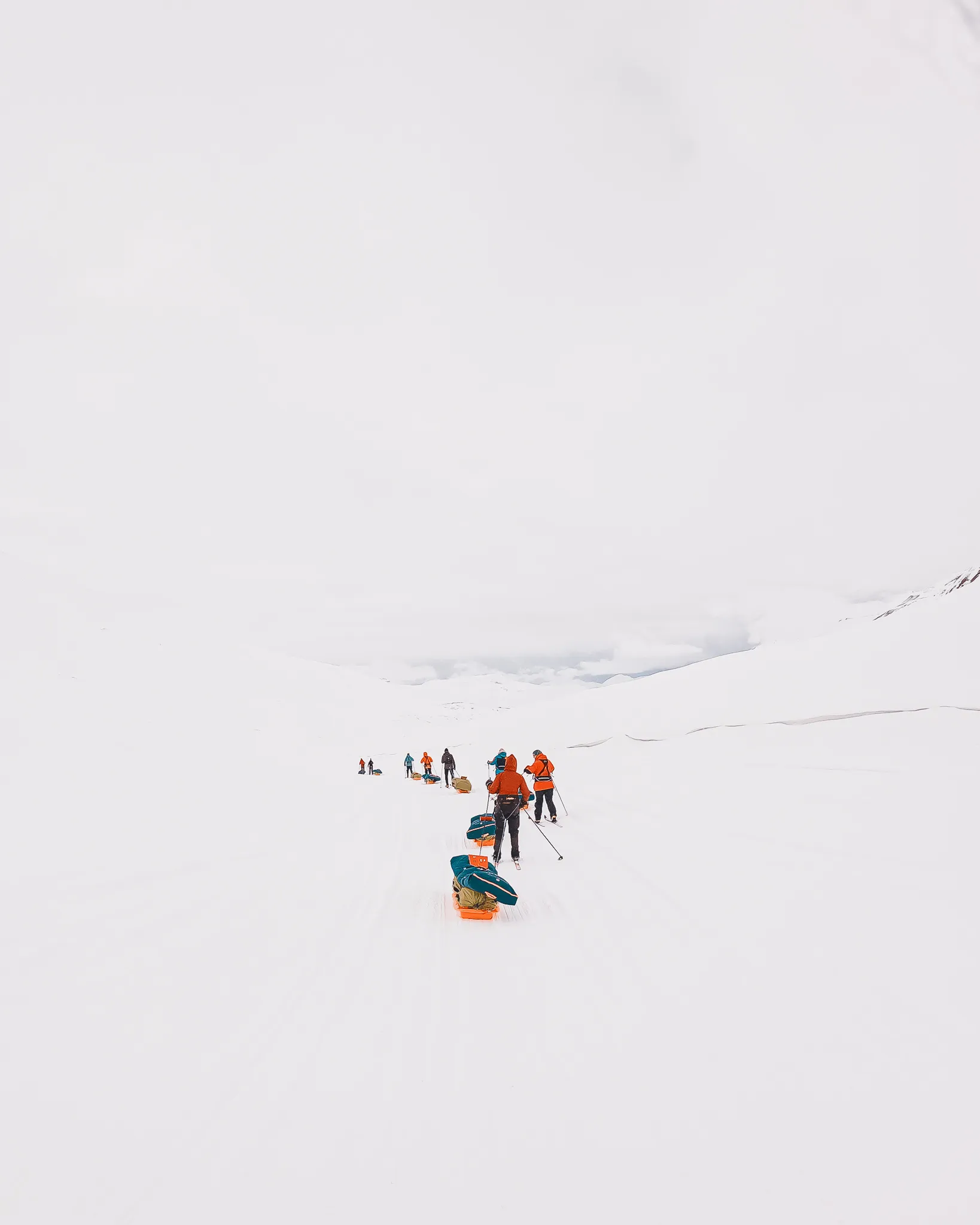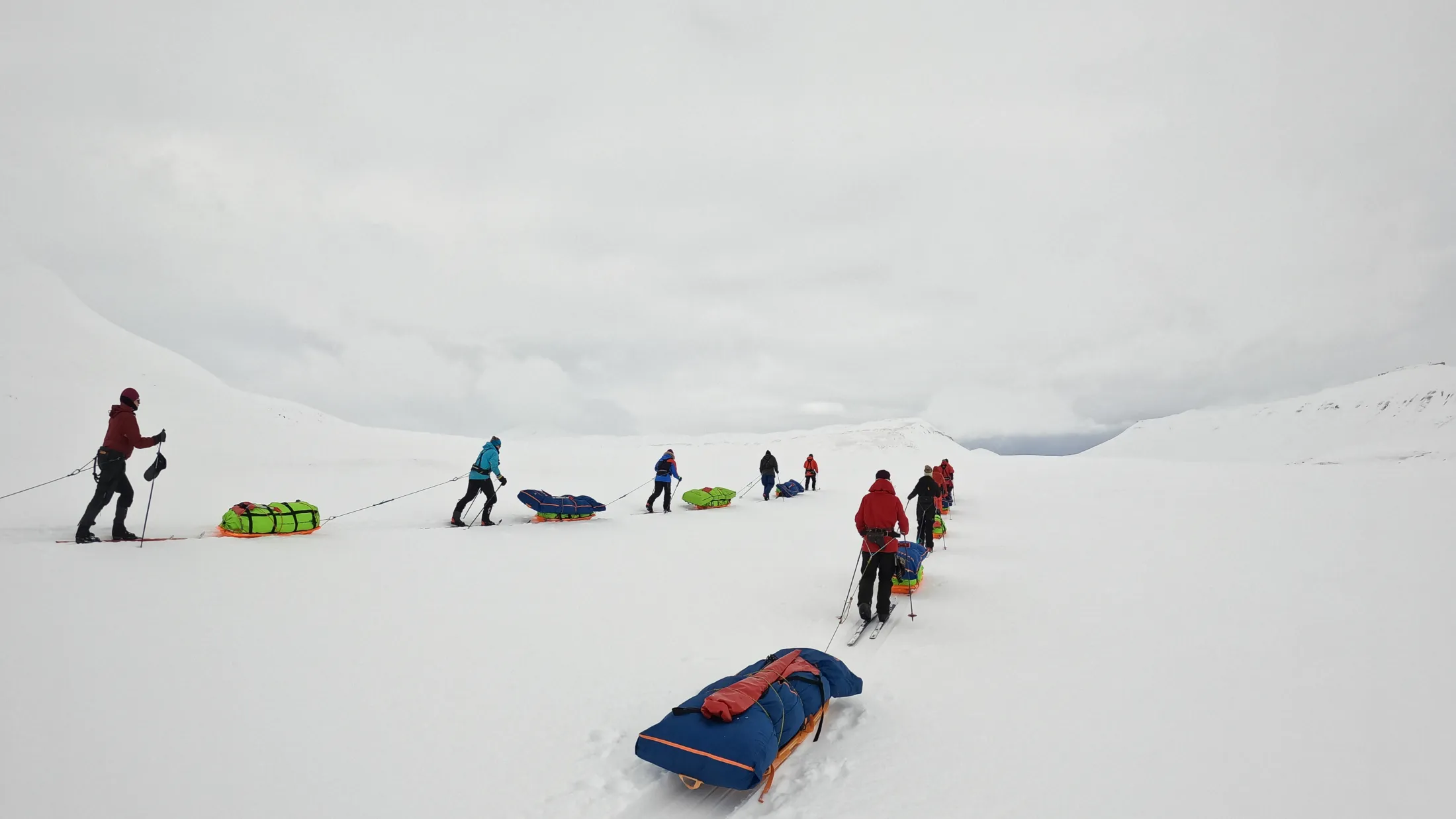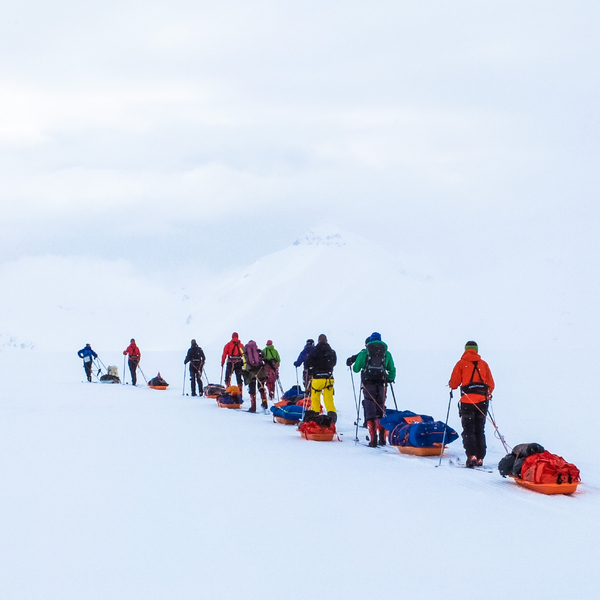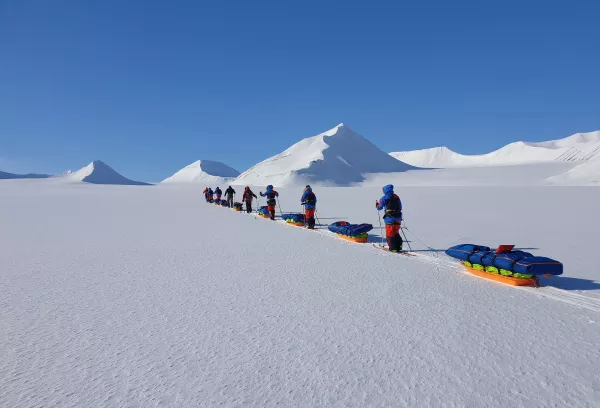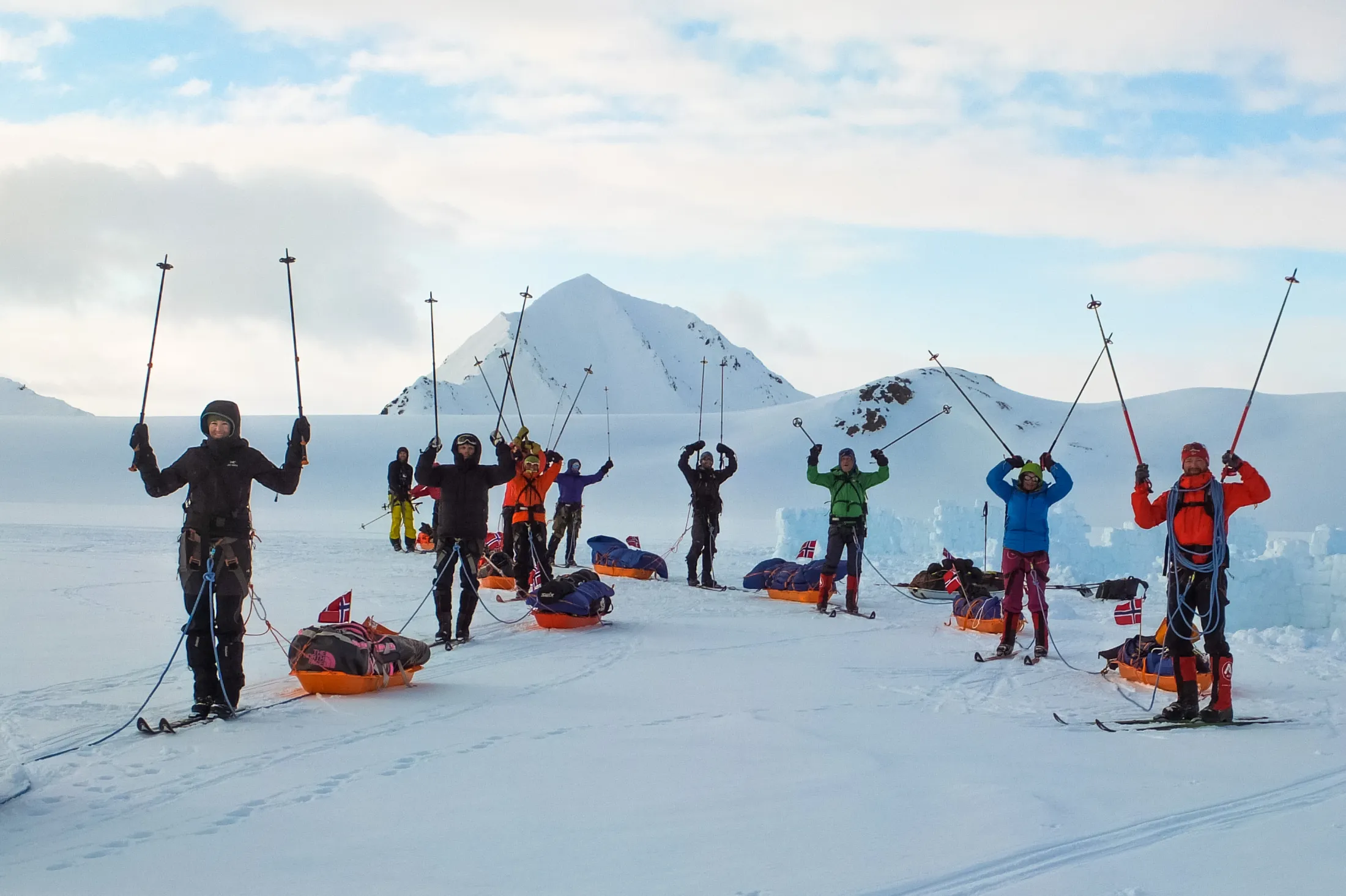
People with mountain skis and sleds at Svalbard standing there with their hands in the air.
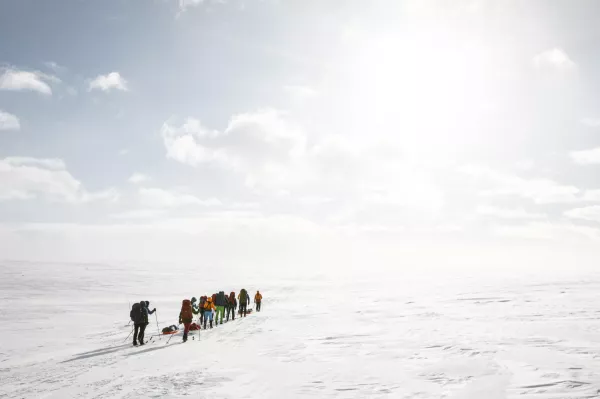
A row of people on skis with sleds on glacier.
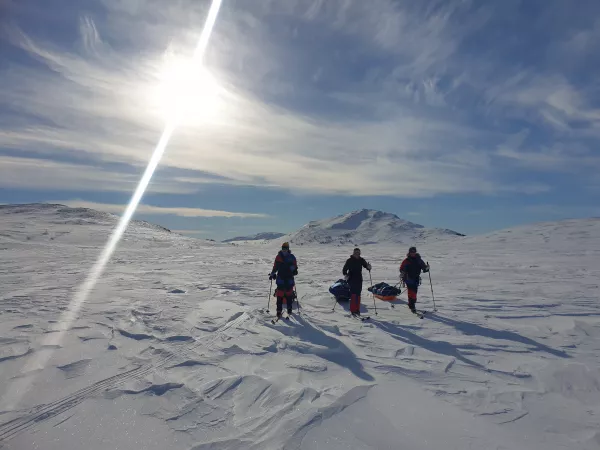
Person on mountian skis with sled in the mountains.

Crossing Svalbard East to West

Agardhbukta to Grønfjorden

Crossing Svalbard East to West

Agardhbukta to Grønfjorden

From USD 5323

For many, crossing Spitsbergen will be the ultimate way to experience the magnificent nature of Svalbard and a great introduction to expedition life in the Arctic. With ice-covered fjords, snow-covered mountains and exciting wildlife, this is a fantastic expedition that simply has to be experienced!

Highlights

  • Cross Svalbard on skis from east to west
  • A whole week out on expedition
  • Skiing expedition in the arctic
  • Polar bear watch in the midnight sun

Together we will cross Svalbard with skis and sleds. We will sleep two and two together in spacious tents, and cook food for ourselves. If necessary, we will each sit on a polar bear watch at night. This is typically one or two hours every second night per person, and does not significantly affect the individual's night's sleep. After a week on expedition, we will arrive in Grønfjorden where a boat will take us back to Longyearbyen for a shower and a nice final dinner together.

10

6-14

NO/EN

4/6

1/6

3/6

Dates and booking

Wed 14. April - Fri 23. April 2027

USD 5323

Flight not included

Available

Book

Wed 28. April - Fri 07. May 2027

USD 5323

Flight not included

Available

Book

Can't find a date? We'll notify you when new trips open!

Plan it your way

Want this trip just for your group? Or got something different in mind? We've got you.

Make this a private trip

Opening hours Phone
Mon-Fri : 08-20
Sat-Sun : 14-17
Opening hours Chat
Mon-Fri : 07-23
Sat : 10-18
Sun : 13-21
CET

Day by day

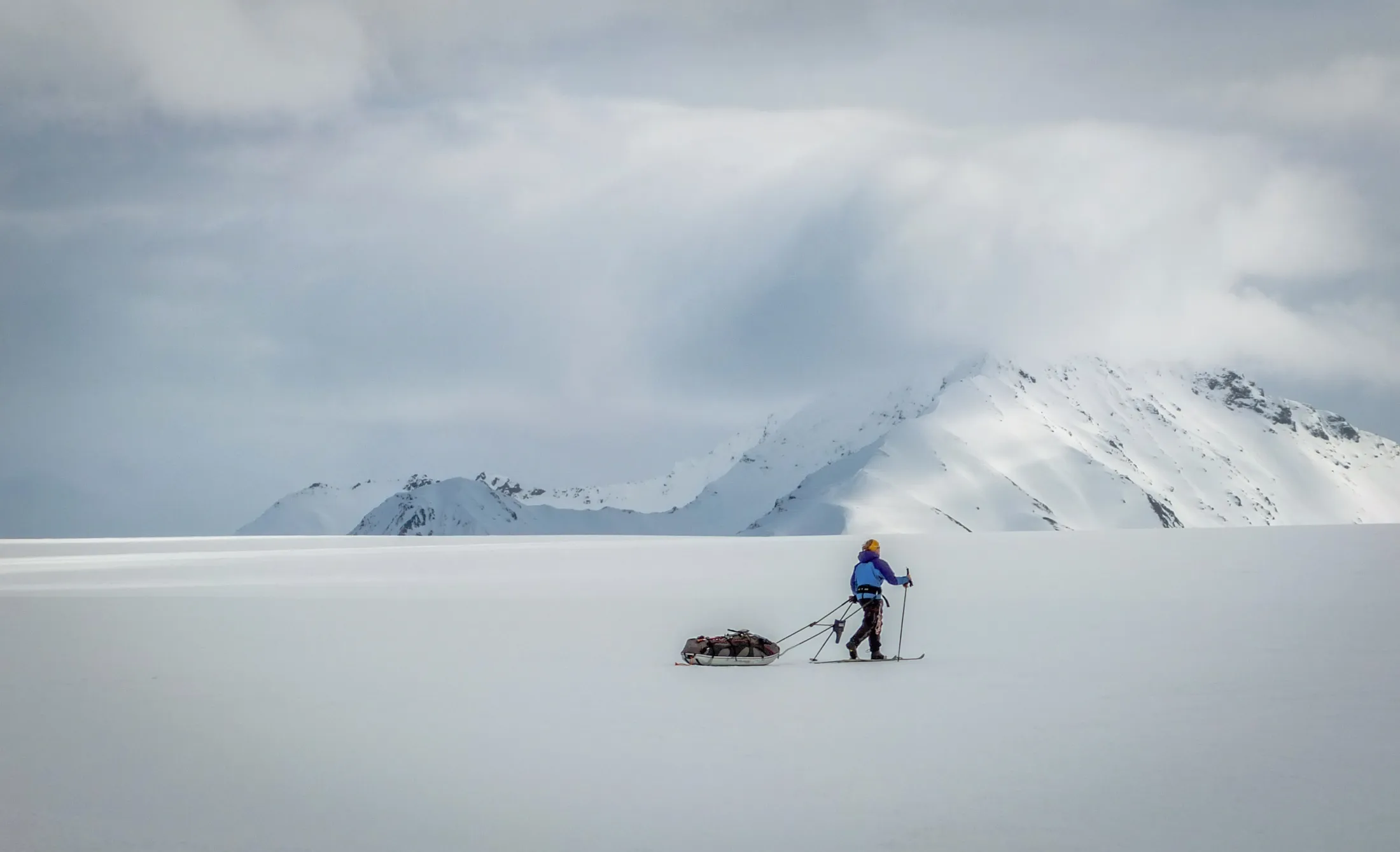
A solitary skier in a blue jacket pulls a heavy sled across a pristine snowfield with jagged mountains under an overcast sky.

Day 1:Arrive Longyearbyen

At 15:00 we meet at Mary-Ann's Polarrigg for an information meeting. We then head to our nearby warehouse to pack up equipment and go over the final details before the evening ends. Bring all your equipment to the meeting place. You can leave personal belongings behind, but try and limit how much extra gear you bring with you on expedition. There will be an opportunity to take a trip to the city's sports shops for last minute purchases. If you want to take a map with you on the expedition, we recommend buying one at the Svalbard Museum next to the University, or in the town's grocery store. Packing may take a few hours, so bring some food and drink with you. NOTE: Dinner and accommodation are not included, and are arranged on an individual basis. Arrival dates in 2027 will be April 14 (departure 1) and April 28 (departure 2).
At 15:00 we meet at Mary-Ann's Polarrigg for an information meeting. We then head to our nearby warehouse to pack up equipment and go over the final details before the evening ends. Bring all your equipment to the meeting place. You can leave personal belongings behind, but try and limit how much extra gear you bring with you on expedition. There will be an opportunity to take a trip to the city's sports shops for last minute purchases. If you want to take a map with you on the expedition, we recommend buying one at the Svalbard Museum next to the University, or in the town's grocery store. Packing may take a few hours, so bring some food and drink with you. NOTE: Dinner and accommodation are not included, and are arranged on an individual basis. Arrival dates in 2027 will be April 14 (departure 1) and April 28 (departure 2).
Not included

-,-,-

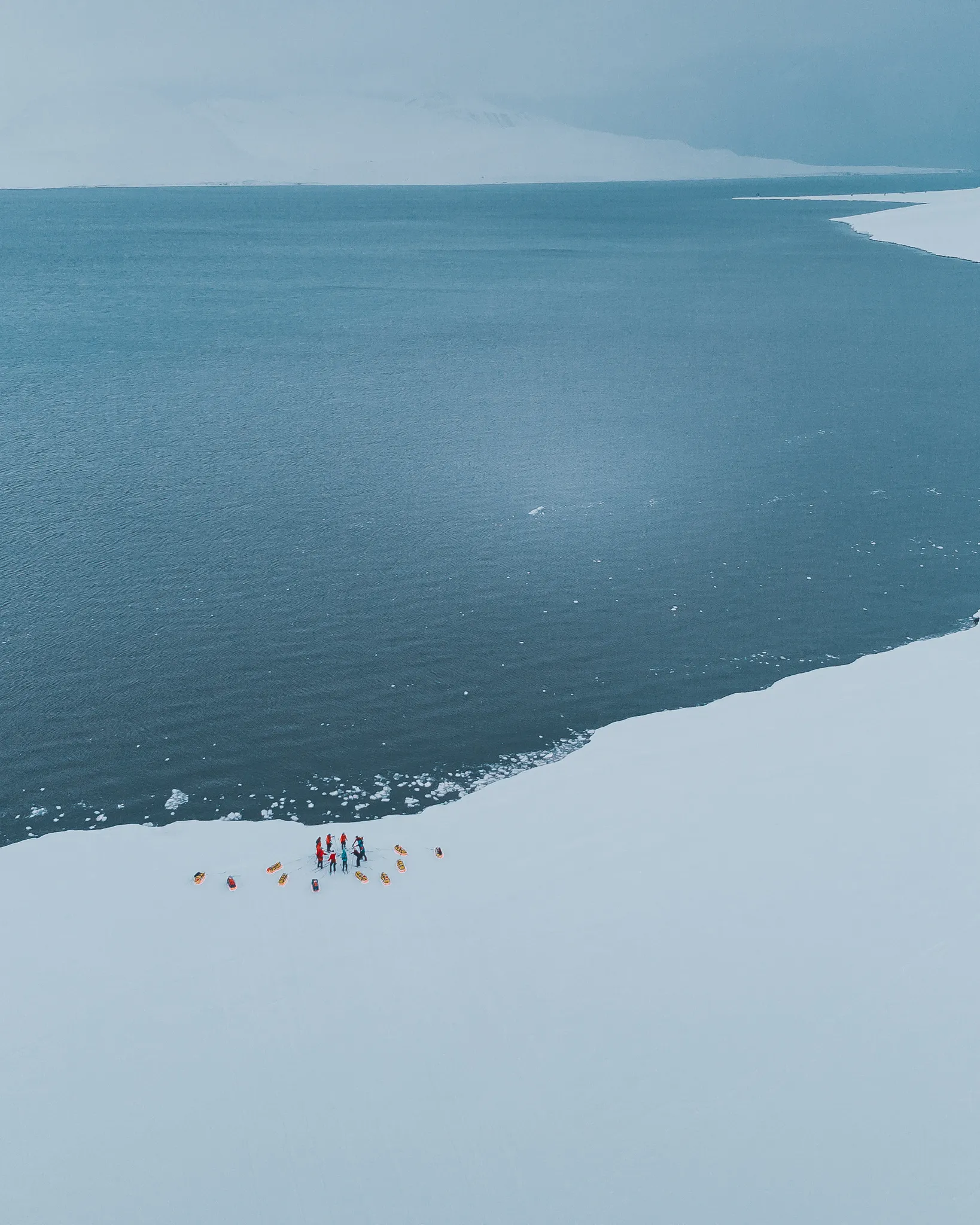
An aerial view of a small expedition group standing in a circle with their sleds at the edge of a snowy shore by the cold, open sea.

Day 2:Departure from Longyearbyen

We will meet at the agreed place in Longyearbyen for a final briefing. After that, we will drive towards the East Coast by a tracked vehicle or snowmobile. The transport takes a few hours but it will be the last hours of sitting still for the week, so enjoy it! Out at Agardhbukta, we will prepare the equipment. If the weather allows we will start skiing on the same day or we will set up camp for the day. In that case, it will be an evening where we establish camp routines and look out for polar bears. We set up daily stages of between 15 and 25 kilometers and set up camp every evening. Most of the day is spent skiing, but we have a leisurely pace and take timed breaks along the way. We will plan the route with the weather in mind and take the path of least resistance - we want to get the best out of the expedition and the route can be adjusted along the way. Upon arrival at the campsite, everyone helps to set up tents, dig cold pits, and build living walls if necessary.

We will meet at the agreed place in Longyearbyen for a final briefing. After that, we will drive towards the East Coast by a tracked vehicle or snowmobile. The transport takes a few hours but it will be the last hours of sitting still for the week, so enjoy it! Out at Agardhbukta, we will prepare the equipment. If the weather allows we will start skiing on the same day or we will set up camp for the day. In that case, it will be an evening where we establish camp routines and look out for polar bears. We set up daily stages of between 15 and 25 kilometers and set up camp every evening. Most of the day is spent skiing, but we have a leisurely pace and take timed breaks along the way. We will plan the route with the weather in mind and take the path of least resistance - we want to get the best out of the expedition and the route can be adjusted along the way. Upon arrival at the campsite, everyone helps to set up tents, dig cold pits, and build living walls if necessary.

Tent

-,L,D

3 hours

1-10 km

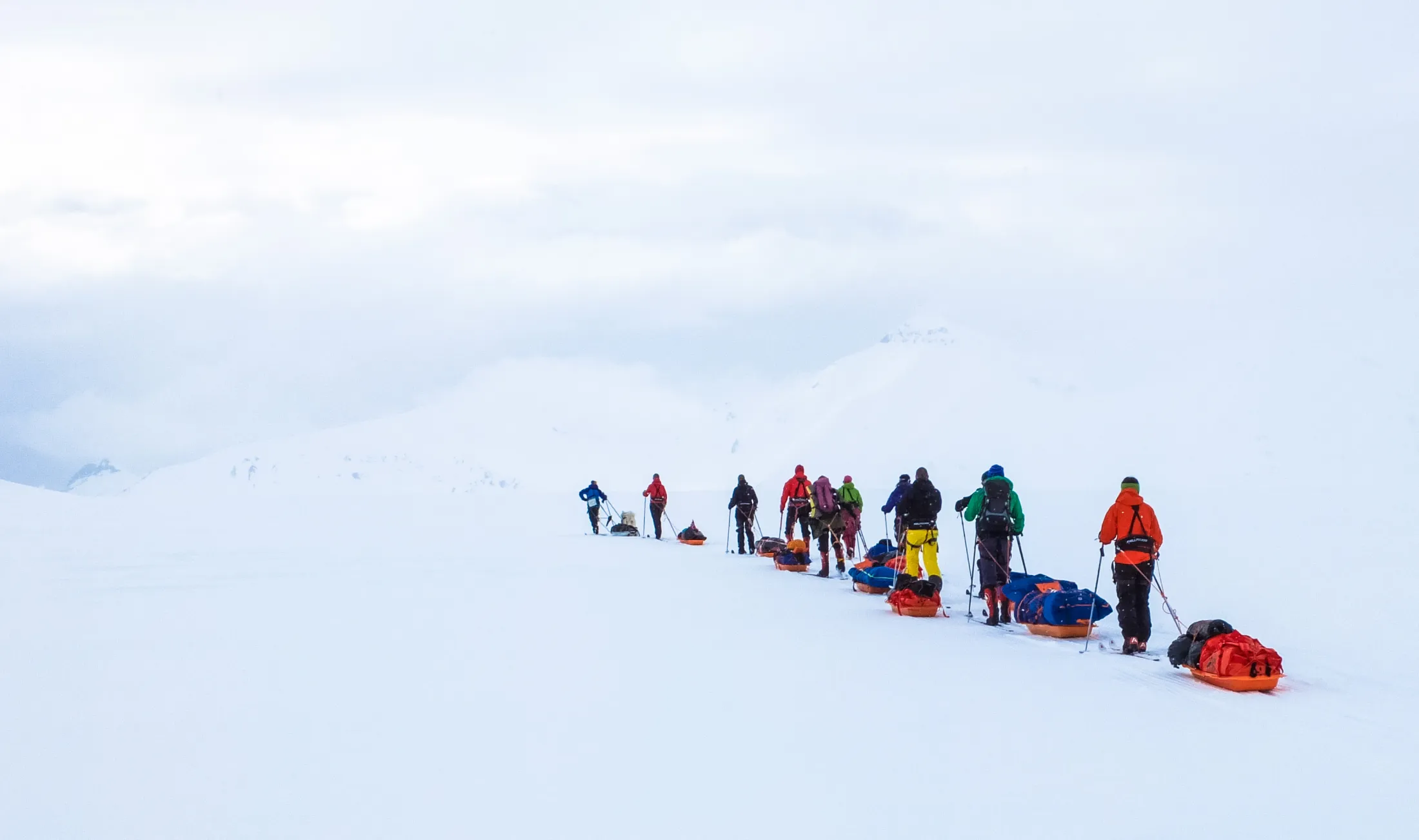
A group of skiers towing sleds advances in a line across a vast, snow-covered landscape under cloudy skies.

Day 3:Up the first glacier

We start the day with coffee after an exciting first night out, where you may have been a polar bear guard for the first time. This is the day we aim to climb the first glacier of the expedition. The glacier has a "gentle" climb, so it's a soft start to the expedition, but we still have to watch out for dangerous cracks. Along the way, we eat the daily expedition lunch, we adjust the pace according to the group, and we use the time we need for reconnaissance and surveys of the terrain. The goal for the day is to set up camp in Lundstrømdalen.

We start the day with coffee after an exciting first night out, where you may have been a polar bear guard for the first time. This is the day we aim to climb the first glacier of the expedition. The glacier has a "gentle" climb, so it's a soft start to the expedition, but we still have to watch out for dangerous cracks. Along the way, we eat the daily expedition lunch, we adjust the pace according to the group, and we use the time we need for reconnaissance and surveys of the terrain. The goal for the day is to set up camp in Lundstrømdalen.

Tent

B,L,D

15-25 km

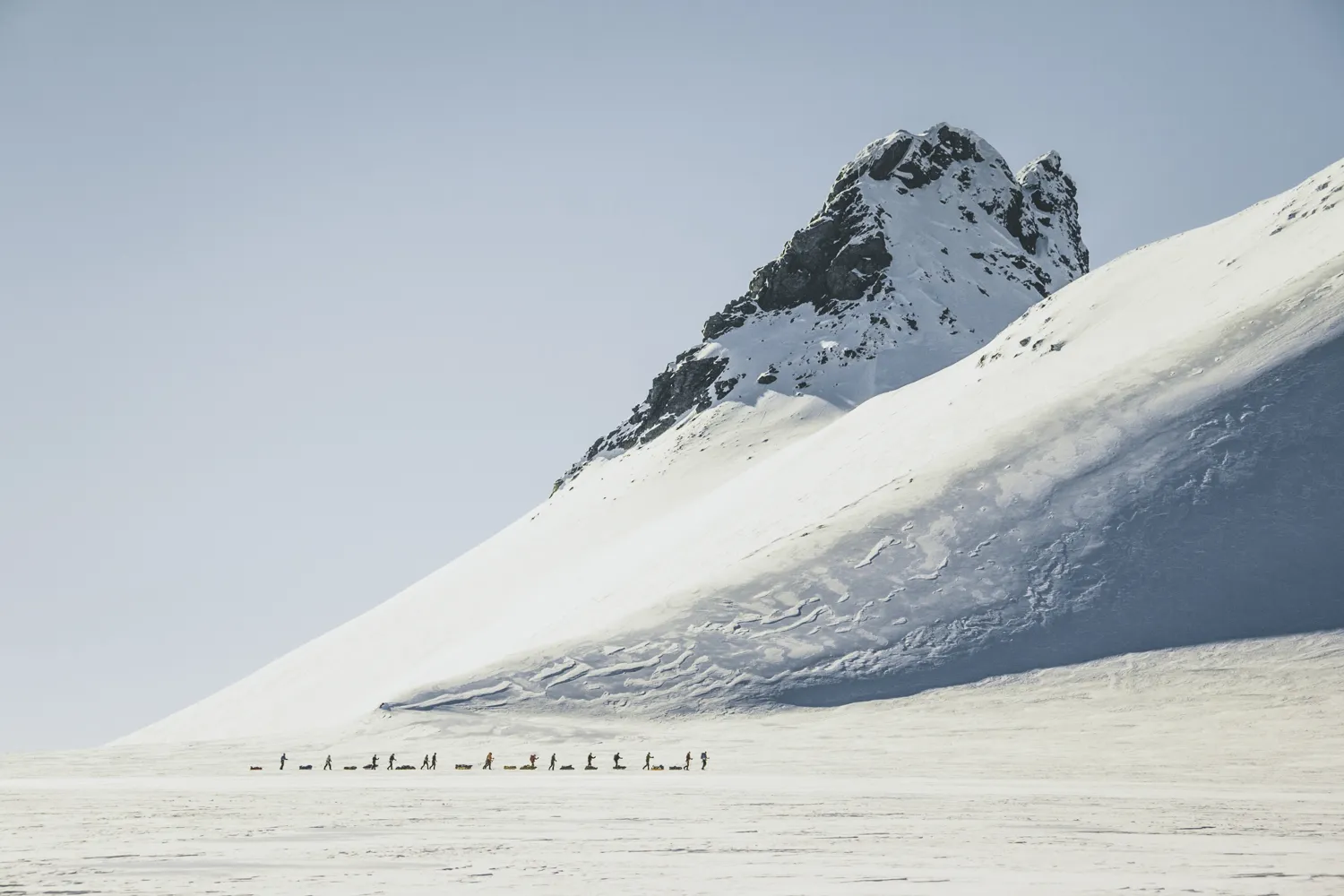
A group of people pulling sleds across a vast, snow-covered Arctic landscape beneath a steep snow mountain peak.

Day 4:Navigating Reindeer Valley- Reindalen

The days vary on a long ski expedition, covering long distances at a slow pace, allowing you to take in all the scenery. Maybe we go 25 kilometers one day, or maybe the snow is heavier and we settle for 20. As we go we continue further into Reindalen (the reindeer valley), we really get to experience one of the classic, long and wide valleys on Svalbard. Like yesterday, we will be walking all day in an area that is prohibited for scooter traffic, so here we can walk in peace.

The days vary on a long ski expedition, covering long distances at a slow pace, allowing you to take in all the scenery. Maybe we go 25 kilometers one day, or maybe the snow is heavier and we settle for 20. As we go we continue further into Reindalen (the reindeer valley), we really get to experience one of the classic, long and wide valleys on Svalbard. Like yesterday, we will be walking all day in an area that is prohibited for scooter traffic, so here we can walk in peace.

Tent

B,L,D

15-25 km

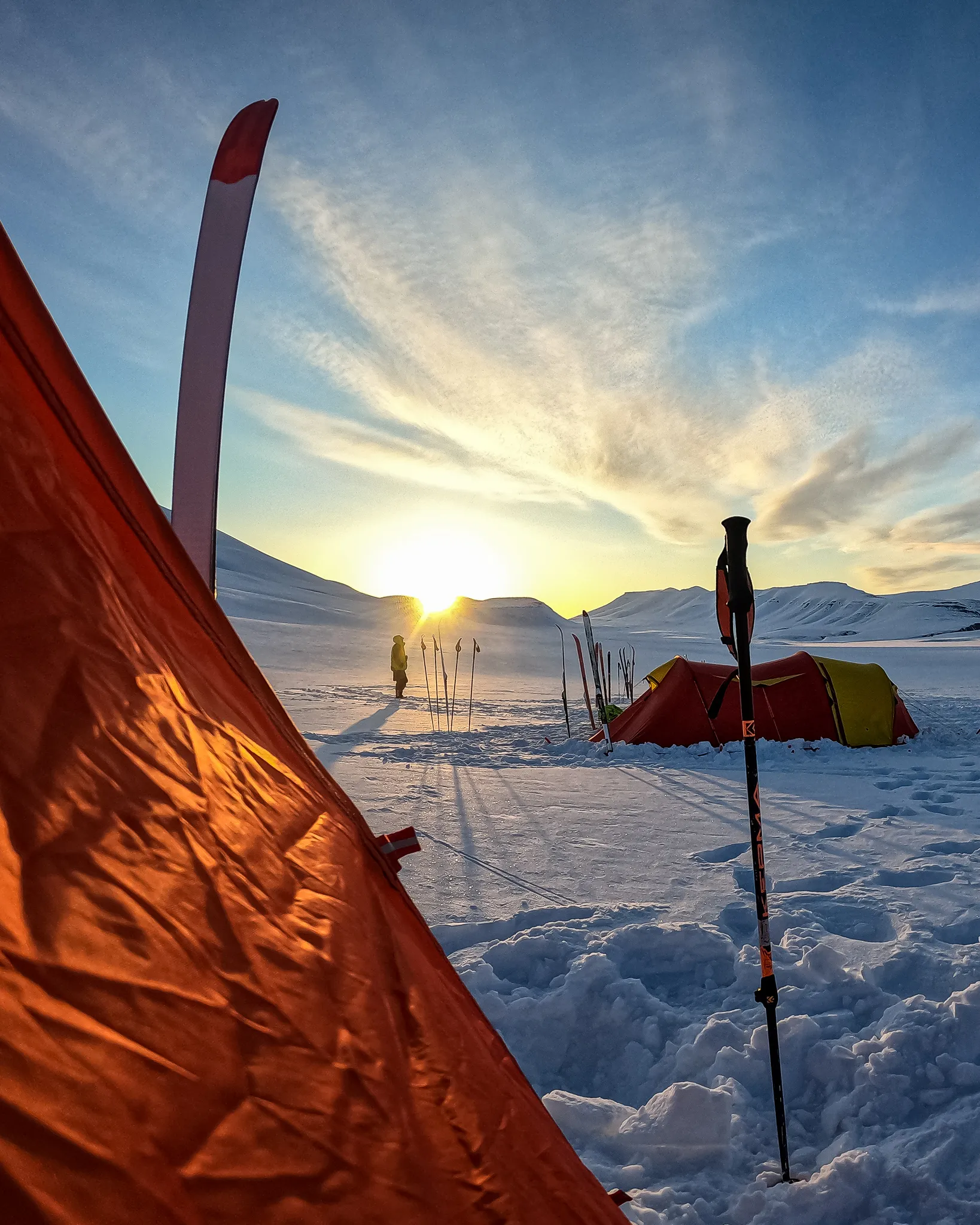
An arctic campsite with orange tents set up on snowy ground as a lone person stands watching the low sun dip between distant mountains.

Day 5-7:Side valleys and mountains

It will be oatmeal again for breakfast, and now that your body is getting used to being out, you certainly won't say no to an extra spoonful of porridge. We continue towards the west in Reindalen and gradually take in one of the smaller side valleys. Now the terrain will begin to change, and the mountains are coming closer. After the majestic Reindalen, we head north up Semmeldalen towards Grøndalen, which we follow westwards towards Barentsburg. We will not enter Barentsburg, but we will ski as far East as the city. When we arrive, we follow our normal camp routines that we have gradually become so familiar with.

It will be oatmeal again for breakfast, and now that your body is getting used to being out, you certainly won't say no to an extra spoonful of porridge. We continue towards the west in Reindalen and gradually take in one of the smaller side valleys. Now the terrain will begin to change, and the mountains are coming closer. After the majestic Reindalen, we head north up Semmeldalen towards Grøndalen, which we follow westwards towards Barentsburg. We will not enter Barentsburg, but we will ski as far East as the city. When we arrive, we follow our normal camp routines that we have gradually become so familiar with.

Tent

B,L,D

15-25 km

Skiers in orange jackets pull expedition sleds single file across a vast, white arctic landscape under a pale sky.

Day 8:Arctic mountains

At the top of Grøndalen (the green valley), we can sense Grønfjorden (the green fjord) in the distance. Today's stage continues down Grøndalen towards Grønfjorden and the west coast. Its incredibly beautiful. As we approach the coast, the destination of the expedition, Grønfjorden, is only a small mountain ridge away. But we will still have the last camp to ourselves in the arctic wilderness tonight. We´ll camp with a view of the sea and the mountains around us. Being our last night with a bear guard, we´ll let the group members argue about who gets the last watch.

At the top of Grøndalen (the green valley), we can sense Grønfjorden (the green fjord) in the distance. Today's stage continues down Grøndalen towards Grønfjorden and the west coast. Its incredibly beautiful. As we approach the coast, the destination of the expedition, Grønfjorden, is only a small mountain ridge away. But we will still have the last camp to ourselves in the arctic wilderness tonight. We´ll camp with a view of the sea and the mountains around us. Being our last night with a bear guard, we´ll let the group members argue about who gets the last watch.

Tent

B,L,D

15-25 km

A group of expedition skiers pull colorful sleds across a white, snowy valley under an overcast grey sky.

Day 9:Time for a shower?

After more than a week on expedition, we move on in the direction of Barentsburg. Down in Grønfjorden will we board the boat that will take us back to Longyearbyen. This transportation takes approx. 4 hours with beautiful views. Once back in Longyearbyen, it's time to pack out the gear and take a shower before we meet in the evening (20:00/21:00, 8/9 PM) for the final dinner. Afterward, a good night's sleep awaits in a well-deserved soft bed. NOTE: Accommodation is not included and must be arranged on an individual basis.

After more than a week on expedition, we move on in the direction of Barentsburg. Down in Grønfjorden will we board the boat that will take us back to Longyearbyen. This transportation takes approx. 4 hours with beautiful views. Once back in Longyearbyen, it's time to pack out the gear and take a shower before we meet in the evening (20:00/21:00, 8/9 PM) for the final dinner. Afterward, a good night's sleep awaits in a well-deserved soft bed. NOTE: Accommodation is not included and must be arranged on an individual basis.

Not included

B,L,-

4 hours

10-20 km

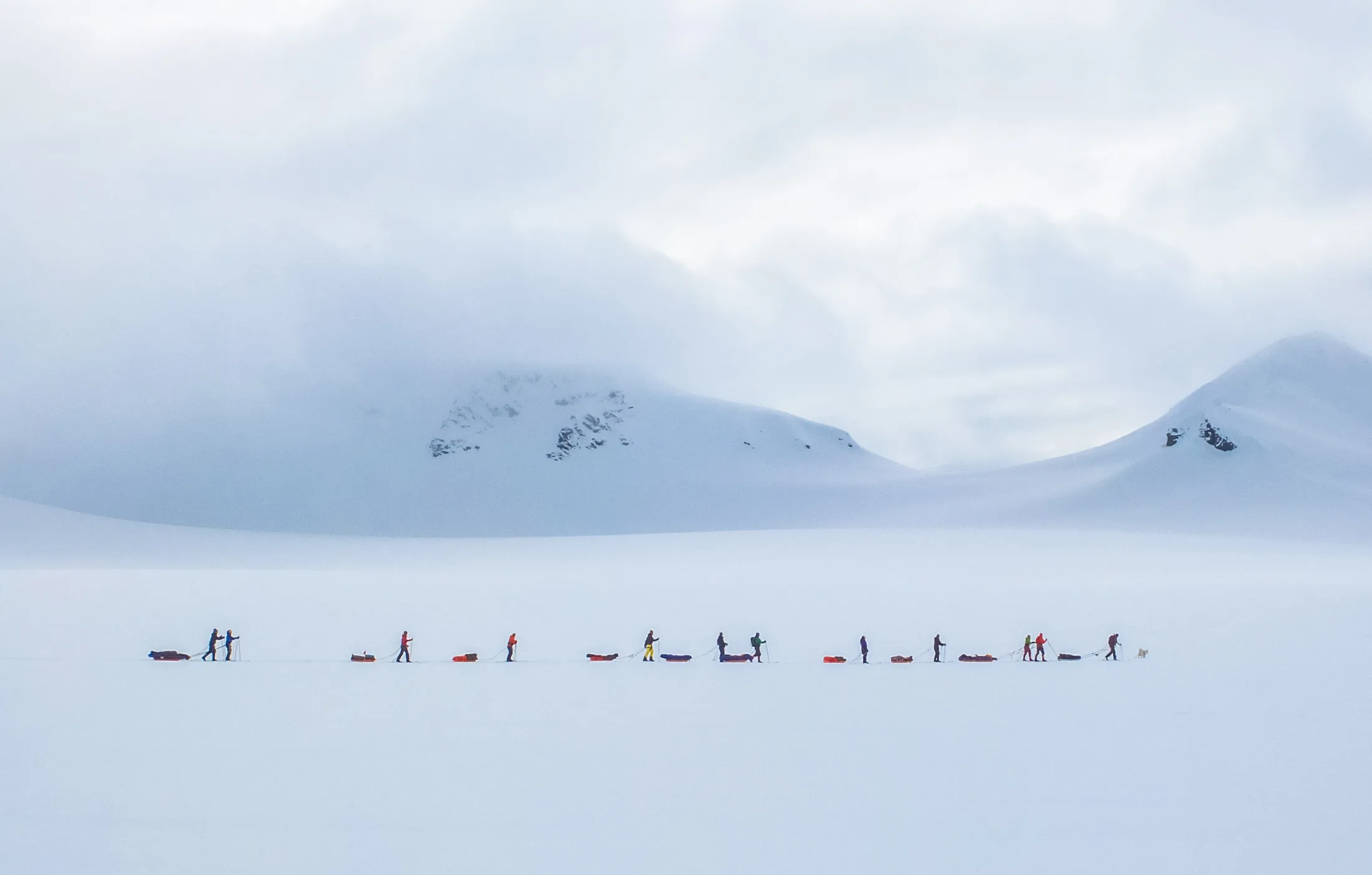
A long line of tiny figures skiing and pulling sleds across a vast white plain under a misty, snow-covered mountain ridge.

Day 10:Return home or stay longer in Svalbard?

Today its time to travel home... unless you want to stay longer in Svalbard. There are many exciting things to do in Longyearbyen, and we are happy to help you find activities to do if you wish! The first possible departure dates in 2027 will be April 23 (departure 1) and May 7 (departure 2).

Today its time to travel home... unless you want to stay longer in Svalbard. There are many exciting things to do in Longyearbyen, and we are happy to help you find activities to do if you wish! The first possible departure dates in 2027 will be April 23 (departure 1) and May 7 (departure 2).

-,-,-

At 15:00 we meet at Mary-Ann's Polarrigg for an information meeting. We then head to our nearby warehouse to pack up equipment and go over the final details before the evening ends. Bring all your equipment to the meeting place. You can leave personal belongings behind, but try and limit how much extra gear you bring with you on expedition. There will be an opportunity to take a trip to the city's sports shops for last minute purchases. If you want to take a map with you on the expedition, we recommend buying one at the Svalbard Museum next to the University, or in the town's grocery store. Packing may take a few hours, so bring some food and drink with you. NOTE: Dinner and accommodation are not included, and are arranged on an individual basis. Arrival dates in 2027 will be April 14 (departure 1) and April 28 (departure 2).
Not included

-,-,-

We will meet at the agreed place in Longyearbyen for a final briefing. After that, we will drive towards the East Coast by a tracked vehicle or snowmobile. The transport takes a few hours but it will be the last hours of sitting still for the week, so enjoy it! Out at Agardhbukta, we will prepare the equipment. If the weather allows we will start skiing on the same day or we will set up camp for the day. In that case, it will be an evening where we establish camp routines and look out for polar bears. We set up daily stages of between 15 and 25 kilometers and set up camp every evening. Most of the day is spent skiing, but we have a leisurely pace and take timed breaks along the way. We will plan the route with the weather in mind and take the path of least resistance - we want to get the best out of the expedition and the route can be adjusted along the way. Upon arrival at the campsite, everyone helps to set up tents, dig cold pits, and build living walls if necessary.

Tent

-,L,D

3 hours

1-10 km

We start the day with coffee after an exciting first night out, where you may have been a polar bear guard for the first time. This is the day we aim to climb the first glacier of the expedition. The glacier has a "gentle" climb, so it's a soft start to the expedition, but we still have to watch out for dangerous cracks. Along the way, we eat the daily expedition lunch, we adjust the pace according to the group, and we use the time we need for reconnaissance and surveys of the terrain. The goal for the day is to set up camp in Lundstrømdalen.

Tent

B,L,D

15-25 km

The days vary on a long ski expedition, covering long distances at a slow pace, allowing you to take in all the scenery. Maybe we go 25 kilometers one day, or maybe the snow is heavier and we settle for 20. As we go we continue further into Reindalen (the reindeer valley), we really get to experience one of the classic, long and wide valleys on Svalbard. Like yesterday, we will be walking all day in an area that is prohibited for scooter traffic, so here we can walk in peace.

Tent

B,L,D

15-25 km

It will be oatmeal again for breakfast, and now that your body is getting used to being out, you certainly won't say no to an extra spoonful of porridge. We continue towards the west in Reindalen and gradually take in one of the smaller side valleys. Now the terrain will begin to change, and the mountains are coming closer. After the majestic Reindalen, we head north up Semmeldalen towards Grøndalen, which we follow westwards towards Barentsburg. We will not enter Barentsburg, but we will ski as far East as the city. When we arrive, we follow our normal camp routines that we have gradually become so familiar with.

Tent

B,L,D

15-25 km

At the top of Grøndalen (the green valley), we can sense Grønfjorden (the green fjord) in the distance. Today's stage continues down Grøndalen towards Grønfjorden and the west coast. Its incredibly beautiful. As we approach the coast, the destination of the expedition, Grønfjorden, is only a small mountain ridge away. But we will still have the last camp to ourselves in the arctic wilderness tonight. We´ll camp with a view of the sea and the mountains around us. Being our last night with a bear guard, we´ll let the group members argue about who gets the last watch.

Tent

B,L,D

15-25 km

After more than a week on expedition, we move on in the direction of Barentsburg. Down in Grønfjorden will we board the boat that will take us back to Longyearbyen. This transportation takes approx. 4 hours with beautiful views. Once back in Longyearbyen, it's time to pack out the gear and take a shower before we meet in the evening (20:00/21:00, 8/9 PM) for the final dinner. Afterward, a good night's sleep awaits in a well-deserved soft bed. NOTE: Accommodation is not included and must be arranged on an individual basis.

Not included

B,L,-

4 hours

10-20 km

Today its time to travel home... unless you want to stay longer in Svalbard. There are many exciting things to do in Longyearbyen, and we are happy to help you find activities to do if you wish! The first possible departure dates in 2027 will be April 23 (departure 1) and May 7 (departure 2).

-,-,-

What's included in the price

Included

Norwegian-speaking guide on programs with Norwegian language.

All transportation as specified in the program. Transport from Longyearbyen to Agardhbukta, and from Barentsburg to Longyearbyen.

Accommodation in tents during the expedition.

Meals as specified in the program. Mainly freeze dried food, and includes a selection of snacks and drinks (coffee, tea, etc) during the ski expedition.

Such as tent, stove, cookware, fuel, snow shovels, toilet paper.

Such as signal gun, rifle, satellite phone, flares, first aid and medication, navigation equipment, repair equipment, and glacier equipment.

Search and rescue insurance for Svalbard is included in the expedition, required by the authorities.

Paris Expedition transport sled, hauling rope, harness, and sled bag for use in the sledge - for each participant.

Not included

Round trip transportation to the meeting place. SAS and Norwegian fly direct from Oslo Gardermoen. It is recommended to book flight tickets well in advance, and the ticket home must be flexible in case there are a few extra days due to the weather. We obviously try to avoid this, but it can happen.

For trips where flights are not included, please check our website to confirm that the departure is guaranteed before booking your own plane tickets. For each trip, we require a minimum number of confirmed participants before the departure can be guaranteed. 

Accommodation in Longyearbyen before and after the expedition. Day 1-2 and day 9-10.

Meals, drinks and snacks in Longyearbyen before and after the ski expedition.

Beyond sled, hauling rope, harness, and sled bag for use in the sledge.

Terms and Conditions 

We reserve the right to change prices. The day by day program is indicative and changes may occur. We also refer to our general travel conditions.

Travel Insurance

On all our trips, we require you to have full health and accident insurance which will also cover any transport home. Read more about travel insurance.

Highlights

Reviews

Rated
-
- reviews
(-)
(-)
(-)
(-)
(-)

Safety & Grading

Read more

For departures with Norrøna Adventure guides:

  • 24-hour emergency response
  • Guides trained in first aid in the field
  • Basic first aid equipment available
  • Cooperation with Turlegen.no for medical advice

On our trips, it is important to understand that we often will be traveling far off the beaten track. We will, of course, do everything we can to assist if anything should happen, but a potential rescue operation can be demanding. It is therefore extremely important that all participants arrive well-prepared and ready to handle unforeseen situations.

Physical level

4/6 Physical

Here you have to be ready for a real challenge! The trips are often longer than at lower levels. Along the way, it will be both physically and mentally demanding, and that requires you to be prepared for this. You should engage in targeted training well in advance of departure, and you must prepare well.

Comfort level

1/6 Comfort

We overnight in tents. On these trips, the participants take part in camp routines such as setting up camp and cooking meals.

Risk level

3/6 Risk

Activities/trips with some risk. Certain incidents may occur, and they may be of such a nature that they may require professional help.

Training and Preparations

You should be used to outdoor activities and must be in normal good physical shape to participate. The expedition also requires the participant to have experience of skiing off groomed slopes. Prior knowledge of Arctic expeditions is not necessary, but you need to have some experience sleeping in a tent in the winter.

Previous experience pulling a sled is not necessary, but some specific training is recommended. Here you will find more info about the Tire Pulling Training.

It is necessary that you have tested your personal equipment/clothing before the trip, and footwear is especially important. Shared equipment will be distributed among the participants. Shared equipment will be distributed between participants. Setting up the tent, cooking and melting snow is done by the individual tent team (2-3 people). The sled will weigh 30-40 kg. The daily stages are approximately 15-25 km.

Participants who are unsure whether their personal skills are sufficient are recommended to take part in our Expedition course in Jotunheimen prior to signing up for this expedition. 

Accommodation and Food

We sleep all nights in tents on the ski expedition. The day before the actual ski expedition starts and the last day in Longyearbyen, are not included. We recommend staying overnight at Mary-Ann's Polarrigg, as it is in close proximity to the warehouse we use to pack everything for the expedition.

Food is included on the ski expedition, and you can pick what you want to take with you from our warehouse - porridge for breakfast, vacuum-packed freeze-dried expedition food for lunch and dinner, drinks (coffee/tea/juice), chocolate, nuts, and biscuits. If you would like more chocolate/snacks, you must bring this yourself. If you have a special treat you enjoy, bring it, but be considerate of adding too much weight to your sled. 

In 2026:

Days you will need to arrange accommodation in Longyearbyen will be from trip day 1-2 and day 9-10:

Departure 1: April 14-15 and April 22-23

Departure 2: April 28-29 and May 6-7

Additional Information

The periods of polar night and midnight sun vary depending on the latitude you are at. Longyearbyen has midnight sun from the 19th April to the 23rd of August, while in the period from the end of October to mid-February the sun is never above the horizon. The dark period lasts from mid-November to the end of January, when total darkness enbodies Svalbard.

Despite Svalbard's northern location, the archipelago has a relatively mild climate compared to areas at the same latitude. In winter, the average temperature in Longyearbyen is -14°C. Nevertheless, there are longer periods with temperatures between -20 and -35 degrees. You need to be prepared for cold weather. If there is additional wind, the apparent temperature is very low and it can feel much colder. However, in our experience we get a low pressure system from the south-west which can bring multiple days of warm temperatures and even rain. The weather on Svalbard can change very quickly and the local variations can be significant.

Related content

People skiing with sleds.

Good to know about our ski expeditions

Read more

Equipment list

This list is intended as a guideline, so that we have what we need regardless of the weather we get on the trip. Remember that you can also get used outdoor equipment that works perfectly. Get in touch if you have any questions. TIP: We recommend that you have the most important equipment in your hand luggage, for example hiking boots and gore-tex jacket/trousers.

Obligatory

Clothing

We recommend wool underwear for both men and women. Wool sportstop is recommended for women. A boxershorts with windstopper is recommended for cold days. 

Not too thick, bring more layers if necessary. Top and bottom.

Wool, 2-3 paris.

2-3 pairs. Wool or synthetic material.

Fleece or wool. 

Down or synthetic insulation, featuring a hood and ideally long enough to cover the butt.

Gore-Tex or similar. Must have a decent hood, and hold out wind and rain. Should have space for midlayers underneath. Ventilation under the arms is recommended. 

Gore-Tex or similar. Must be waterproof and windproof,  zips for ventilation are recommended.

Warm hat for cold days.

The overmittens should be roomy and extend well up the forearm. They should be windproof and ideally handle some moisture. They need to provide a good grip, even with the inner mittens inside. The inner mittens should be thick and warm, preferably made of wool.

To protect the face from freezing wind and blowing snow. We recommend neoprene, which provides extra good protection in the wind. Breathing hole in front of nose/mouth for ventilation. 

Footwear

Ski boots intended for ski expeditions. Large enough to fit inner boots. Must be compatible with BC bindings.

Equipment

Good, warm sleeping bag that can withstand -30°C in comfort temperature. We recommend down. They are lighter, and become smaller in package volume. 

For winter use. For example Exped down mat or Thermarest NeoAir. Used together with the flat sleeping mat.

Flat type made of closed-cell foam, e.g., Therm-a-Rest Z-Lite. Designed to be used underneath an inflatable sleeping mat.

Waterproof pack bags to keep your clothes and gear dry, organized, and help reduce volume. It is especially important to have dedicated waterproof bags for essential equipment on your trip, such as your sleeping bag, down jacket, and electronics.

They can be used in your backpack while hiking or skiing, in your sled bag on ski expeditions, or in your duffel bag on trips where the bag is carried by porters, mules, or similar.

Personal medicines and, for example, band-aids, blister plaster, sports tape, throat lozenges, nasal drops, Paracetamol/Ibuprofen, stomach regulators, etc.
We need to know about all medicines you are taking, in case something happens. 

Compact and light.

Preferably a spoon with a long handle if you are going to eat freeze dried food.

High SPF, 30-50. Remember chapstick for lips and nose. 

A solid pair, with dark glass. 

Alpine snow glasses. To protect your face and eyes in snow, wind and cold conditions.

Nordic backcountry skis with steel edges. Large pulleys on the rods, and not too long. We're not going to be poling, and long poles make your hands cold. Preferably poles with a "long handle". We walk with around 90 degrees in the elbow. Skis must have BC binding with manual closure.

We mostly use short skins, but should we be unlucky with the conditions (hard and icy or lots of powder snow), long skins often work best.

Svalbard is outside Schengen and the Nordic passport agreement. Everyone must show a passport or national ID card when traveling to and from Svalbard.

A small bag with antibac, and dog poop bags for used wet wipes etc. Here you can also keep toilet paper, and matches to burn used toilet paper.

For hot drinks in breaks and in camp.

2 x 1 litre bottles, with insulation cover, so they dont freeze. For example Nalgene bottles with wide mouth. They can handle hot water, so you can use them to keep warm in the sleeping bag. If you do not have 2 bottles you can bring an extra thermos instead (must be 3 litres of water capacity all together).

1-2 litre (3 litres all together in thermos and waterbottles).

Recommended

Clothing

Down or synthetic insulation. Should be roomy, making them easy to wear over shell pants, preferably with a full-length side zipper. 

Thin, ultra light.

Such as the Norrøna arktis Windstopper Ousland Edition or similar.

For warmer days, and as a hat when sleeping.

Thin gloves/liners can be worn inside your thick mittens/windproof mittens. Also practical when in the tent, handling the burner etc.

High gaiters for protection against wind, snow, moisture, and icing on boots and laces. Mandatory if you don’t have ski boots or pants with integrated gaiters.

Footwear

Lightweight  and back up very small. Keep your feet warm inside the tent, sleeping bag or while walking around camp. Down or synthetic filling. In addition, warm and good footwear in case of emergency, if your feet are very cold.

Equipment

To increase the comfort temperature in your sleeping bag.

Tooth brush, tooth paste, small towel, ear plugs, wet wipes, biodegradable soap, etc.

Nuts, chocolate, energy bars, etc.

If youre a light sleeper.

Might be a good idea if you're going on a trip when it's bright at night (you can possibly use a buff/neck gaiter).

Remember new/extra batteries. Lithium batteries are good in the cold. NOTE: A headlamp is only necessary until around mid-April.

For example Piteraq HD. Be sure to have the right size, that fits your sleeping mats.

Packing Tips

It is important that you pack your clothes and sleeping bag 100% waterproof. Even if you already have a cover on your sleeping bag, it is important that you pack it in a waterproof drybag bag as well. Read more about how to pack and prepare.

Sometimes some of us have to drive snowmobiles ourselves on the transport to/from the ski trip, so take your driver's license with you.

TIP: Travel in your outdoor clothes. We recommend that you have the most important outdoor equipment in your hand luggage, for example ski boots and gore-tex jacket/trousers.

We will also provide the following shared and safety equipment:

  • Camp stoves and fuel
  • Rifle
  • First aid
  • Expedition tents
  • Signal gun
  • Satellite telephone
  • Snow shovels
  • Navigation gear (GPS, map, and compass)
  • Pots
  • Food, drink and snacks (Food is included on the ski trip, and you pick what you want to take with you from our warehouse - oat porridge for breakfast, vacuum-packed freeze-dried food for lunch and dinner, drinks (coffee/tea), chocolate, nuts, biscuits. If you would like more chocolate/snacks, you must bring this yourself.)
  • Glacier gear (Harnesses, ropes, carabiners etc.)
  • Tripflares
  • Toilet paper
  • Probe
  • Sleds (Paris Expedition transportation sled)
  • Harnesses and rope pulls for sleds
  • Sled bags (One big sled bag that fits in the sled keeps all your gear away from the snow. NOTE: The bag is not waterproof, so you will still need dry bags for your gear/clothes/sleeping bag.)

Recommended trips

Testimonial

Feel like crossing Spitsbergen, do it!

– Hege K. 2022

Testimonial

An enjoyable experience with skilled guides and pleasant participants.

– Johannes S. 2022