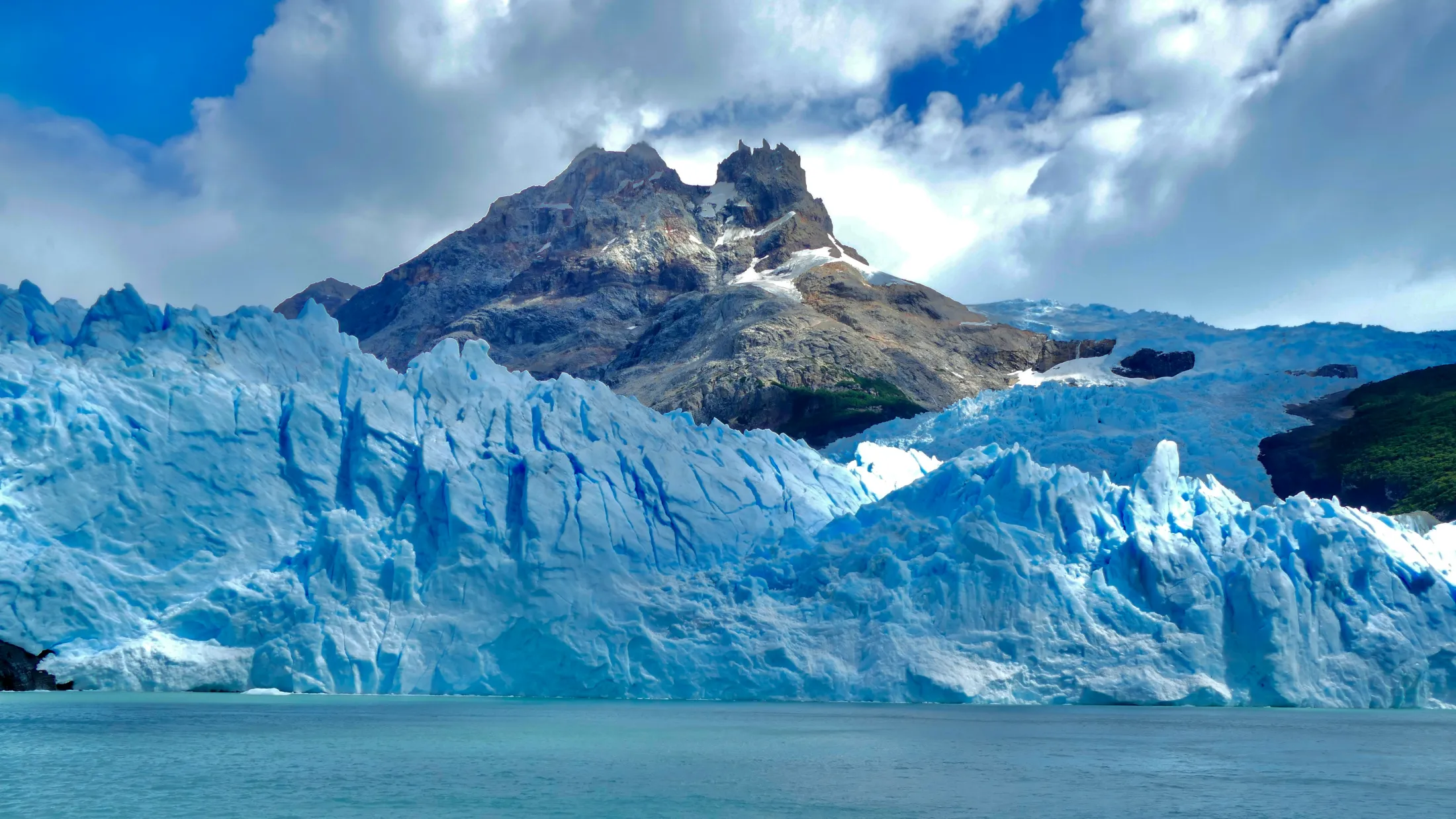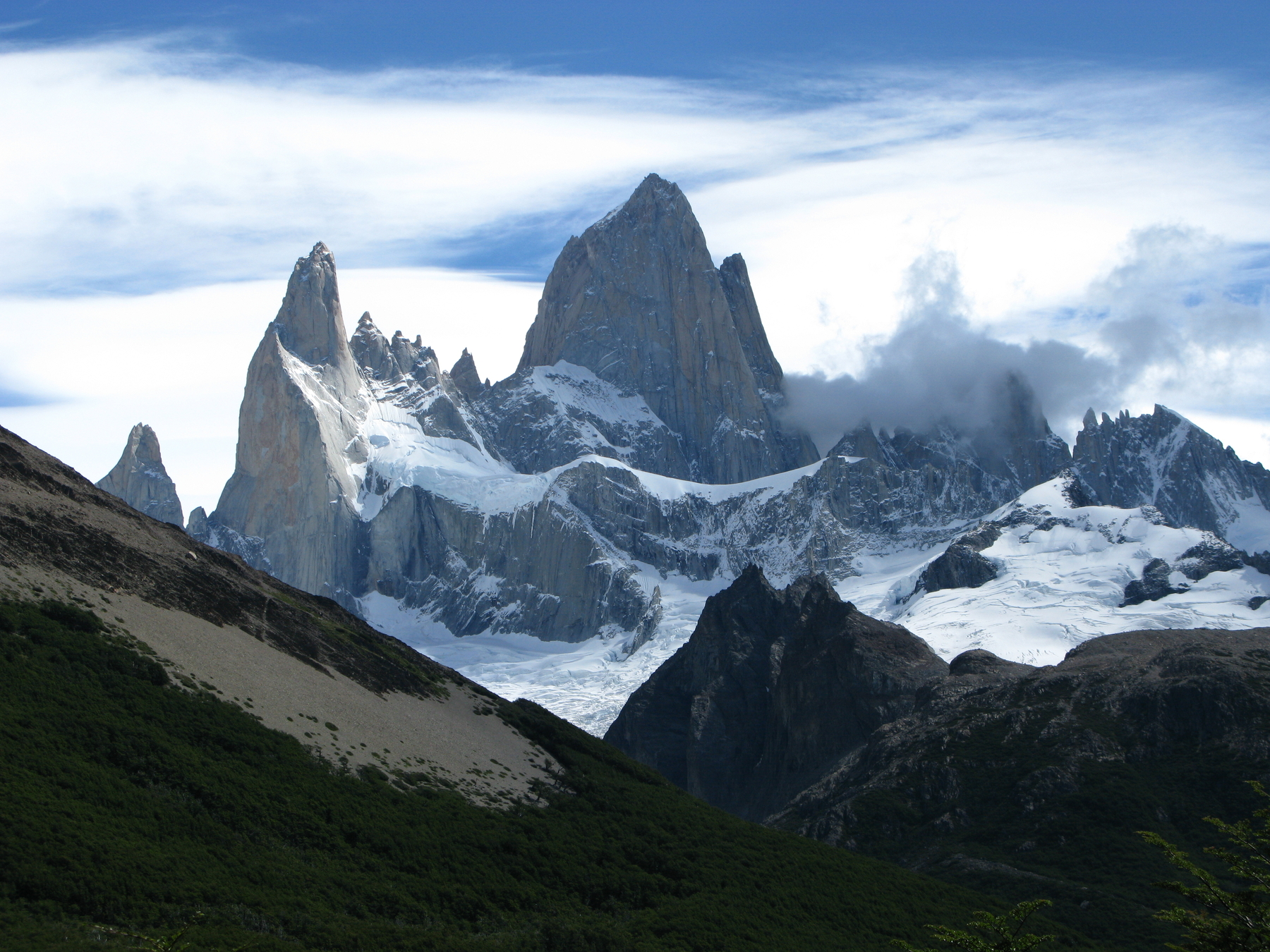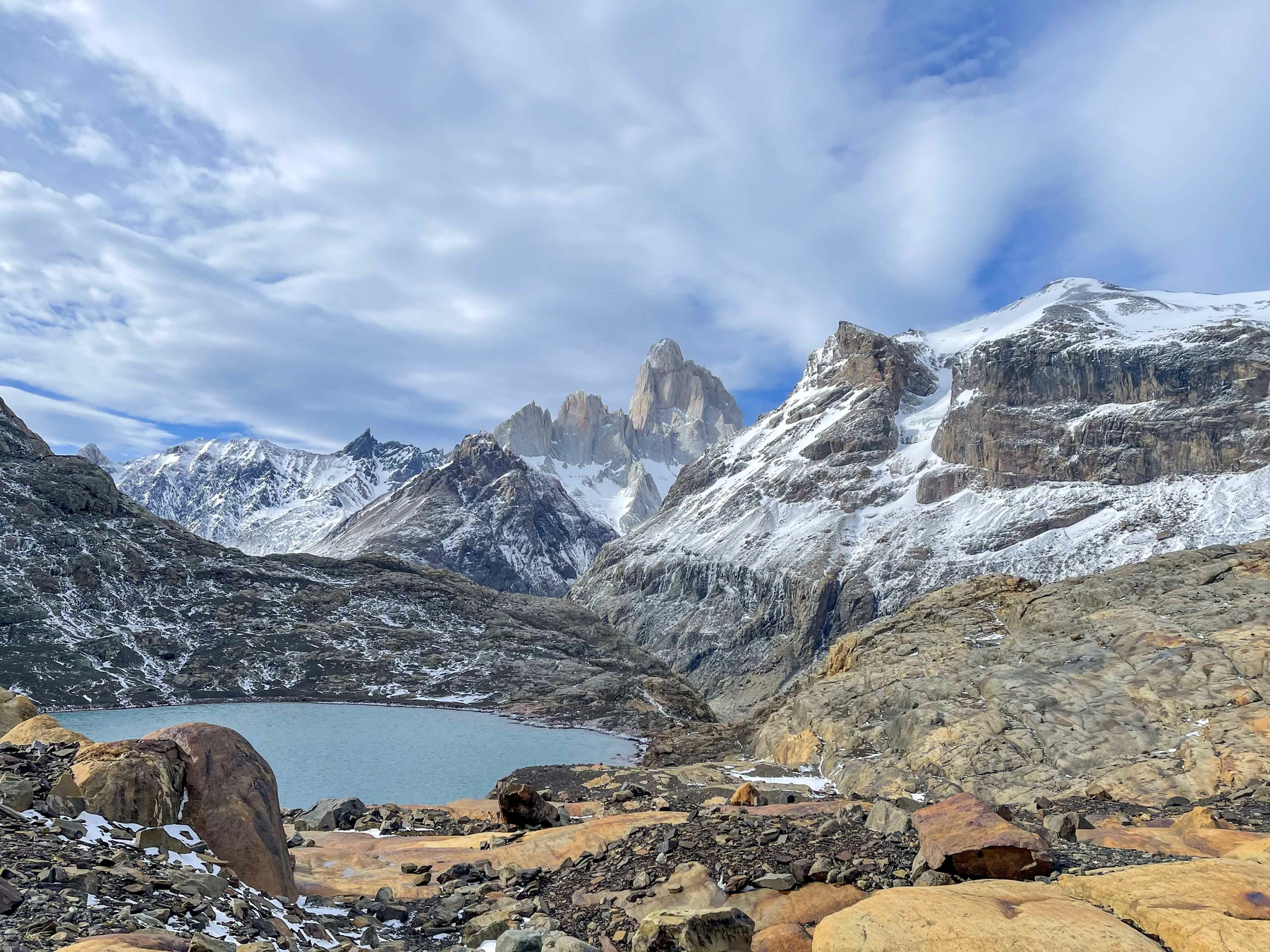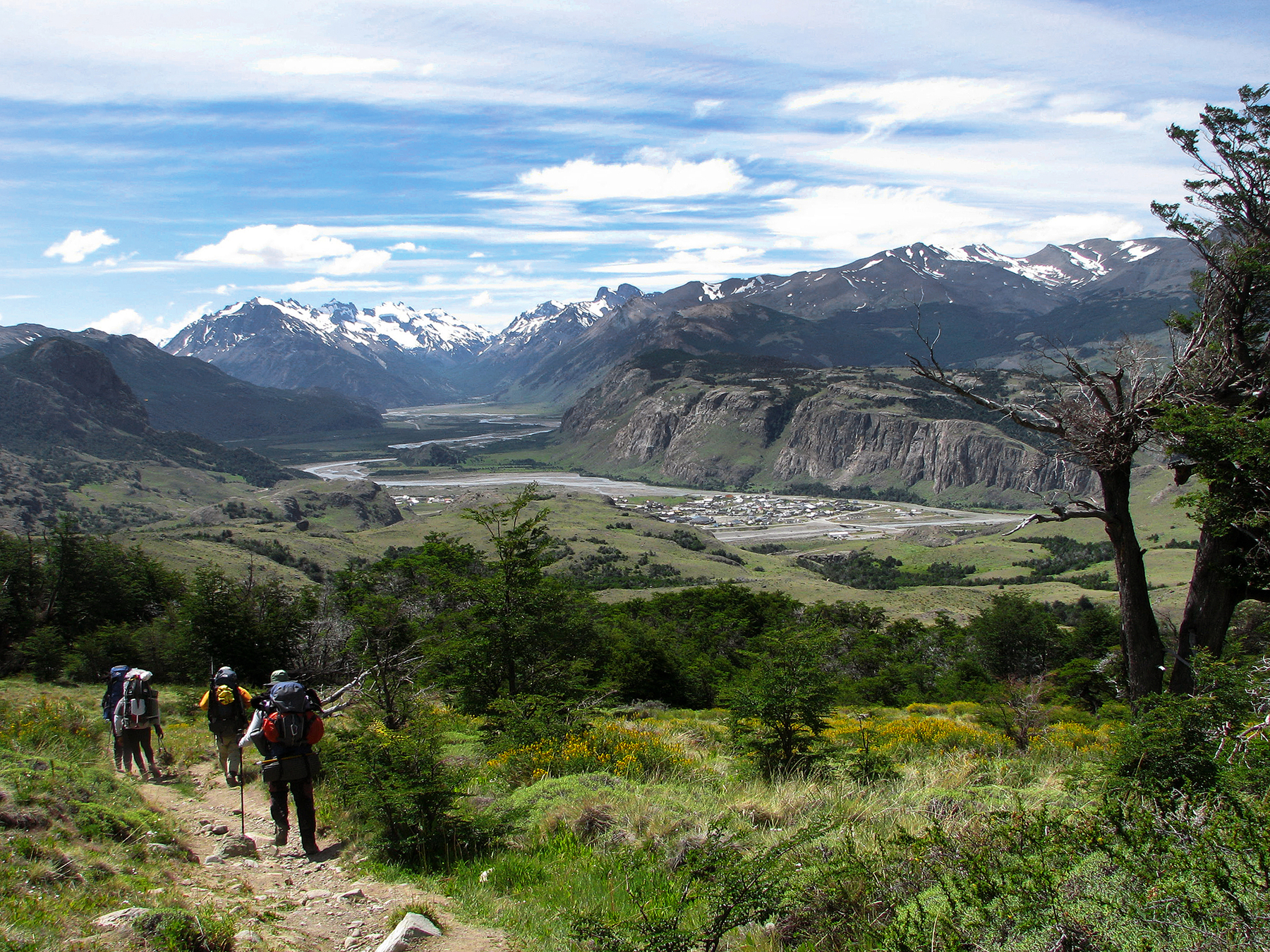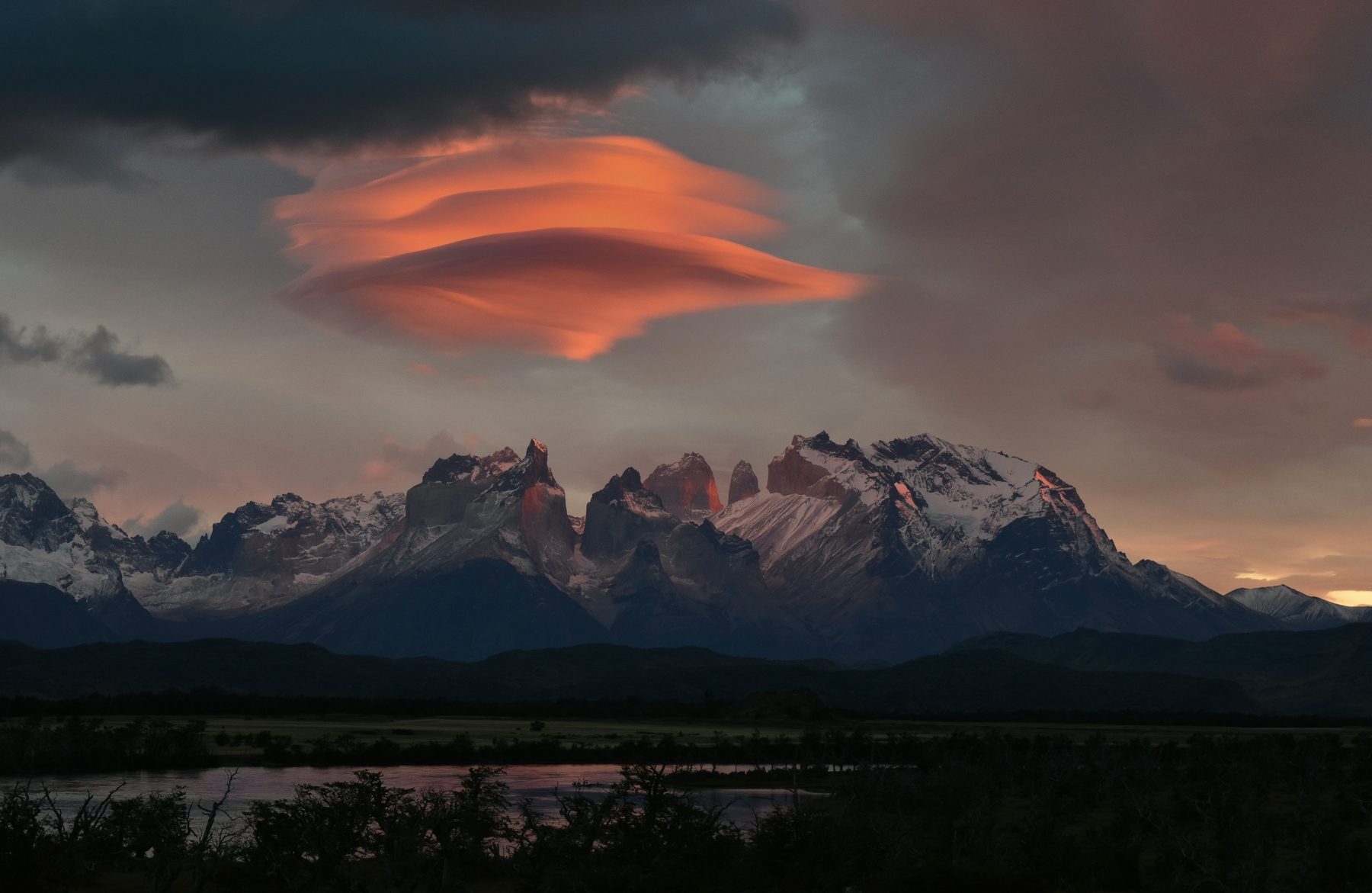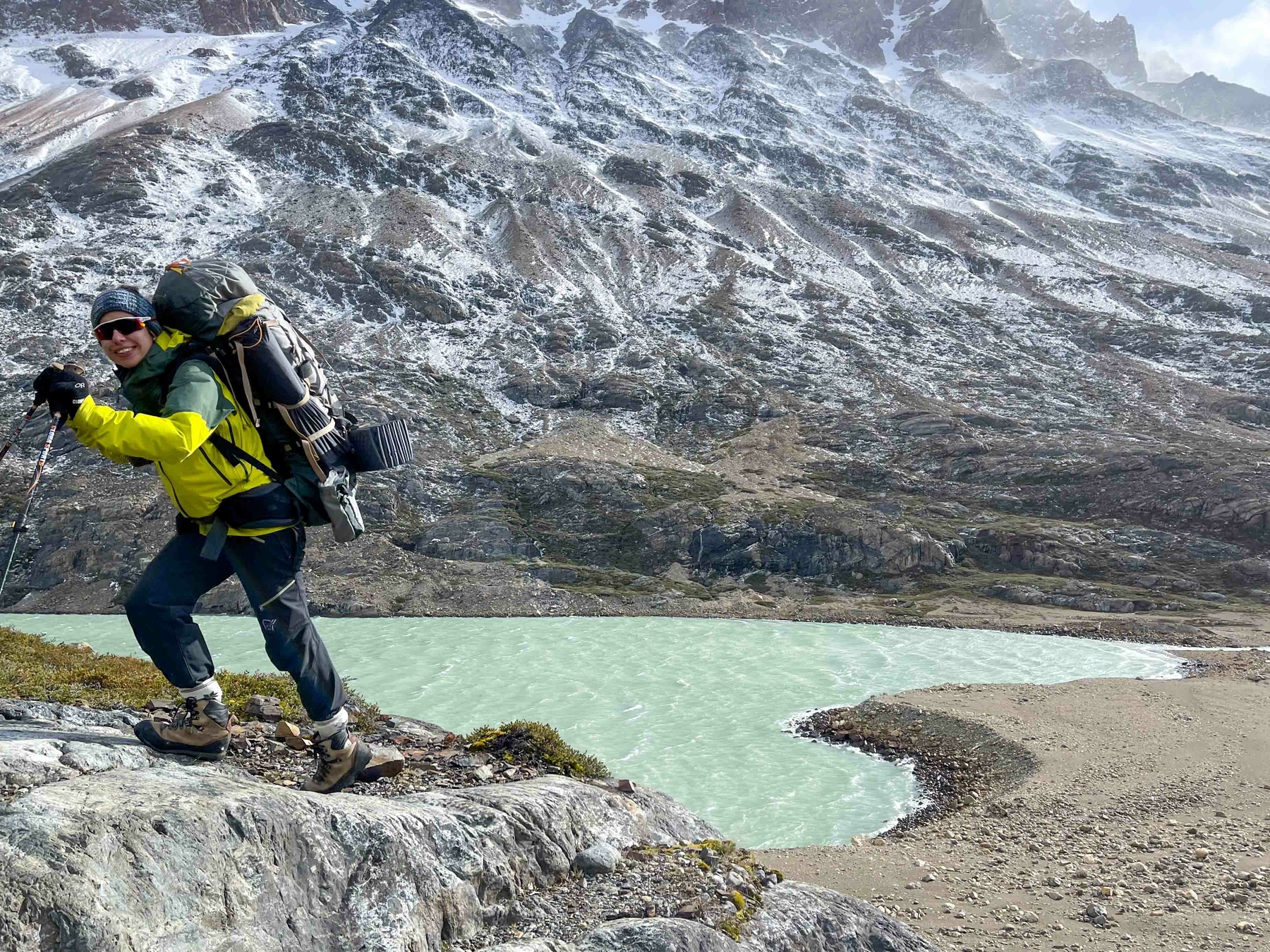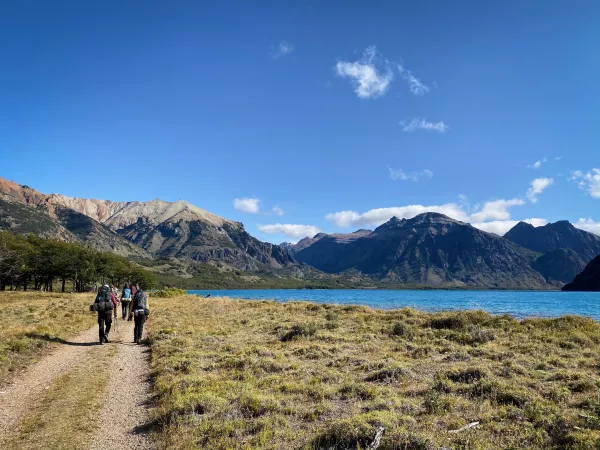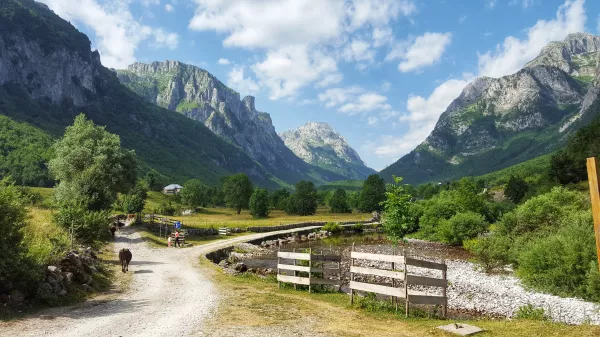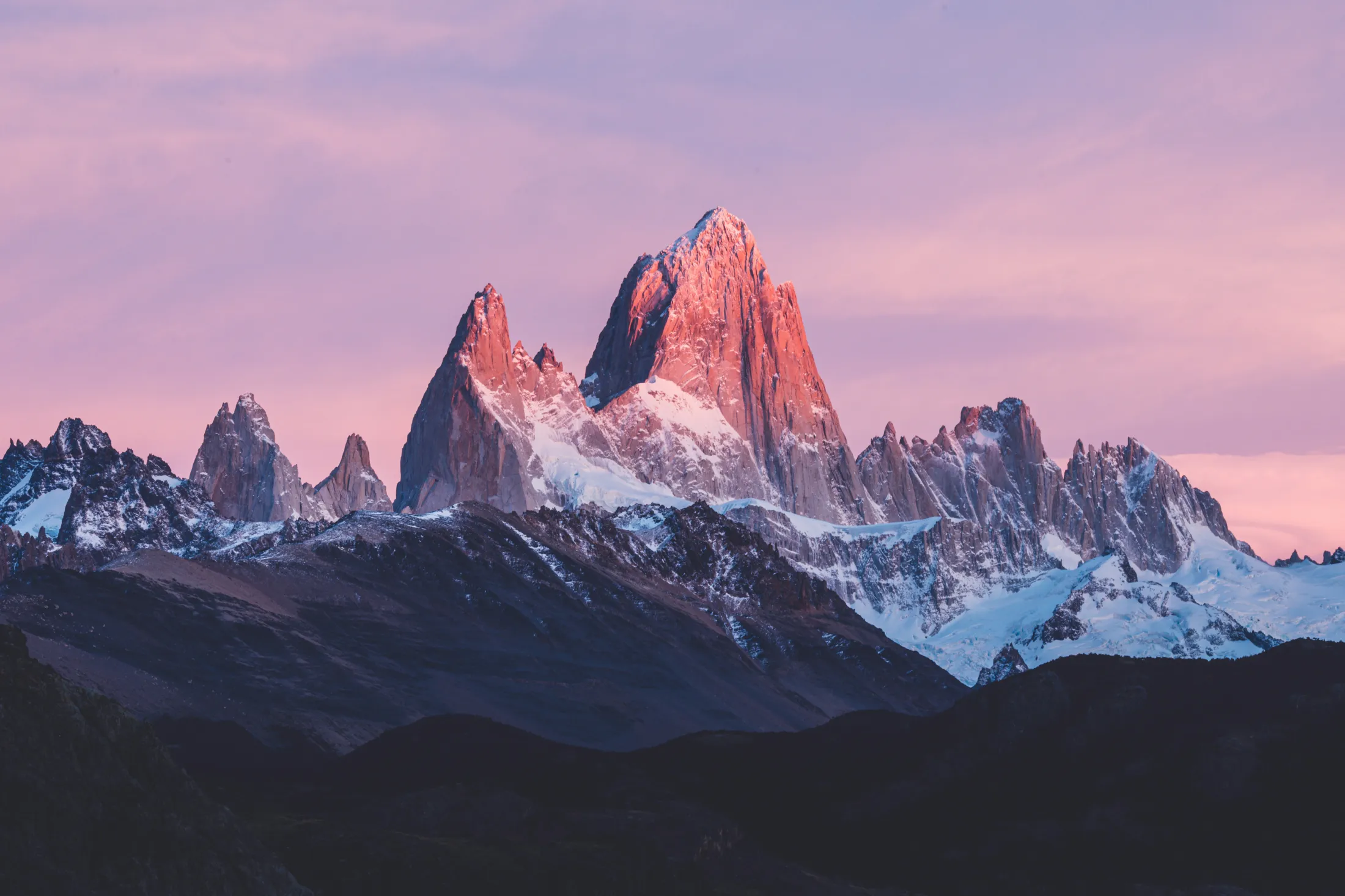
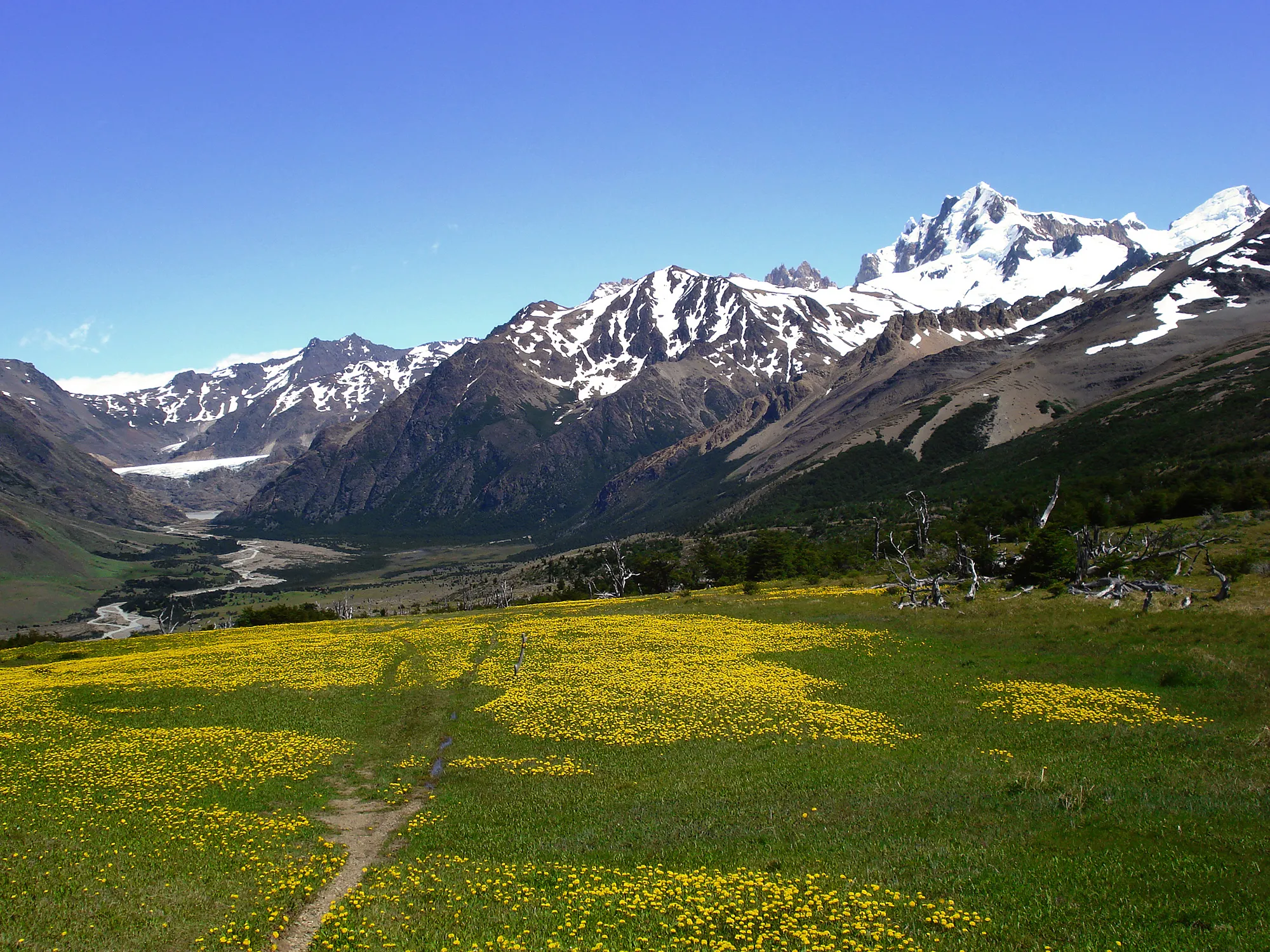
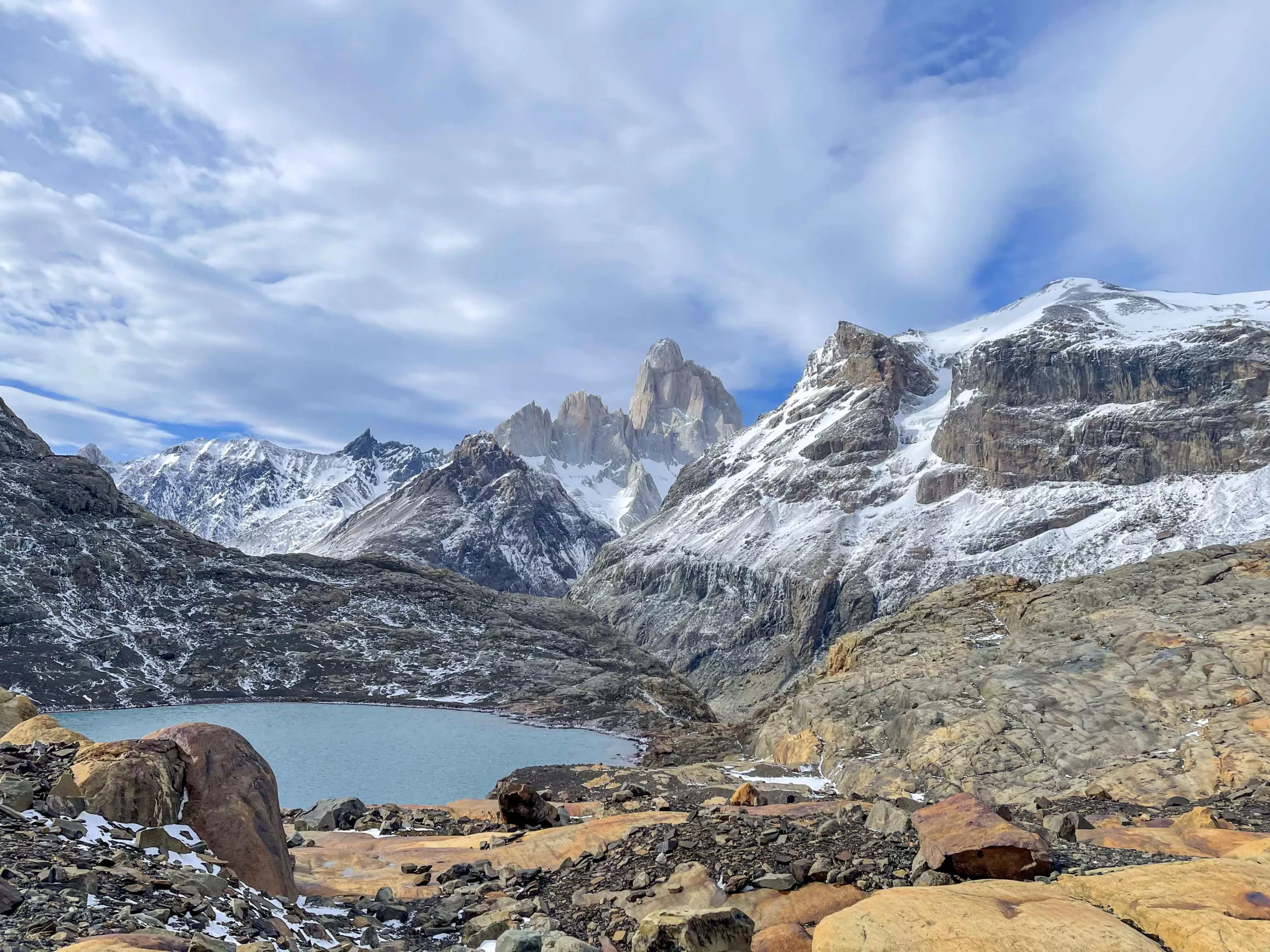
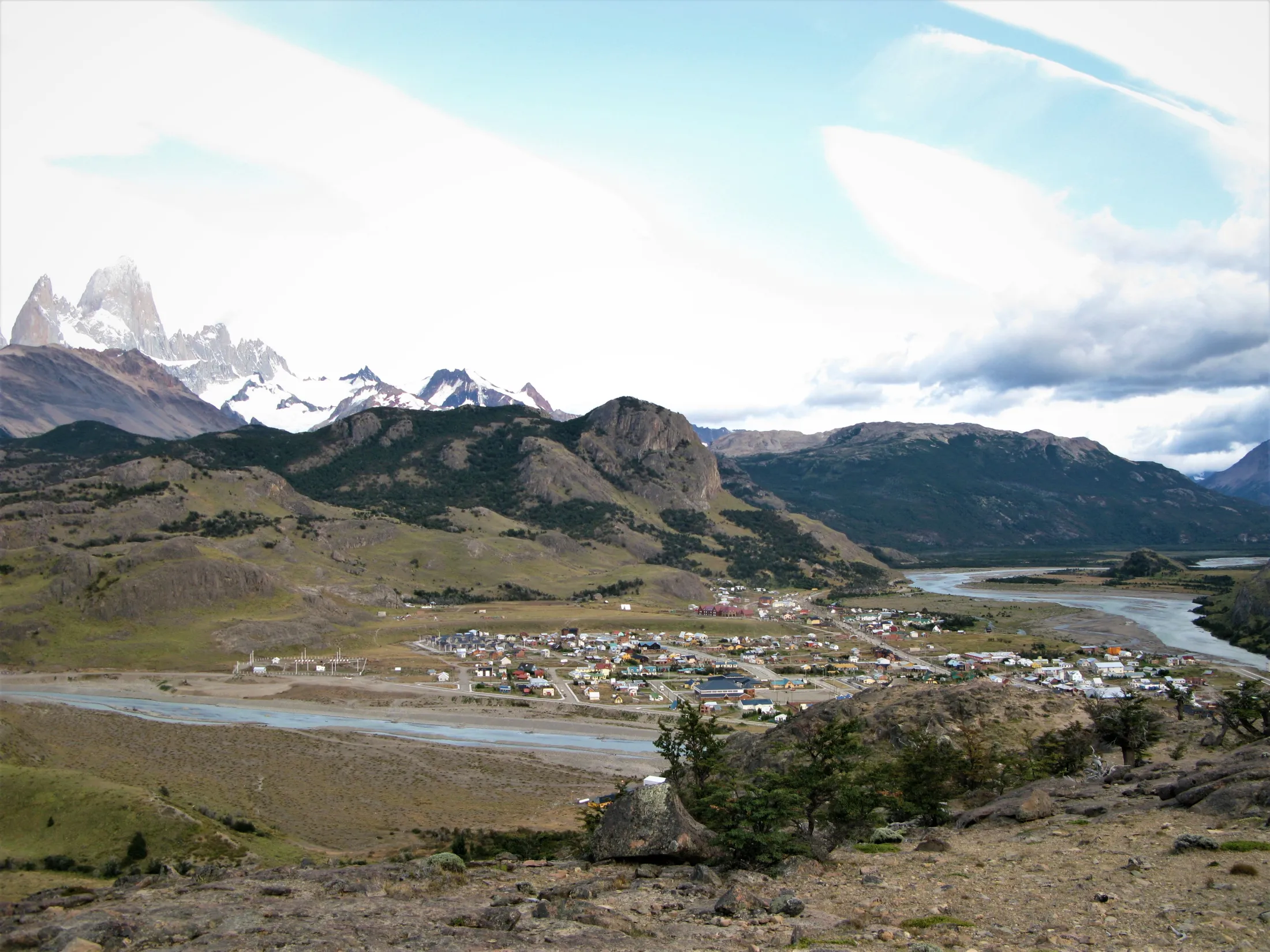
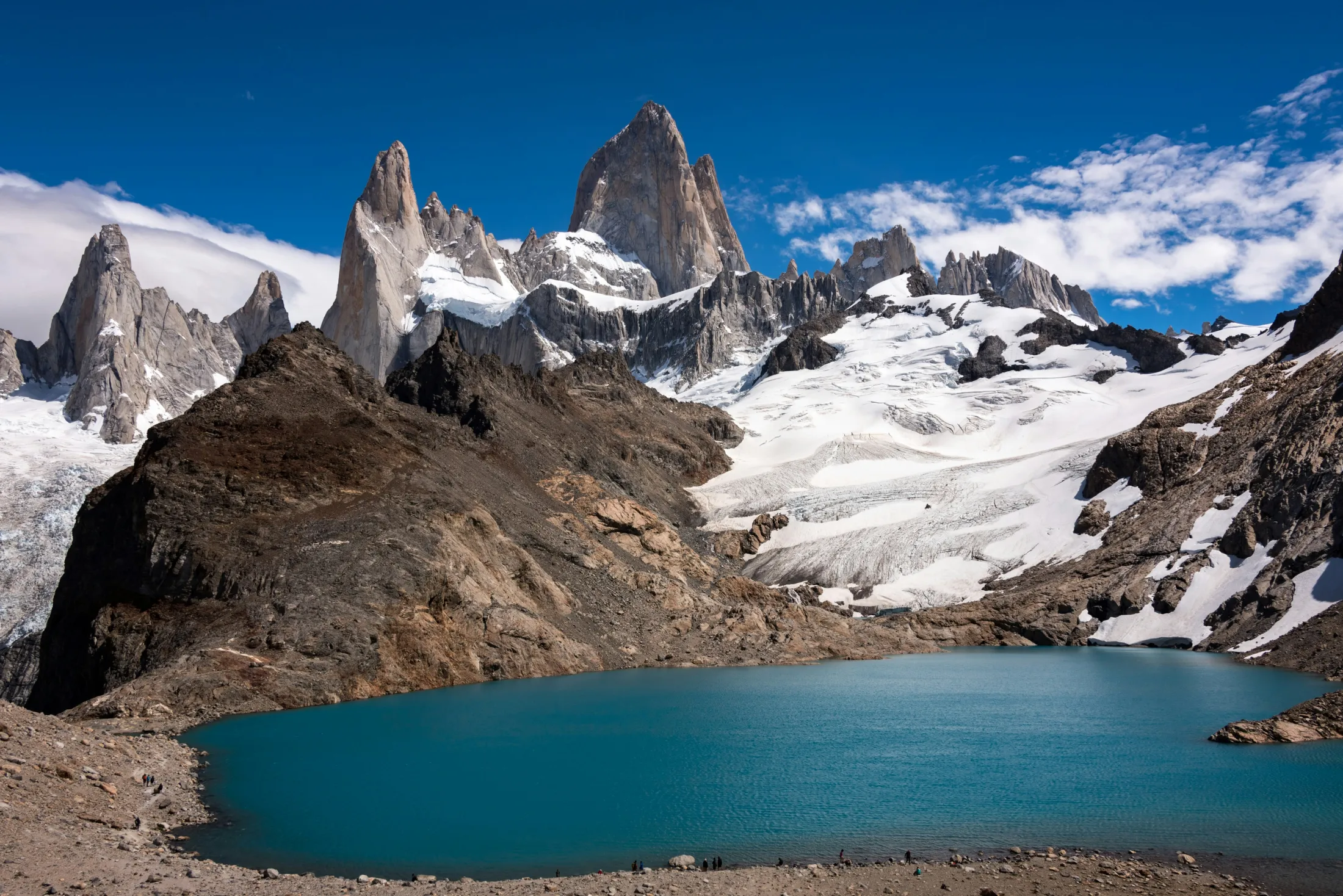
Snow covered mountains in Patagonia with a lake in the front

Trekking in Patagonia

With views of Fitz Roy and the mighty inland ice cap

Trekking in Patagonia

With views of Fitz Roy and the mighty inland ice cap

Patagonia is the ultimate dream for many trekking enthusiasts. At the very southern tip of South America, we hike through deep forests and over windswept mountain passes, surrounded by sheer granite peaks and the world's largest ice cap outside the polar regions. This is not just a trip, it is raw, wild, and unforgettable.

Highlights

  • The classic Huemul Circuit
  • The view from Paso del Viento
  • Fitz Roy and Laguna de los Tres
  • True wilderness life
  • Classic Patagonian asado

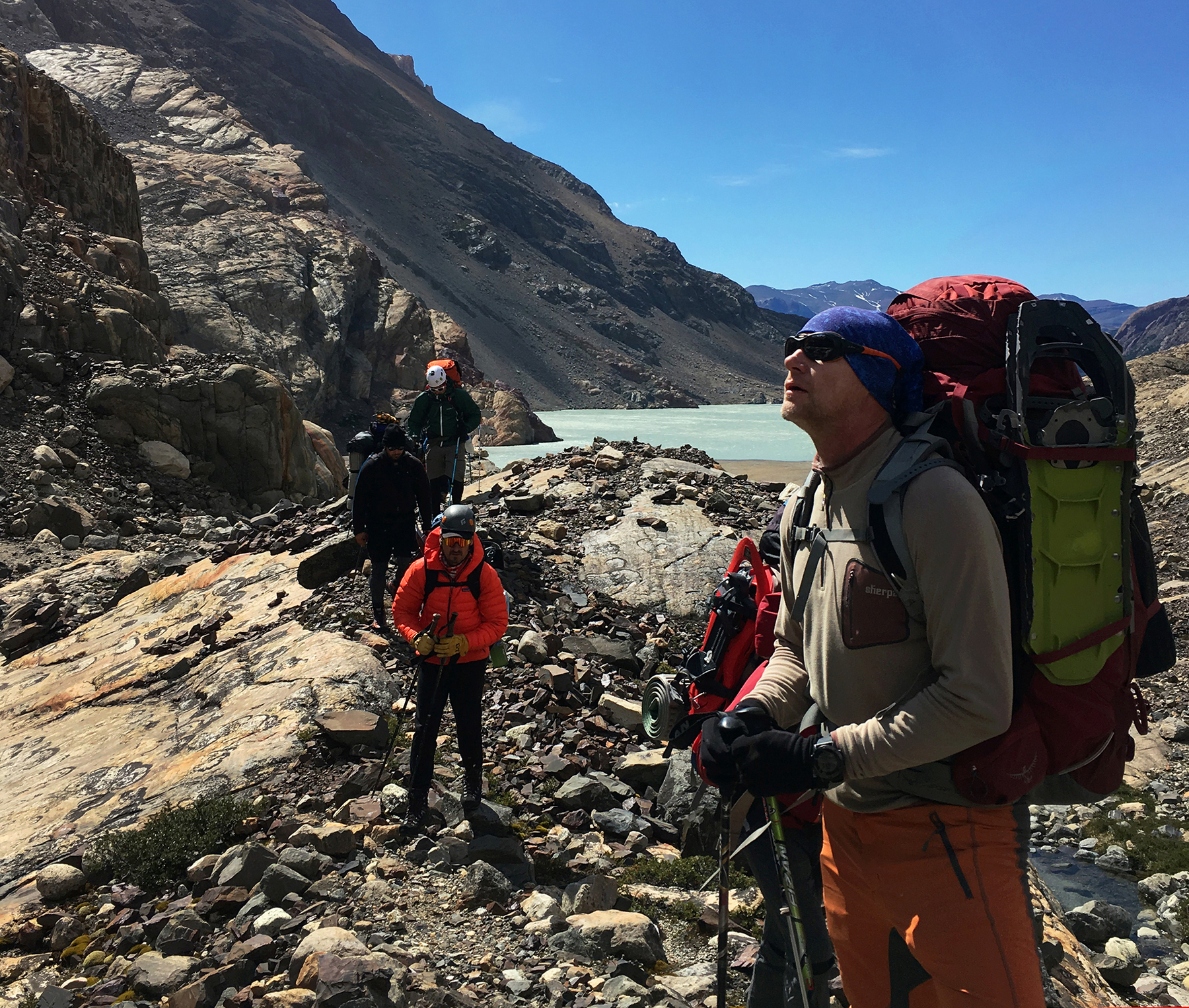
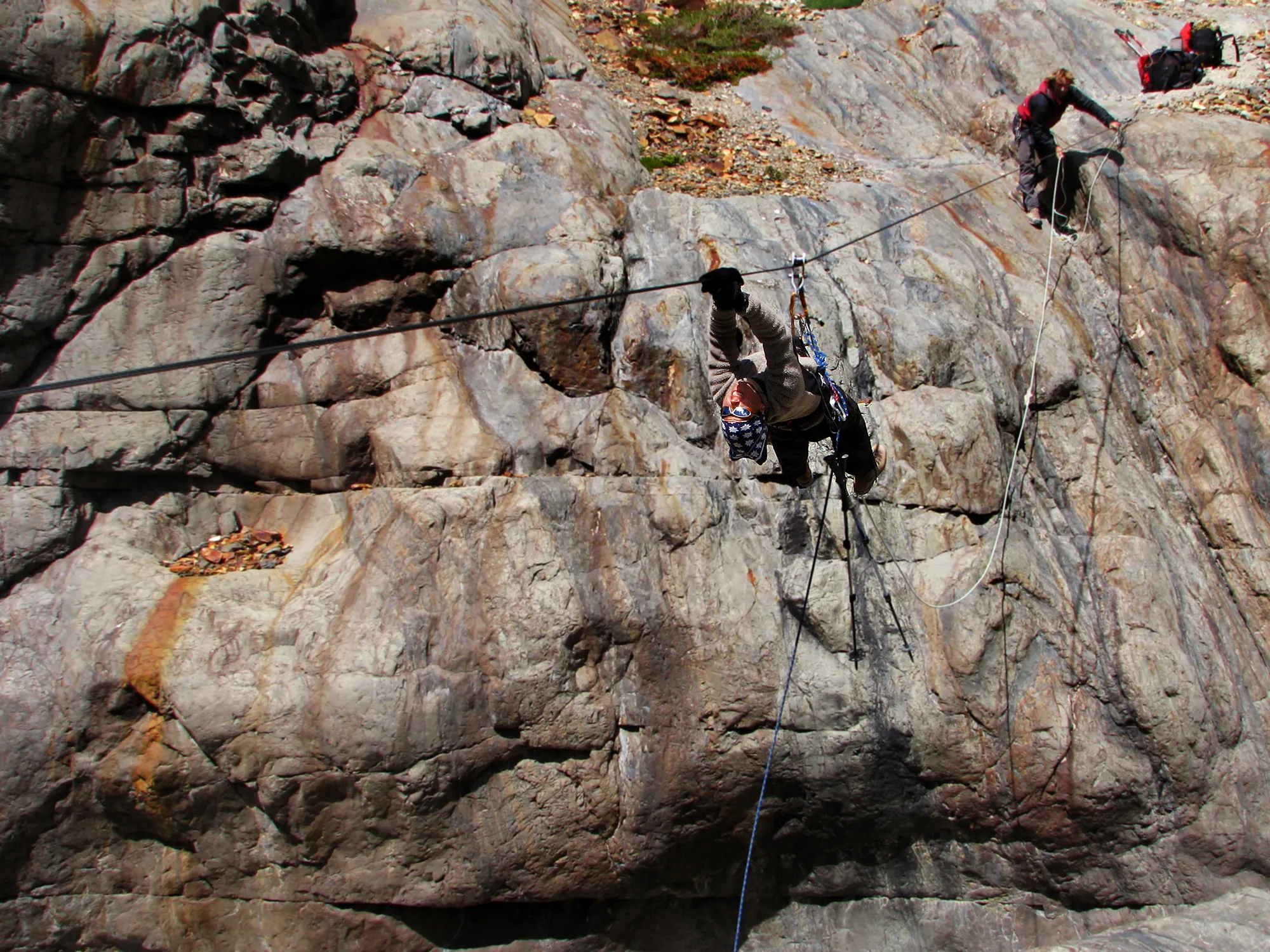
The landscape of Patagonia must be experienced firsthand to be truly understood. On the Huemul Circuit, we pack our tents, lace up our boots, and venture into one of the most rugged and spectacular mountain areas in the world. This is a physical and raw trek where we cross rivers by zip line, navigate unmarked scree slopes, and fall asleep to the sound of icebergs beneath a starry sky like few others.

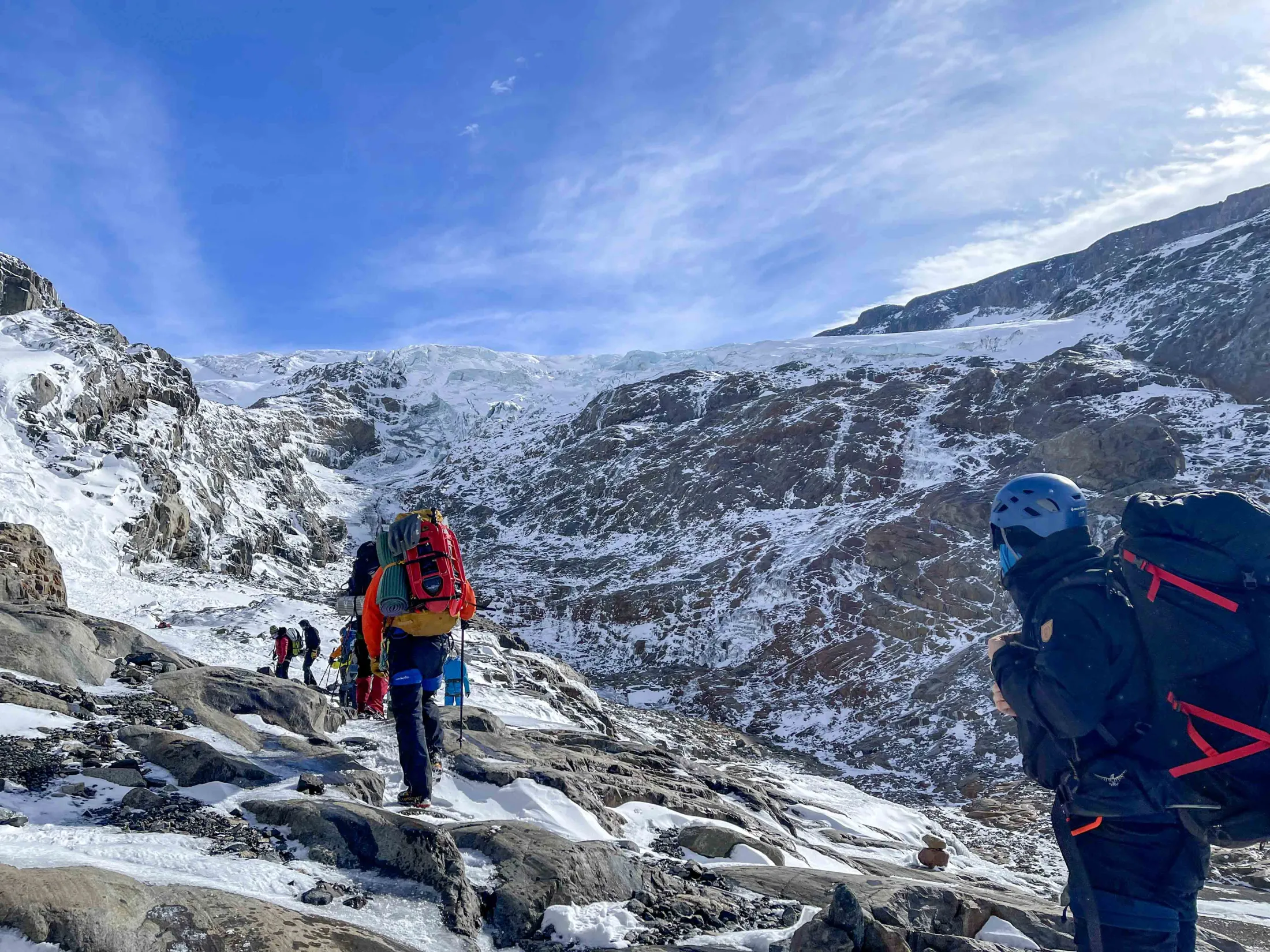
During the trek, you will experience the brutal contrasts that make this region legendary. We start in the shadow of the sheer granite walls of Fitz Roy and push our way up to Paso del Viento. Up there, in the infamous Patagonian wind, the landscape suddenly opens up, leaving you face-to-face with the Southern Patagonian Ice Field, a sea of ice stretching as far as the eye can see. It is a sight guaranteed to give you goosebumps, no matter how many mountain peaks you have climbed before.

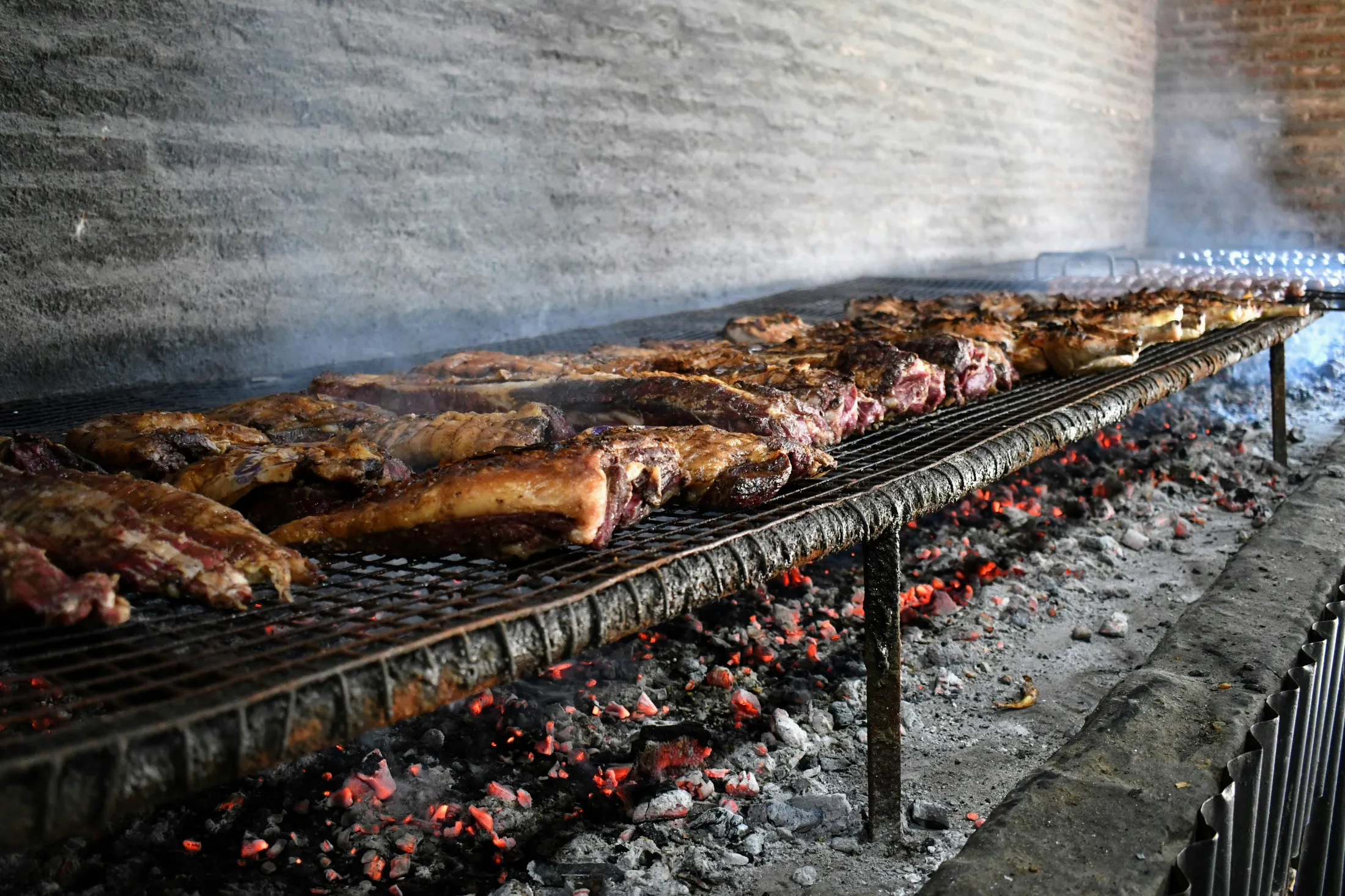
Once the wilderness is behind us, we celebrate at a traditional Patagonian ranch with a sheep shearing demonstration and a proper asado, whole lamb slow-roasted on a spit over an open fire. Afterwards, we have a flexible day in El Calafate where you can rest your legs, take an optional day trip across the Chilean border to Torres del Paine, or experience the Upsala Glacier up close.

We round off the journey in vibrant Buenos Aires, swapping hiking boots for city life, fantastic food, and colorful culture. This is the trip for those seeking the genuine, the challenging, and the unforgettable.

15

9-16

EN

3/6

2/6

3/6

Dates and booking
There are no departures on this trip.
Can't find a date? We'll notify you when new trips open!

Plan it your way

Want this trip just for your group? Or got something different in mind? We've got you.

Make this a private trip

Opening hours Phone
Mon-Fri : 08-20
Sat-Sun : 14-17
Opening hours Chat
Mon-Fri : 07-23
Sat : 10-18
Sun : 13-21
CET

Day by day

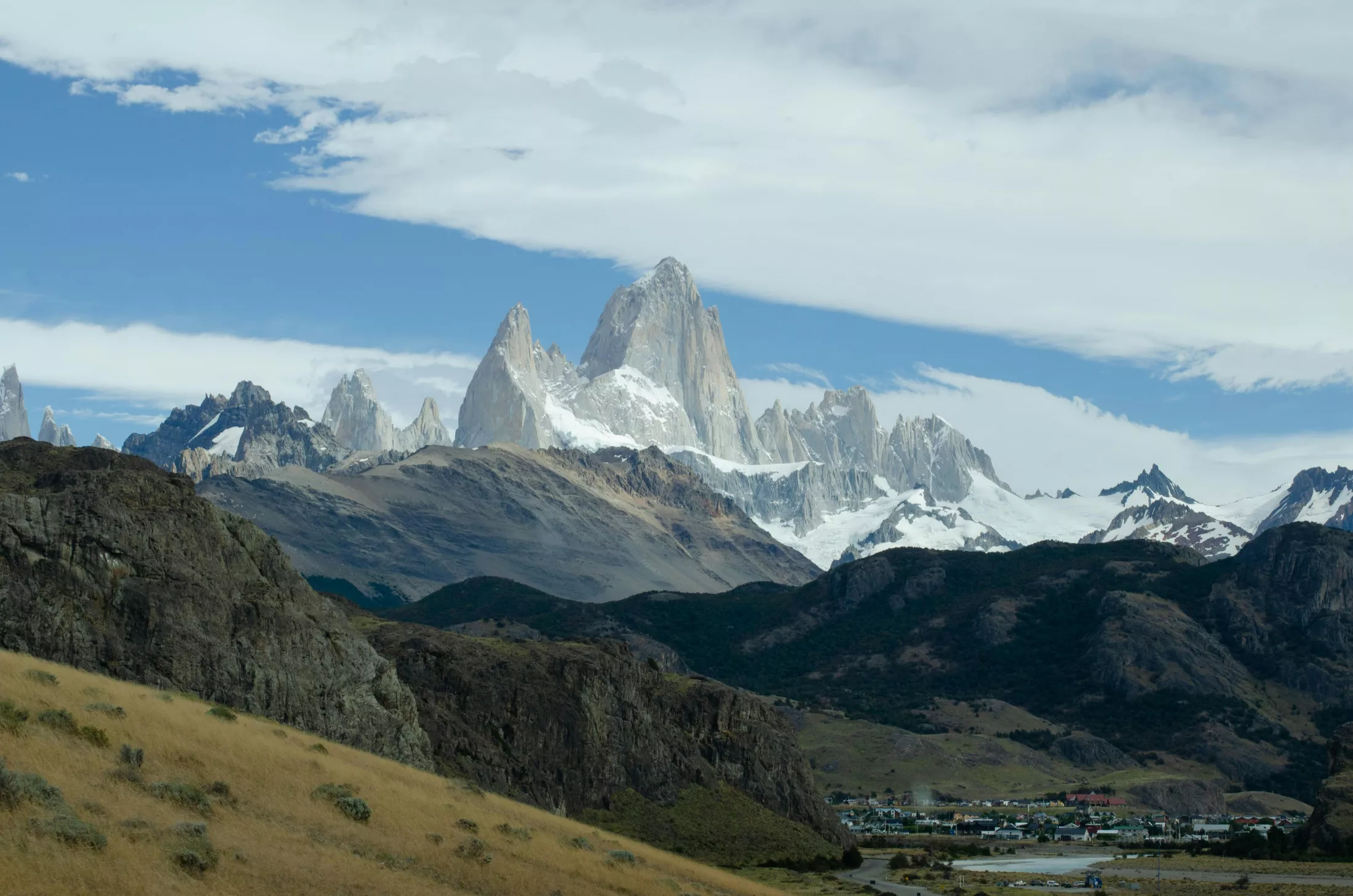
An overview shot of El Calafate along the river, with the mountains in the distance

Day 1:Arrival in Patagonia and El Calafate

We arrive in El Calafate and check in to the hotel. We can explore the town on our own, or together for those who wish. In the evening, we meet for a group dinner to get to know each other and go through the itinerary for the coming days.
We arrive in El Calafate and check in to the hotel. We can explore the town on our own, or together for those who wish. In the evening, we meet for a group dinner to get to know each other and go through the itinerary for the coming days.
Hotel

-,-,D

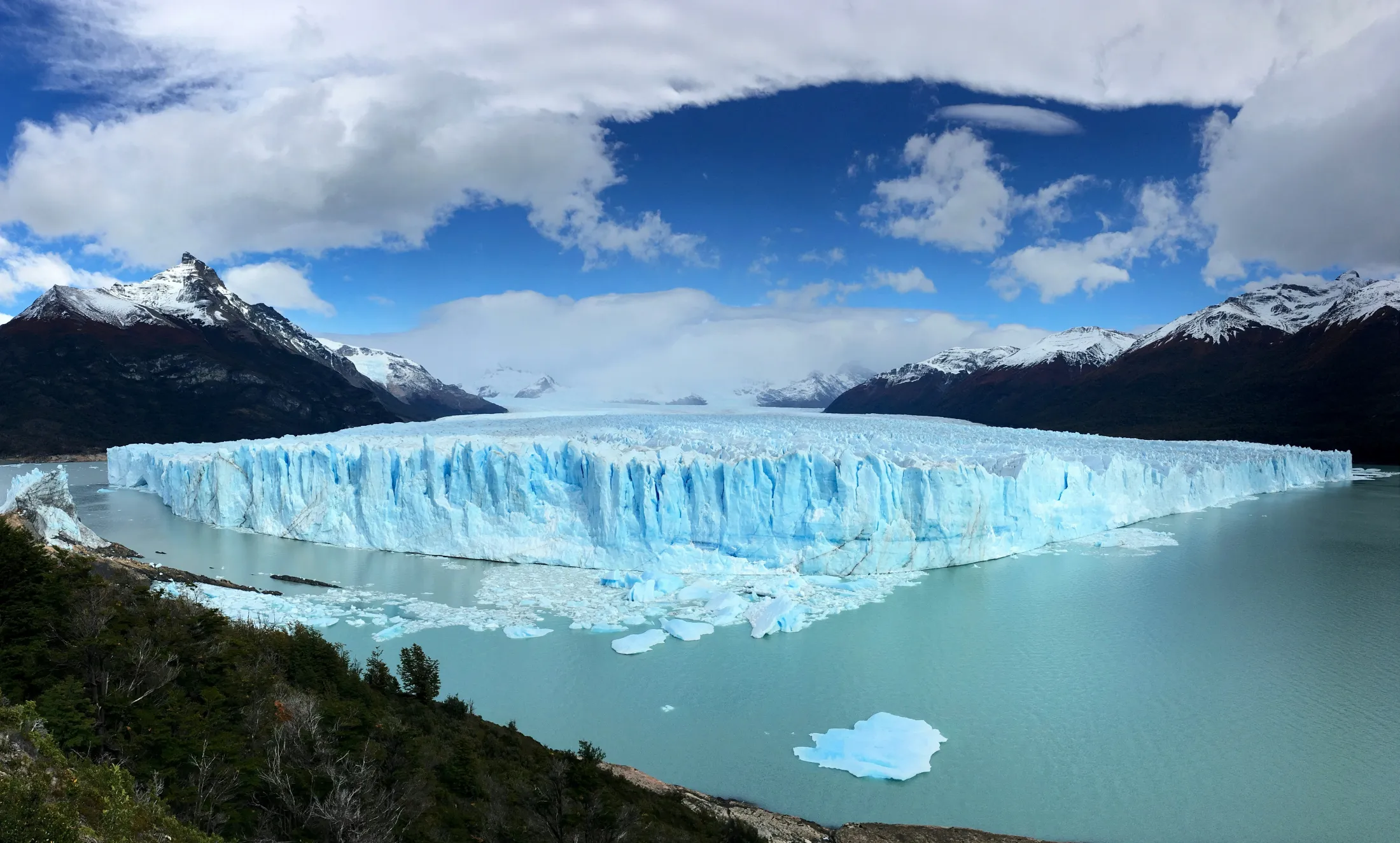
The Perito Moreno Glacier with green glacial water in the foreground and snow-capped mountains in the background

Day 2:Perito Moreno glacier

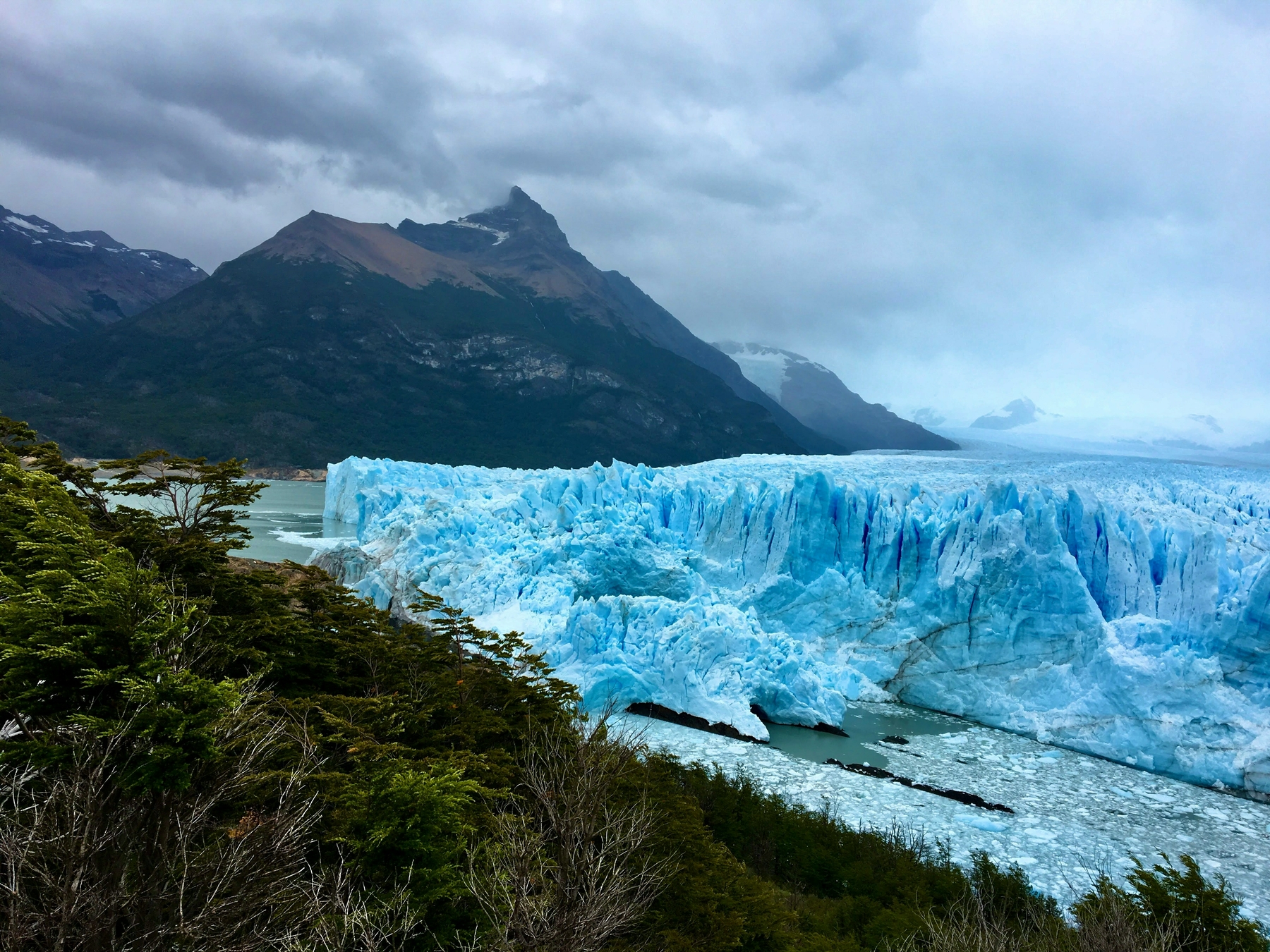
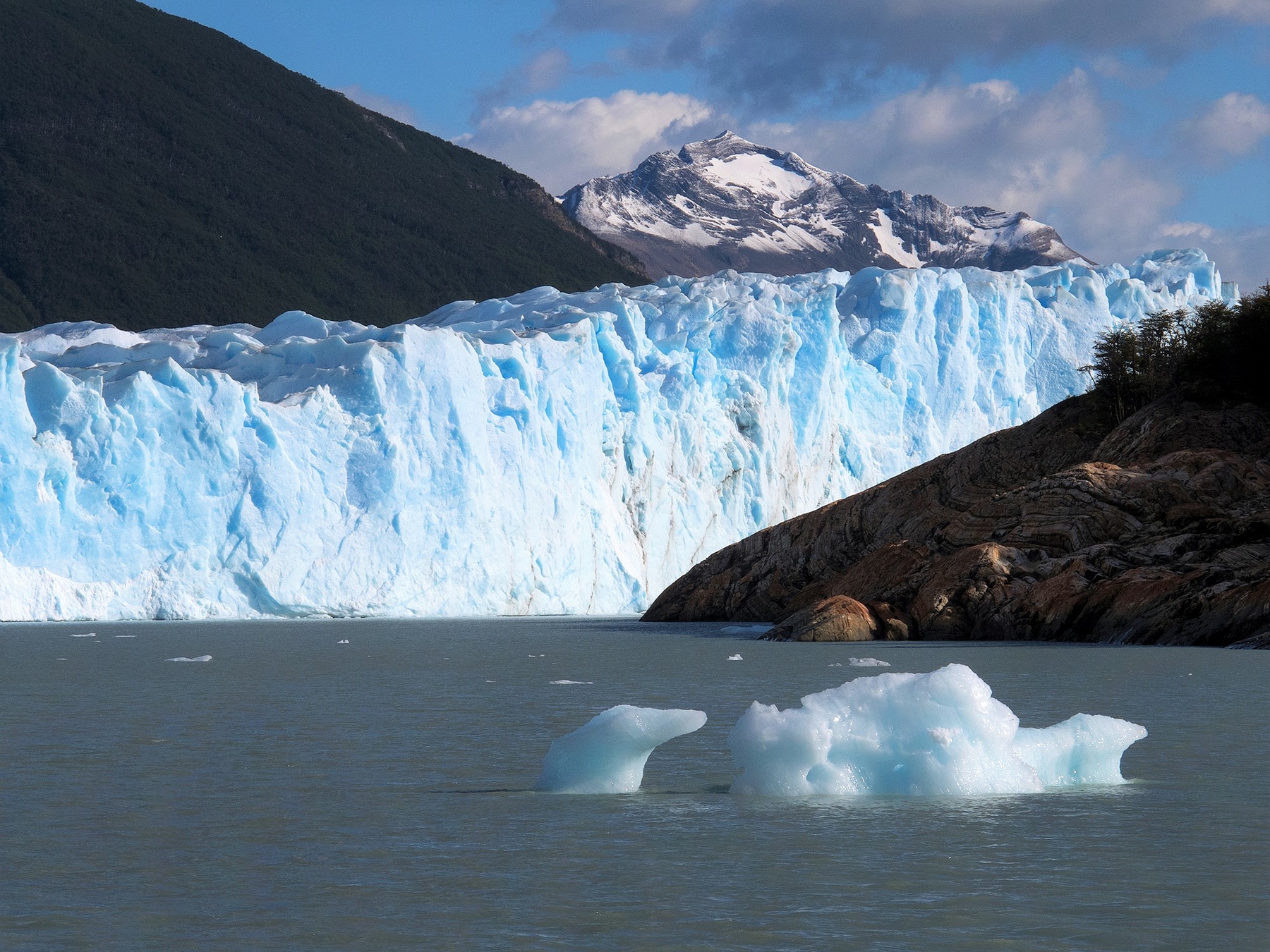
Today, we will experience one of the world's most impressive and living natural wonders. We set course west toward the Chilean border. After about a two-hour drive, we arrive at Los Glaciares National Park to see the Perito Moreno Glacier. Here, we board a catamaran to sail right up to the massive glacier wall. With a bit of luck, we will witness the dramatic sight and hear the thundering roar as enormous blocks of ice break off and plunge into the cold, turquoise water. After the boat trip, we head up to the visitor center for a short walk with views of the glacier. We can also grab a coffee and a bite to eat before returning to El Calafate during the afternoon.

Today, we will experience one of the world's most impressive and living natural wonders. We set course west toward the Chilean border. After about a two-hour drive, we arrive at Los Glaciares National Park to see the Perito Moreno Glacier. Here, we board a catamaran to sail right up to the massive glacier wall. With a bit of luck, we will witness the dramatic sight and hear the thundering roar as enormous blocks of ice break off and plunge into the cold, turquoise water. After the boat trip, we head up to the visitor center for a short walk with views of the glacier. We can also grab a coffee and a bite to eat before returning to El Calafate during the afternoon.

Hotel

B,-,-

Day 3:Chaltén - Río Eléctrico - Poincenot Camp

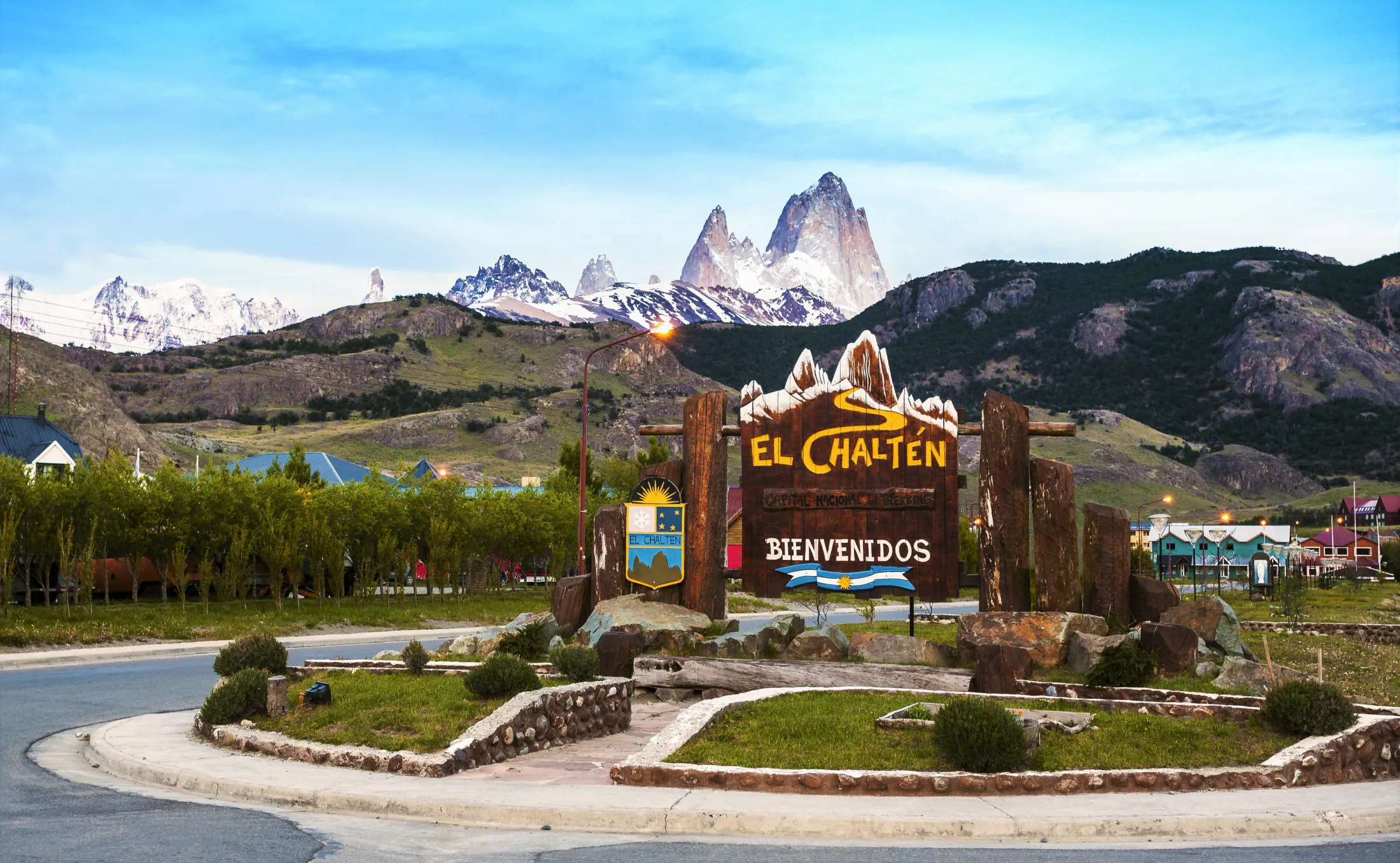
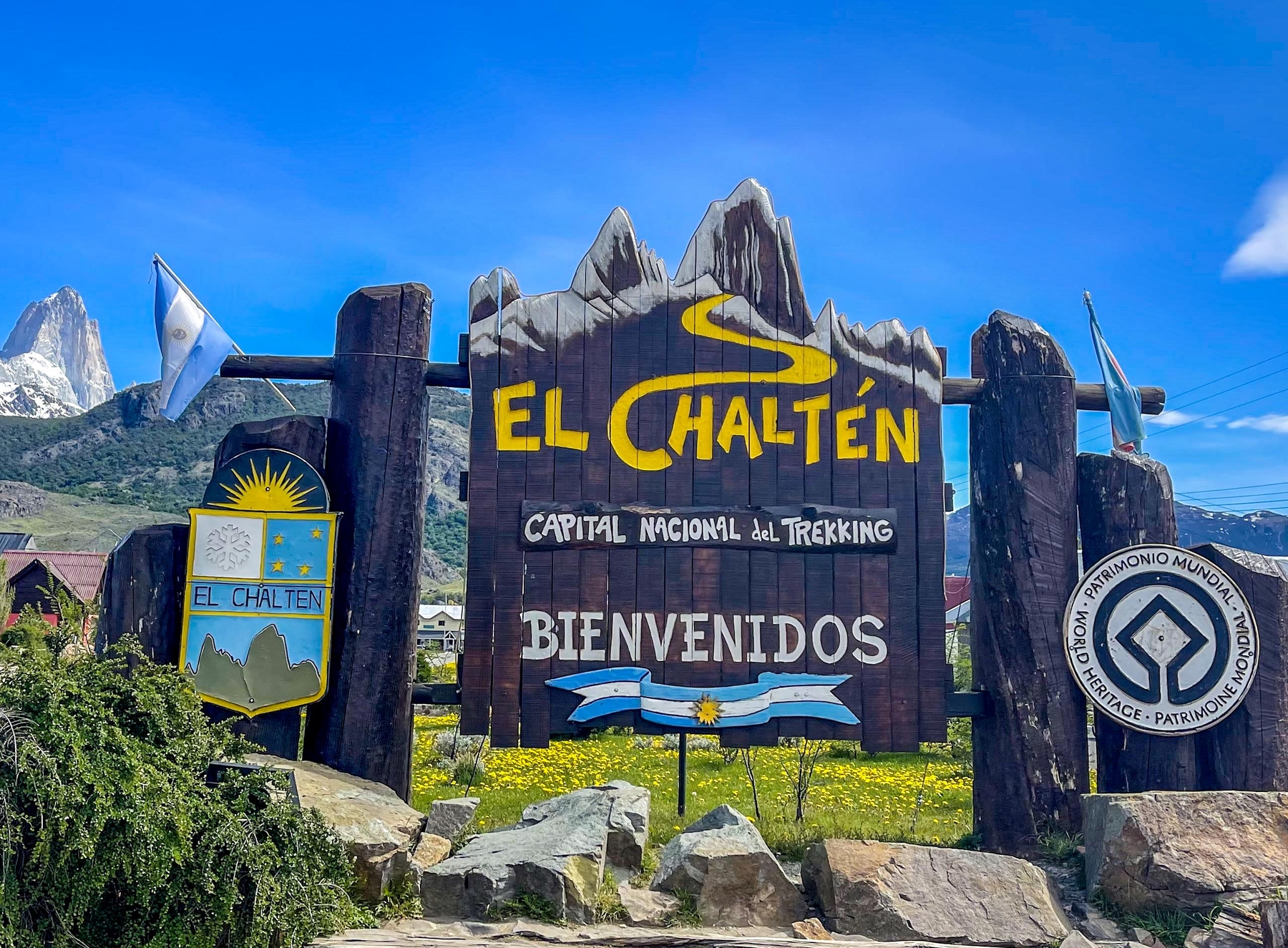
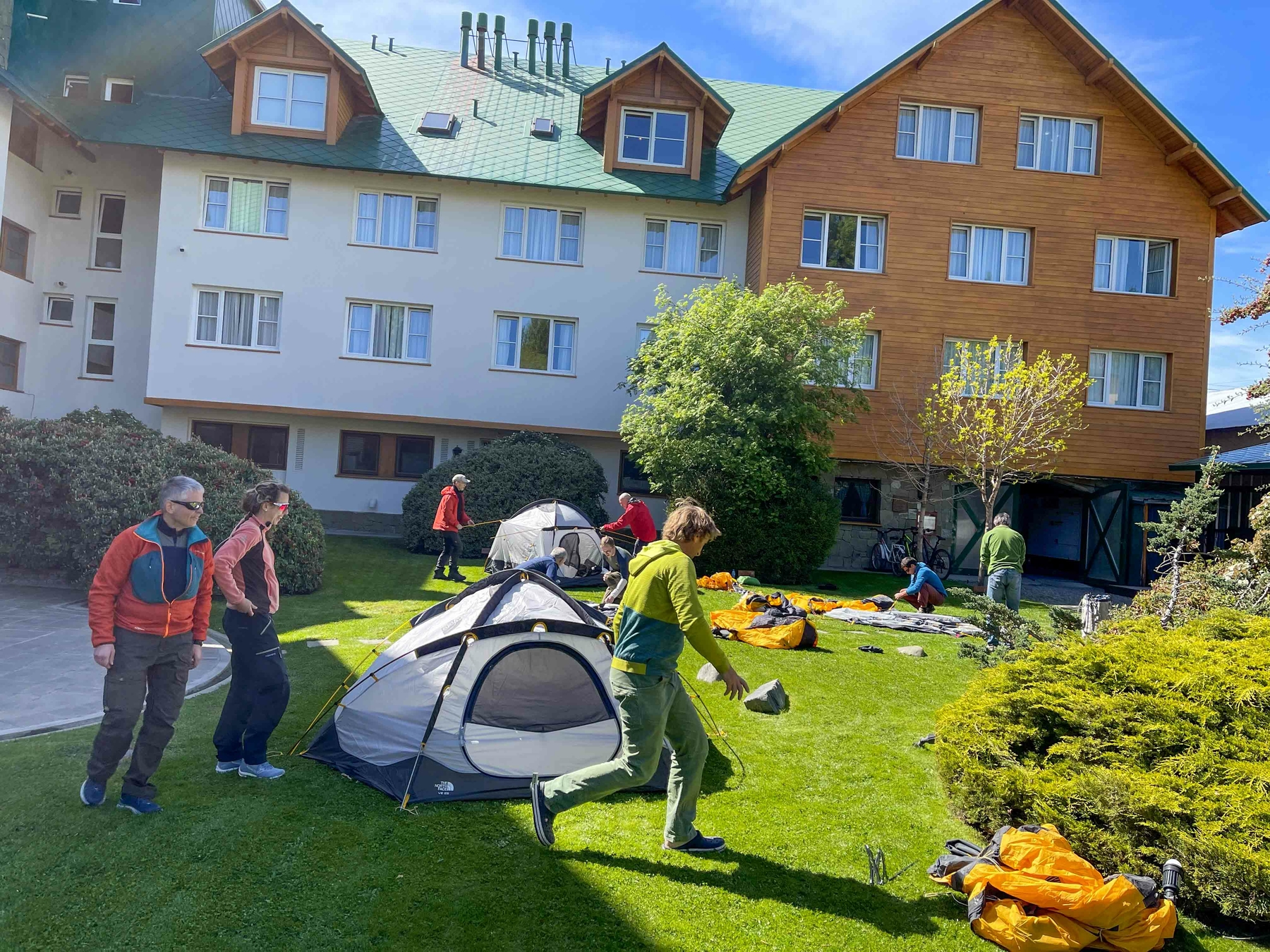
We start the day with a scenic drive from El Calafate to El Chaltén. The roughly 220-kilometer journey takes us through the vast, magnificent Patagonian landscape, past steppes, sparkling lakes, and the first glimpses of the Andes Mountains in the distance. We will take time for photo stops along the way. In El Chaltén, Argentina's official trekking capital, we leave our main luggage behind before driving the last short stretch toward Río Eléctrico and Hostería El Pilar (448 m). Here, we begin our hike into the beautiful Fitz Roy Valley. The trail offers fantastic views all the way up to our camp. Upon arrival at Poincenot Camp (774 m), we pitch our tents and prepare for dinner under the open sky.

We start the day with a scenic drive from El Calafate to El Chaltén. The roughly 220-kilometer journey takes us through the vast, magnificent Patagonian landscape, past steppes, sparkling lakes, and the first glimpses of the Andes Mountains in the distance. We will take time for photo stops along the way. In El Chaltén, Argentina's official trekking capital, we leave our main luggage behind before driving the last short stretch toward Río Eléctrico and Hostería El Pilar (448 m). Here, we begin our hike into the beautiful Fitz Roy Valley. The trail offers fantastic views all the way up to our camp. Upon arrival at Poincenot Camp (774 m), we pitch our tents and prepare for dinner under the open sky.

Tent

B,L,D

2 - 3 hours

+350m

9 km

Day 5:Laguna Torre - Paso de las Agachonas (1450 m) - Laguna Toro (671 m)

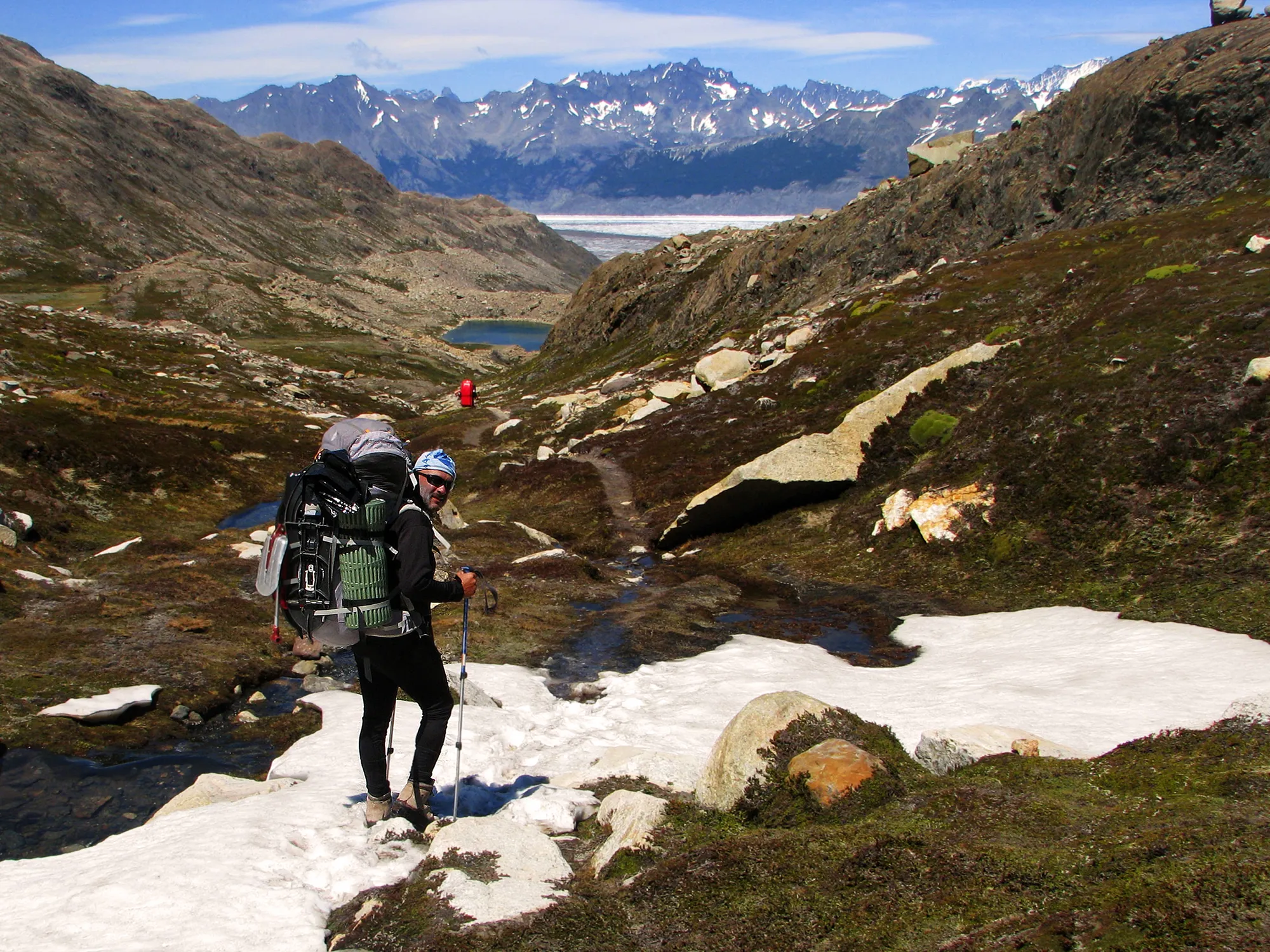
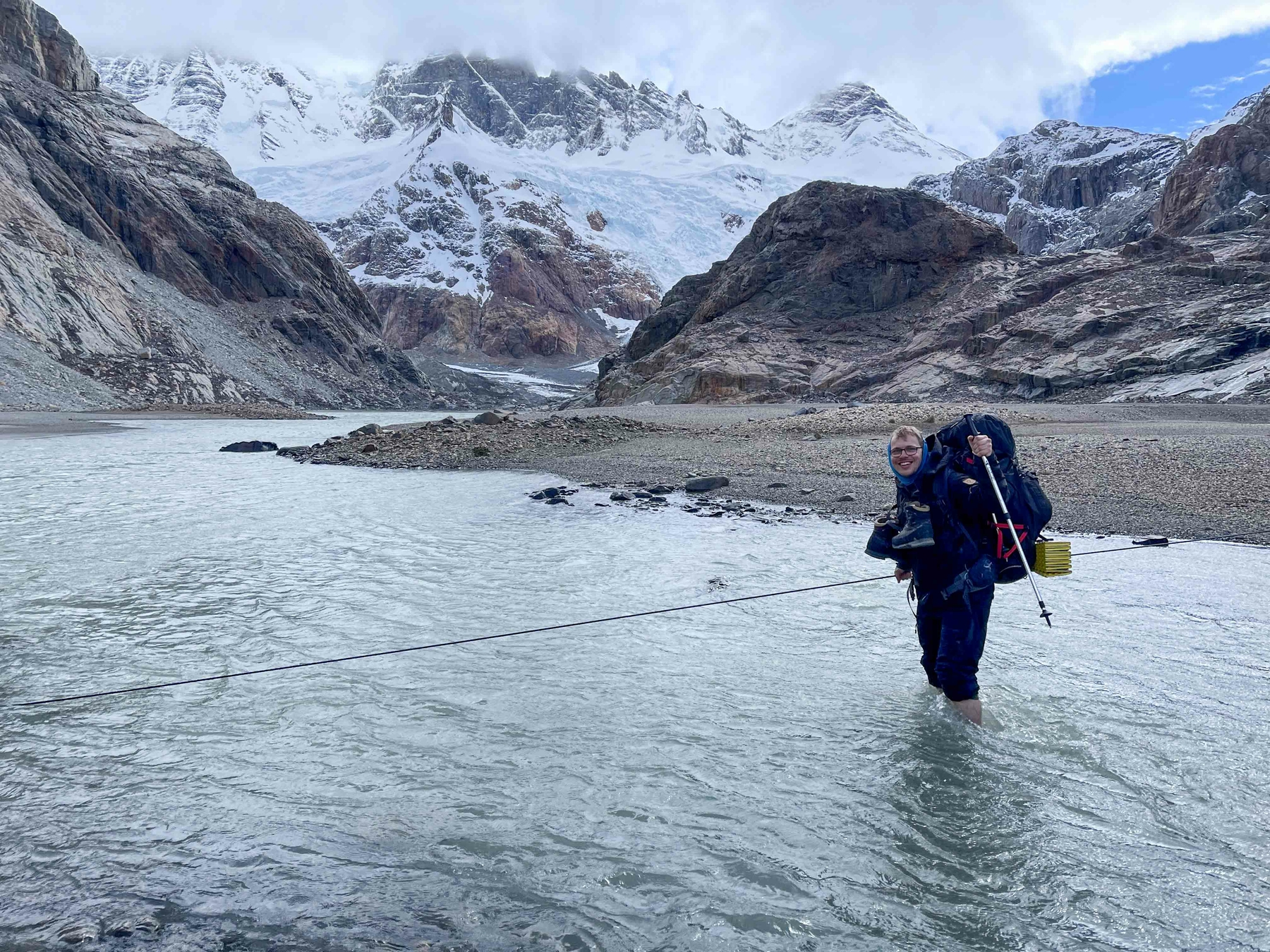
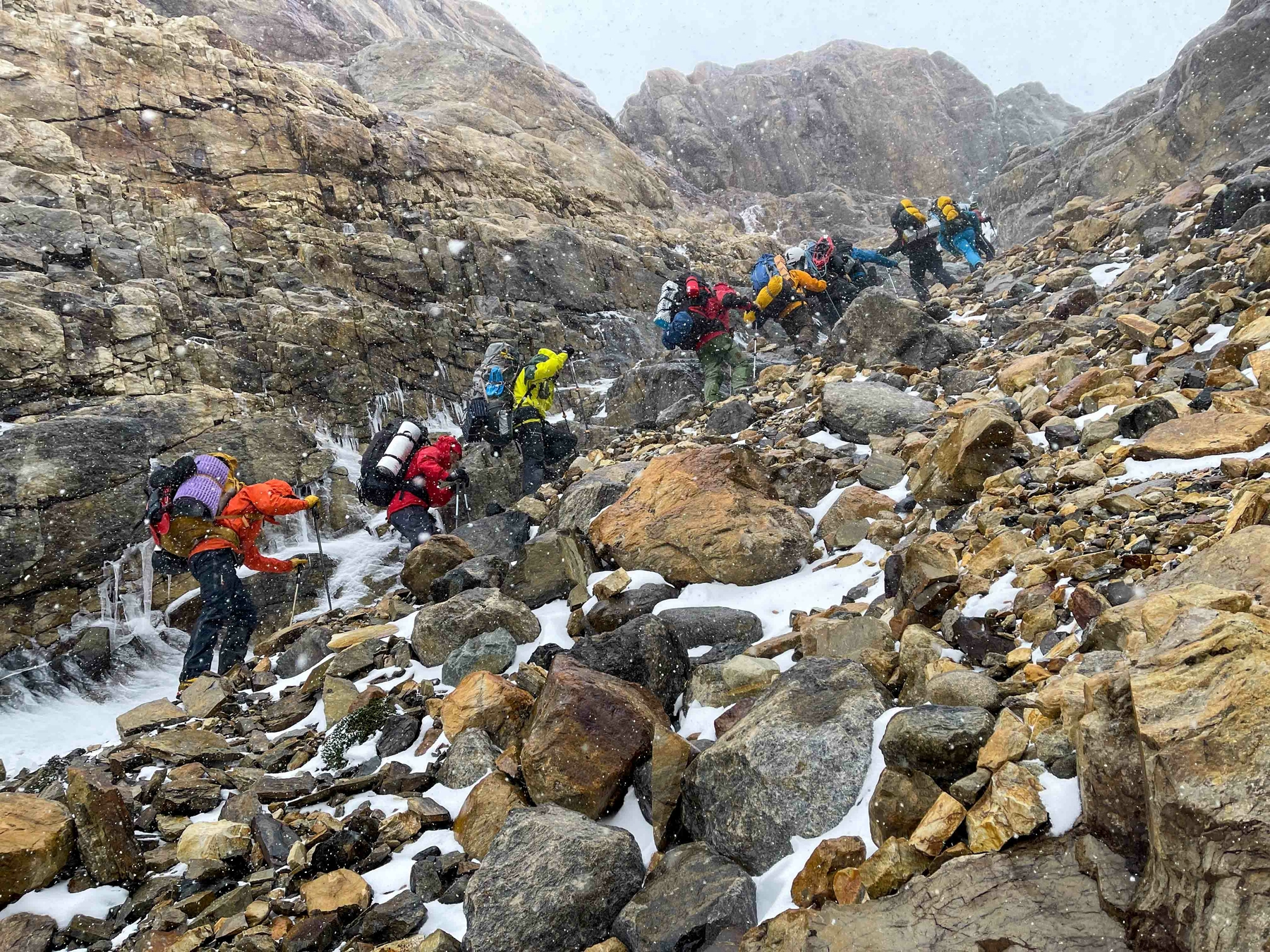
We start early by crossing the rushing Fitz Roy River using a zipline system (rope and harness). Once on the other side, we begin the brisk ascent toward Paso de las Agachonas. Paso de las Agachonas (1,450 m) is a spectacular and exposed mountain pass squeezed between raw, jagged peaks. Up here, we are rewarded with expansive views of the surrounding valleys and glaciers. Crossing the pass requires surefootedness, there is no marked trail here, and we must safely navigate rough, unpredictable, and rocky high-mountain terrain. After conquering the pass, we begin the descent toward Laguna Toro (671 m). The landscape that meets us here is nothing short of striking. If we are lucky, snow-capped peaks will reflect in the mirror-still water, and a truly special sense of peace and isolation rests over this campsite.

We start early by crossing the rushing Fitz Roy River using a zipline system (rope and harness). Once on the other side, we begin the brisk ascent toward Paso de las Agachonas. Paso de las Agachonas (1,450 m) is a spectacular and exposed mountain pass squeezed between raw, jagged peaks. Up here, we are rewarded with expansive views of the surrounding valleys and glaciers. Crossing the pass requires surefootedness, there is no marked trail here, and we must safely navigate rough, unpredictable, and rocky high-mountain terrain. After conquering the pass, we begin the descent toward Laguna Toro (671 m). The landscape that meets us here is nothing short of striking. If we are lucky, snow-capped peaks will reflect in the mirror-still water, and a truly special sense of peace and isolation rests over this campsite.

Tent

B,L,D

7 - 8 hours

800m/800m

14 km

Day 4:Poincenot - Laguna de los Tres (1200 m) - Laguna Torre (645 m)

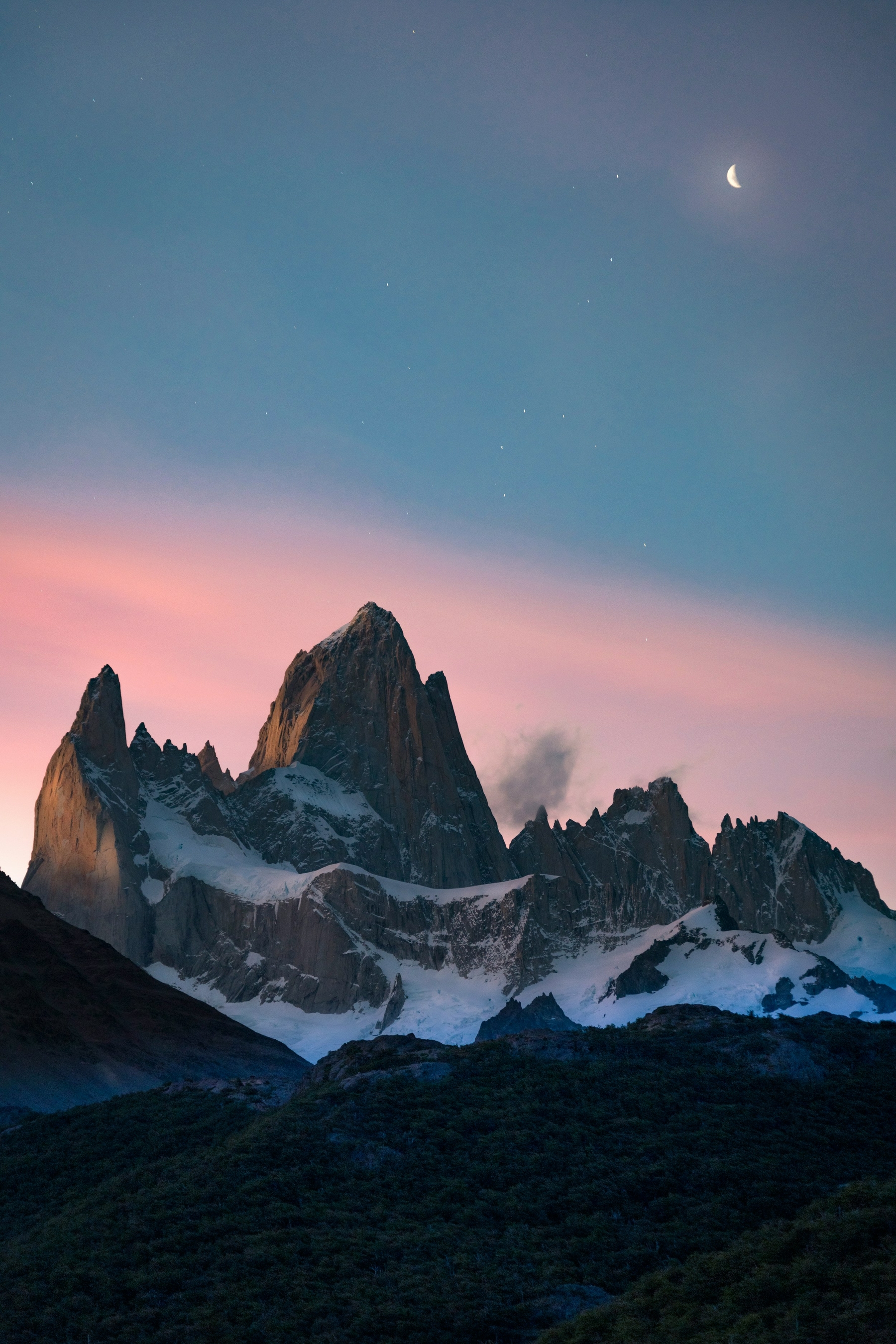
Get ready for an unforgettable day featuring two of the area's absolute classics on a single leg. We start at the crack of dawn and hike up the steep trail to Laguna de los Tres. The reward is magical: up here, we experience the sunrise casting a fiery red and golden glow over the east face of Fitz Roy. After soaking in the magnificent view, we hike back down, pick up our luggage, and continue our trek past the lakes Laguna Madre and Laguna Hija, where we enjoy panoramic views over the Torre Valley. The trail winds onward through deep, ancient lenga forests, over historic moraine ridges, and across flat riverbeds before we finally reach Laguna Torre. At the shores of Laguna Torre, a beautiful sight awaits us: large, blue-and-white icebergs floating lazily on the water after calving from the Torre Glacier.

Get ready for an unforgettable day featuring two of the area's absolute classics on a single leg. We start at the crack of dawn and hike up the steep trail to Laguna de los Tres. The reward is magical: up here, we experience the sunrise casting a fiery red and golden glow over the east face of Fitz Roy. After soaking in the magnificent view, we hike back down, pick up our luggage, and continue our trek past the lakes Laguna Madre and Laguna Hija, where we enjoy panoramic views over the Torre Valley. The trail winds onward through deep, ancient lenga forests, over historic moraine ridges, and across flat riverbeds before we finally reach Laguna Torre. At the shores of Laguna Torre, a beautiful sight awaits us: large, blue-and-white icebergs floating lazily on the water after calving from the Torre Glacier.

Tent

B,L,D

4 - 5 hours

450m/650m

18 km

Day 6:Laguna Toro - Paso del Viento (1550 m) - Paso del Viento-hytta (924 m)

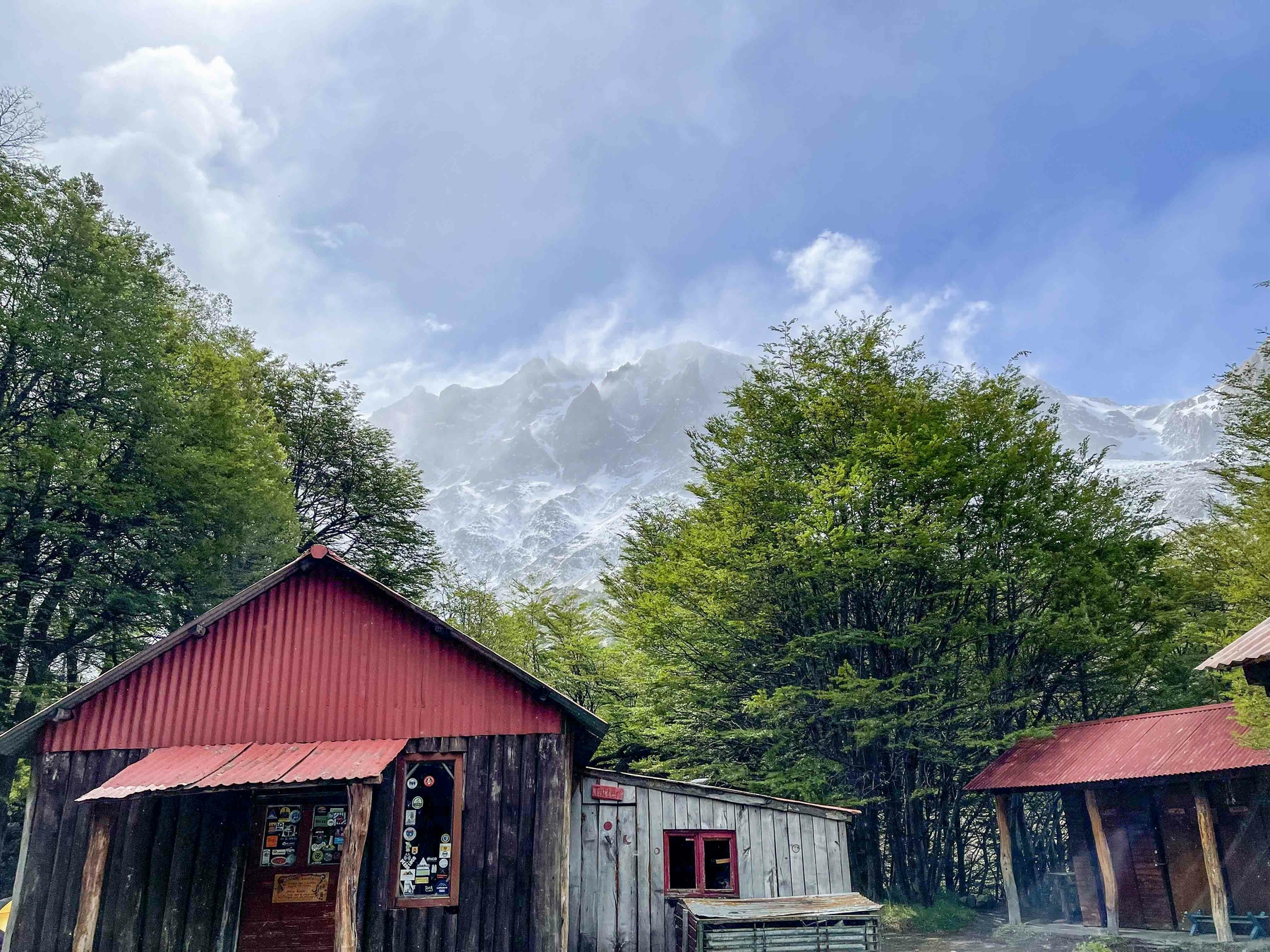
The day starts by crossing the Río Túnel, an exciting river crossing carried out either via zipline or by wading through the icy water. We then begin a long, challenging ascent, making our way up through ancient moraines, scree, and snowfields toward Paso del Viento (1,550 m). When we reach the top of the pass, the landscape opens up, revealing the Southern Patagonian Icefield (Campo de Hielo Sur) stretching out as far as the eye can see. Standing here in the wind and looking out over this massive, white sea of ice is a goosebump-inducing natural spectacle. After taking in this majestic scene, we descend to our camp near the Paso del Viento hut (924 m), where we pitch our tents for the night.

The day starts by crossing the Río Túnel, an exciting river crossing carried out either via zipline or by wading through the icy water. We then begin a long, challenging ascent, making our way up through ancient moraines, scree, and snowfields toward Paso del Viento (1,550 m). When we reach the top of the pass, the landscape opens up, revealing the Southern Patagonian Icefield (Campo de Hielo Sur) stretching out as far as the eye can see. Standing here in the wind and looking out over this massive, white sea of ice is a goosebump-inducing natural spectacle. After taking in this majestic scene, we descend to our camp near the Paso del Viento hut (924 m), where we pitch our tents for the night.

Tent

B,L,D

4 - 6 hours

750m/500m

13 km

Day 7:Via Paso Huemul (1016 m) og ned til Bahía de los Témpanos ved Viedmasjøen (268 m)

We continue our journey along the edge of the mighty Viedma Glacier. The trail winds up and down through raw, rugged terrain. After a few hours of hard work, we reach Paso Huemul (1,016 m). From here, we enjoy a stunning view of the point where the glacier plunges directly into Lake Viedma. A long and steep descent toward the shores of the lake begins from the pass. It is a real test for the knees, but the reward at the bottom is worth every single step. We arrive at Bahía de los Témpanos (Iceberg Bay), where we pitch camp right by the water's edge. Here, we fall asleep to the sight of massive, bluish ice blocks drifting silently past, right outside our tent openings.

We continue our journey along the edge of the mighty Viedma Glacier. The trail winds up and down through raw, rugged terrain. After a few hours of hard work, we reach Paso Huemul (1,016 m). From here, we enjoy a stunning view of the point where the glacier plunges directly into Lake Viedma. A long and steep descent toward the shores of the lake begins from the pass. It is a real test for the knees, but the reward at the bottom is worth every single step. We arrive at Bahía de los Témpanos (Iceberg Bay), where we pitch camp right by the water's edge. Here, we fall asleep to the sight of massive, bluish ice blocks drifting silently past, right outside our tent openings.

Tent

B,L,D

6 - 7 hours

950m/300m

15 km

Day 8:Toro Lake and river crossing

We start the morning at a relaxed pace by the shores of Lake Viedma, enjoying a final cup of coffee as we watch the icebergs float by. We then set off on today's leg, where the trail crosses the open, dry, and wind-swept Patagonian steppe. As we trek, the barren landscape flattens out and gradually softens. After about 6 to 7 hours of hiking, the houses of El Chaltén finally appear in the distance. It is a fantastic feeling to see civilization again, we have completed the legendary circuit around the entirety of Cerro Huemul and its mighty world of glaciers. The final stretch from the trailhead to the hotel in El Chaltén is completed by car.

We start the morning at a relaxed pace by the shores of Lake Viedma, enjoying a final cup of coffee as we watch the icebergs float by. We then set off on today's leg, where the trail crosses the open, dry, and wind-swept Patagonian steppe. As we trek, the barren landscape flattens out and gradually softens. After about 6 to 7 hours of hiking, the houses of El Chaltén finally appear in the distance. It is a fantastic feeling to see civilization again, we have completed the legendary circuit around the entirety of Cerro Huemul and its mighty world of glaciers. The final stretch from the trailhead to the hotel in El Chaltén is completed by car.

Tent

B,L,D

6 - 7 hours

250m/250m

18 km

Day 9:Resting day in El Chaltén

We press on with our descent, and today, we set our sights on the vibrant town of El Chaltén. Our trail meanders beside a lively river, leading us gradually down to the lowlands. As we tackle the final pass of our journey, the landscape transforms into a tapestry of lush greenery, vibrant flowers, and teeming wildlife. At last, we arrive in Chaltén, greeted by the comforts of civilization. Our quaint hostel awaits, promising a well-deserved rest. Reacquainting ourselves with the conveniences of town life, we relish the contrasting experiences of our adventure.

We press on with our descent, and today, we set our sights on the vibrant town of El Chaltén. Our trail meanders beside a lively river, leading us gradually down to the lowlands. As we tackle the final pass of our journey, the landscape transforms into a tapestry of lush greenery, vibrant flowers, and teeming wildlife. At last, we arrive in Chaltén, greeted by the comforts of civilization. Our quaint hostel awaits, promising a well-deserved rest. Reacquainting ourselves with the conveniences of town life, we relish the contrasting experiences of our adventure.

Tent

B,L,-

5 - 6 hours

350m/600m

Day 10:Visit to an authentic estancia with a traditional Patagonian asado

We start the day with transport from the hotel to a traditional estancia (ranch) located in Los Glaciares National Park, right on the shores of Lake Roca. After a warm welcome, you can choose how to explore the beautiful surroundings of the ranch, either on a peaceful hike or on horseback alongside real gauchos. After the activity, we gather at the shearing shed for a demonstration of how sheep shearing was done in the old days. Finally, we come together in the barbecue pavilion, where the master asador (pitmaster) has prepared a true Patagonian feast: Patagonian lamb slowly roasted on a spit over an open fire. As we enjoy the meal against the backdrop of the Andes Mountains, our hosts share stories of the tough pioneers who first settled this rugged region. After lunch, we drive back to El Calafate.

We start the day with transport from the hotel to a traditional estancia (ranch) located in Los Glaciares National Park, right on the shores of Lake Roca. After a warm welcome, you can choose how to explore the beautiful surroundings of the ranch, either on a peaceful hike or on horseback alongside real gauchos. After the activity, we gather at the shearing shed for a demonstration of how sheep shearing was done in the old days. Finally, we come together in the barbecue pavilion, where the master asador (pitmaster) has prepared a true Patagonian feast: Patagonian lamb slowly roasted on a spit over an open fire. As we enjoy the meal against the backdrop of the Andes Mountains, our hosts share stories of the tough pioneers who first settled this rugged region. After lunch, we drive back to El Calafate.

Guesthouse

B,-,D

Day 11:Free day in El Calafate or optional excursion

After a good night's sleep in El Calafate, this day is entirely at your leisure. El Calafate offers charming shops and cozy cafes, or you can choose to spend the day on an optional excursion from the town.

After a good night's sleep in El Calafate, this day is entirely at your leisure. El Calafate offers charming shops and cozy cafes, or you can choose to spend the day on an optional excursion from the town.

Hotel

B,-,-

Day 12:To Buenos Aires

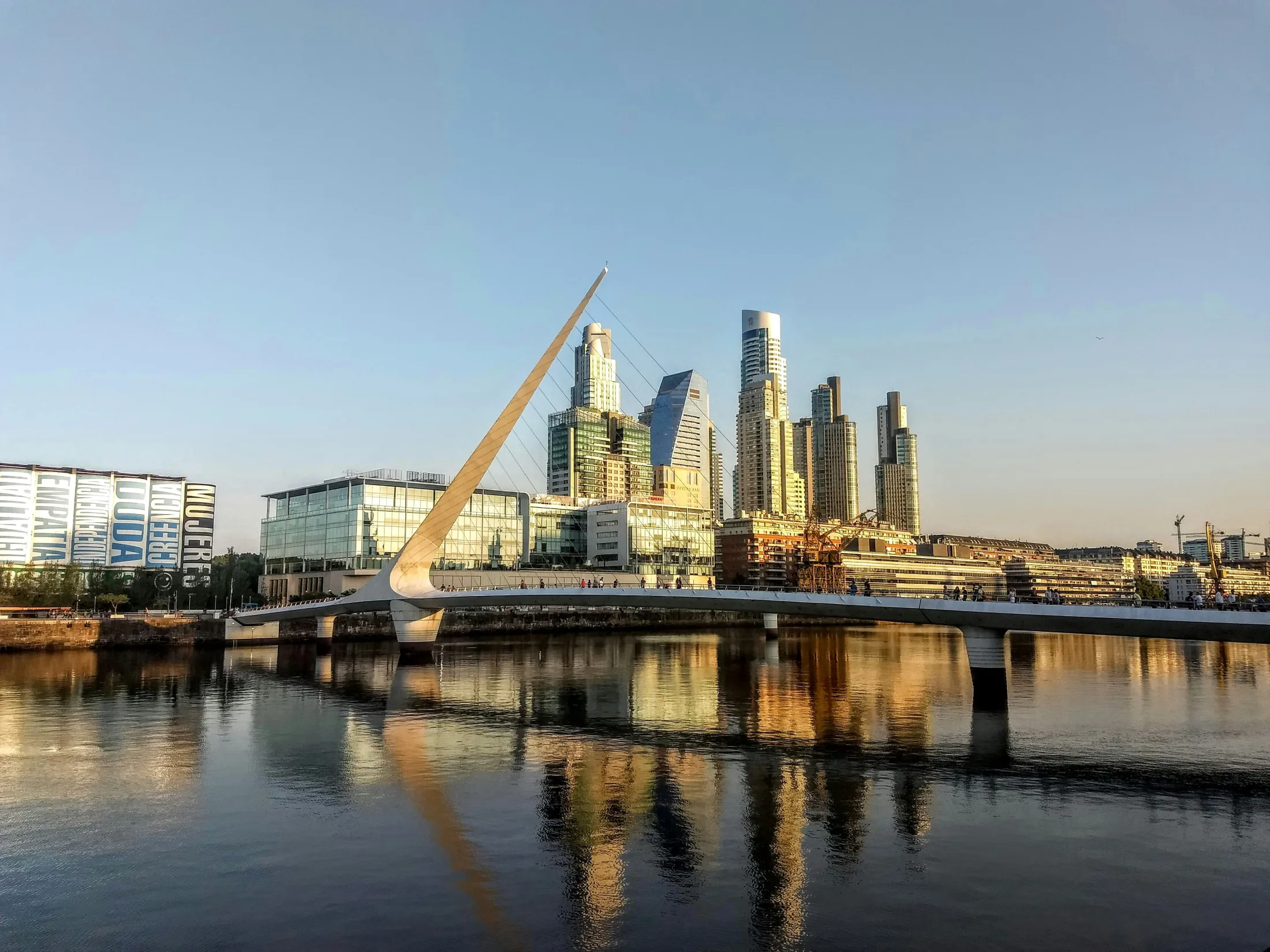
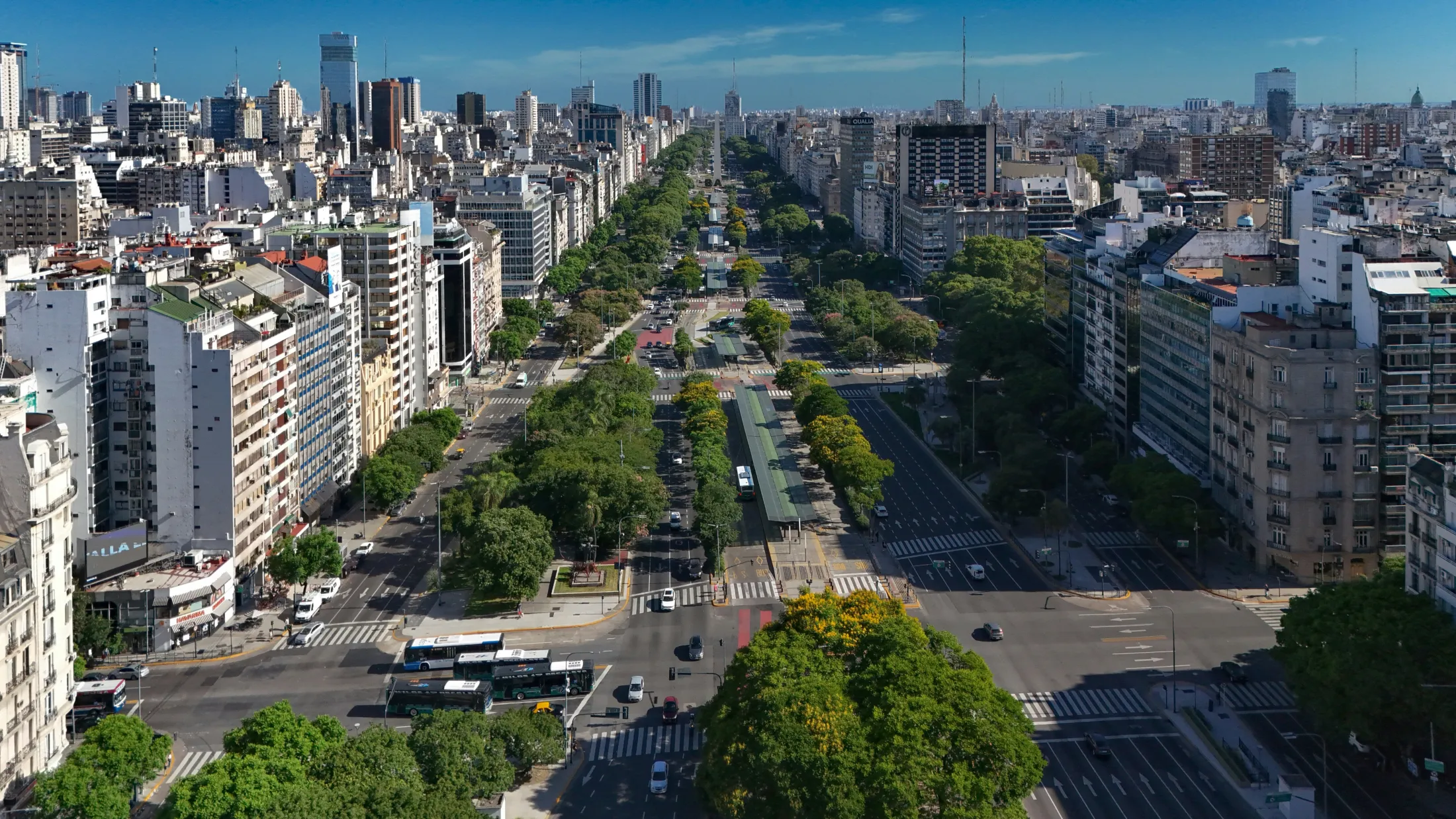
After a good breakfast at the hotel, we transfer to the airport in El Calafate to catch our flight to Buenos Aires. Once we have checked in to our hotel, we head out into the streets to take in the vibrant atmosphere of this exciting city.

After a good breakfast at the hotel, we transfer to the airport in El Calafate to catch our flight to Buenos Aires. Once we have checked in to our hotel, we head out into the streets to take in the vibrant atmosphere of this exciting city.

B,-,-

Day 13:Buenos Aires

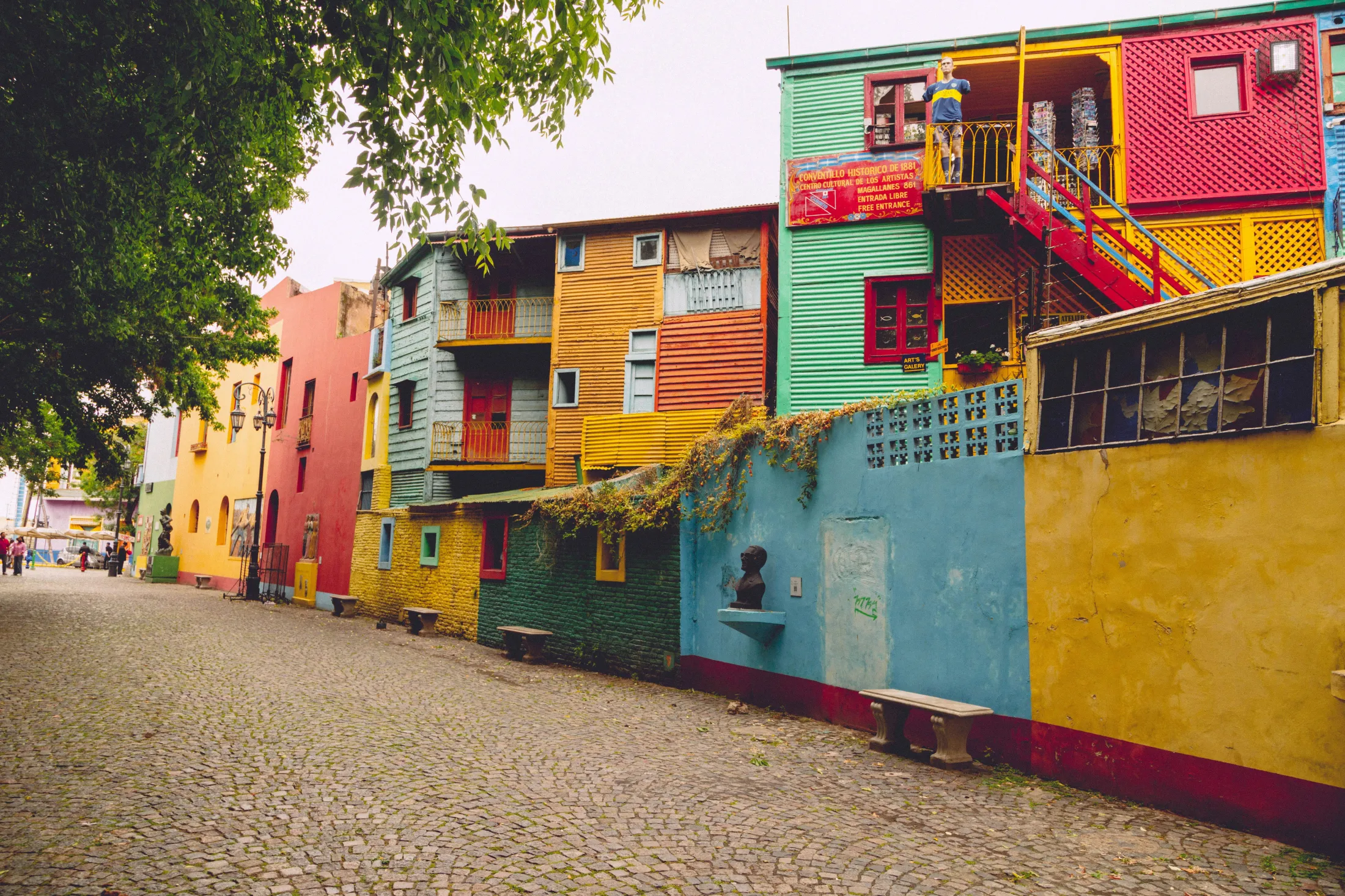
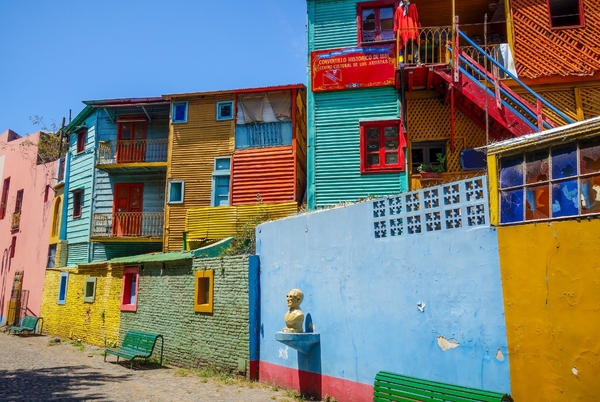
Today is entirely at your leisure. We can head to the city's oldest district, San Telmo, where the streets feature cobblestones, colonial architecture, and charming antique shops. We can visit the waterfront area where Italian immigrants built houses out of corrugated iron and leftover paint, or stop by the political district with the famous pink presidential palace. There are also opportunities to take in a tango show or enjoy a drink at one of the city's countless bars.

Today is entirely at your leisure. We can head to the city's oldest district, San Telmo, where the streets feature cobblestones, colonial architecture, and charming antique shops. We can visit the waterfront area where Italian immigrants built houses out of corrugated iron and leftover paint, or stop by the political district with the famous pink presidential palace. There are also opportunities to take in a tango show or enjoy a drink at one of the city's countless bars.

Hotel

B,-,-

Day 14:Journey home

We take an afternoon flight back home, leaving the morning free to soak up a little more of the Argentine atmosphere.

We take an afternoon flight back home, leaving the morning free to soak up a little more of the Argentine atmosphere.

Hotel

B,-,-

Day 15:Back home

Another adventure has come to an end, what will your next one be?

Another adventure has come to an end, what will your next one be?

We arrive in El Calafate and check in to the hotel. We can explore the town on our own, or together for those who wish. In the evening, we meet for a group dinner to get to know each other and go through the itinerary for the coming days.
Hotel

-,-,D

Today, we will experience one of the world's most impressive and living natural wonders. We set course west toward the Chilean border. After about a two-hour drive, we arrive at Los Glaciares National Park to see the Perito Moreno Glacier. Here, we board a catamaran to sail right up to the massive glacier wall. With a bit of luck, we will witness the dramatic sight and hear the thundering roar as enormous blocks of ice break off and plunge into the cold, turquoise water. After the boat trip, we head up to the visitor center for a short walk with views of the glacier. We can also grab a coffee and a bite to eat before returning to El Calafate during the afternoon.

Hotel

B,-,-

We start the day with a scenic drive from El Calafate to El Chaltén. The roughly 220-kilometer journey takes us through the vast, magnificent Patagonian landscape, past steppes, sparkling lakes, and the first glimpses of the Andes Mountains in the distance. We will take time for photo stops along the way. In El Chaltén, Argentina's official trekking capital, we leave our main luggage behind before driving the last short stretch toward Río Eléctrico and Hostería El Pilar (448 m). Here, we begin our hike into the beautiful Fitz Roy Valley. The trail offers fantastic views all the way up to our camp. Upon arrival at Poincenot Camp (774 m), we pitch our tents and prepare for dinner under the open sky.

Tent

B,L,D

2 - 3 hours

+350m

9 km

We start early by crossing the rushing Fitz Roy River using a zipline system (rope and harness). Once on the other side, we begin the brisk ascent toward Paso de las Agachonas. Paso de las Agachonas (1,450 m) is a spectacular and exposed mountain pass squeezed between raw, jagged peaks. Up here, we are rewarded with expansive views of the surrounding valleys and glaciers. Crossing the pass requires surefootedness, there is no marked trail here, and we must safely navigate rough, unpredictable, and rocky high-mountain terrain. After conquering the pass, we begin the descent toward Laguna Toro (671 m). The landscape that meets us here is nothing short of striking. If we are lucky, snow-capped peaks will reflect in the mirror-still water, and a truly special sense of peace and isolation rests over this campsite.

Tent

B,L,D

7 - 8 hours

800m/800m

14 km

Get ready for an unforgettable day featuring two of the area's absolute classics on a single leg. We start at the crack of dawn and hike up the steep trail to Laguna de los Tres. The reward is magical: up here, we experience the sunrise casting a fiery red and golden glow over the east face of Fitz Roy. After soaking in the magnificent view, we hike back down, pick up our luggage, and continue our trek past the lakes Laguna Madre and Laguna Hija, where we enjoy panoramic views over the Torre Valley. The trail winds onward through deep, ancient lenga forests, over historic moraine ridges, and across flat riverbeds before we finally reach Laguna Torre. At the shores of Laguna Torre, a beautiful sight awaits us: large, blue-and-white icebergs floating lazily on the water after calving from the Torre Glacier.

Tent

B,L,D

4 - 5 hours

450m/650m

18 km

The day starts by crossing the Río Túnel, an exciting river crossing carried out either via zipline or by wading through the icy water. We then begin a long, challenging ascent, making our way up through ancient moraines, scree, and snowfields toward Paso del Viento (1,550 m). When we reach the top of the pass, the landscape opens up, revealing the Southern Patagonian Icefield (Campo de Hielo Sur) stretching out as far as the eye can see. Standing here in the wind and looking out over this massive, white sea of ice is a goosebump-inducing natural spectacle. After taking in this majestic scene, we descend to our camp near the Paso del Viento hut (924 m), where we pitch our tents for the night.

Tent

B,L,D

4 - 6 hours

750m/500m

13 km

We continue our journey along the edge of the mighty Viedma Glacier. The trail winds up and down through raw, rugged terrain. After a few hours of hard work, we reach Paso Huemul (1,016 m). From here, we enjoy a stunning view of the point where the glacier plunges directly into Lake Viedma. A long and steep descent toward the shores of the lake begins from the pass. It is a real test for the knees, but the reward at the bottom is worth every single step. We arrive at Bahía de los Témpanos (Iceberg Bay), where we pitch camp right by the water's edge. Here, we fall asleep to the sight of massive, bluish ice blocks drifting silently past, right outside our tent openings.

Tent

B,L,D

6 - 7 hours

950m/300m

15 km

We start the morning at a relaxed pace by the shores of Lake Viedma, enjoying a final cup of coffee as we watch the icebergs float by. We then set off on today's leg, where the trail crosses the open, dry, and wind-swept Patagonian steppe. As we trek, the barren landscape flattens out and gradually softens. After about 6 to 7 hours of hiking, the houses of El Chaltén finally appear in the distance. It is a fantastic feeling to see civilization again, we have completed the legendary circuit around the entirety of Cerro Huemul and its mighty world of glaciers. The final stretch from the trailhead to the hotel in El Chaltén is completed by car.

Tent

B,L,D

6 - 7 hours

250m/250m

18 km

We press on with our descent, and today, we set our sights on the vibrant town of El Chaltén. Our trail meanders beside a lively river, leading us gradually down to the lowlands. As we tackle the final pass of our journey, the landscape transforms into a tapestry of lush greenery, vibrant flowers, and teeming wildlife. At last, we arrive in Chaltén, greeted by the comforts of civilization. Our quaint hostel awaits, promising a well-deserved rest. Reacquainting ourselves with the conveniences of town life, we relish the contrasting experiences of our adventure.

Tent

B,L,-

5 - 6 hours

350m/600m

We start the day with transport from the hotel to a traditional estancia (ranch) located in Los Glaciares National Park, right on the shores of Lake Roca. After a warm welcome, you can choose how to explore the beautiful surroundings of the ranch, either on a peaceful hike or on horseback alongside real gauchos. After the activity, we gather at the shearing shed for a demonstration of how sheep shearing was done in the old days. Finally, we come together in the barbecue pavilion, where the master asador (pitmaster) has prepared a true Patagonian feast: Patagonian lamb slowly roasted on a spit over an open fire. As we enjoy the meal against the backdrop of the Andes Mountains, our hosts share stories of the tough pioneers who first settled this rugged region. After lunch, we drive back to El Calafate.

Guesthouse

B,-,D

After a good night's sleep in El Calafate, this day is entirely at your leisure. El Calafate offers charming shops and cozy cafes, or you can choose to spend the day on an optional excursion from the town.

Hotel

B,-,-

After a good breakfast at the hotel, we transfer to the airport in El Calafate to catch our flight to Buenos Aires. Once we have checked in to our hotel, we head out into the streets to take in the vibrant atmosphere of this exciting city.

B,-,-

Today is entirely at your leisure. We can head to the city's oldest district, San Telmo, where the streets feature cobblestones, colonial architecture, and charming antique shops. We can visit the waterfront area where Italian immigrants built houses out of corrugated iron and leftover paint, or stop by the political district with the famous pink presidential palace. There are also opportunities to take in a tango show or enjoy a drink at one of the city's countless bars.

Hotel

B,-,-

We take an afternoon flight back home, leaving the morning free to soak up a little more of the Argentine atmosphere.

Hotel

B,-,-

Another adventure has come to an end, what will your next one be?

What's included in the price

Included

English-speaking local guide

All transportation as specified in the program.

In shared double rooms and two-person tents.

As specified in the program.

Not included

To local guides and assistants. Tips are a common and expected part of being a tourist in many of the destinations we visit. These are given in cash during the trip and therefore cannot be included in the tour price.

On request in El Calafate and El Chalten

Terms and Conditions

We reserve the right to change prices. The day by day program is indicative and changes may occur. We also refer to our general travel conditions.

Travel Insurance

On all our trips, we advise you to have full travel and accident insurance, which must also cover potential medical repatriation. Read more about travel insurance.

Highlights

Reviews

Rated
-
- reviews
(-)
(-)
(-)
(-)
(-)

Safety & Grading

Read more

For departures with Norrøna Adventure guides:

  • 24-hour emergency response
  • Guides trained in first aid in the field
  • Basic first aid equipment available
  • Cooperation with Turlegen.no for medical advice

On this trip, it is important to understand that we will be traveling far off the beaten track. We will of course do everything we can to assist if anything should happen, but any rescue operation could take longer than on other trips we organize. It is therefore extremely important that all participants are well prepared and ready to deal with unforeseen situations. 

Physical level

3/6 Physical

Some segments of the journey may prove challenging. It's essential to possess a solid level of fitness prior to departure. Persistence will be required in reaching the trip's goal.

Comfort level

2/6 Comfort

We overnight in tents. We are usually served food, but may have to contribute with cooking on certain occasions.

Risk level

3/6 Risk

Activities/trips with some risk. Certain incidents may occur, and they may be of such a nature that they may require professional help.

Training and Preparations

This trip is for the tough, featuring numerous and relatively long stages, and you can expect a lot of wind and challenging weather. For seven days, we will be hiking and carrying all our gear for the entire trek in our backpacks. At a couple of points along the way, we will likely need to cross rivers via zip line; this is not technically demanding, and no prior experience is required.

We carry our backpacks for the entire trek. Be prepared to carry some extra equipment, such as shared food, in addition to your personal gear. You should be accustomed to hiking with a heavy pack.

This trip is designed for participants with experience from multi-day treks. Parts of the route will be physically demanding: we must set up our own tents, break camp, and carry our backpacks, sometimes in brilliant sunshine, other times in rain and wind. Weather is a major factor that can turn even a simple day hike into a significant challenge. On several days we will be tackling considerable elevation gain, so trekking poles are highly recommended.

Visas, Vaccinations and Health

Before embarking on our journey together, we kindly remind all trip participants to check their respective country's visa status and vaccination requirements. Ensuring your travel documents are in order is a crucial step in guaranteeing a smooth and hassle-free adventure. 

Norwegian citizens do not need a visa to travel to Mongolia. Your passport must be valid for at least 6 months after your return. See also the current entry and visa regulations on the Ministry of Foreign Affairs' country pages.

 If you are over 67 years old, you should have a thorough medical check-up before your trip. Make your doctor aware that this is a trip involving physical exertion and moving off the beaten track.

It is important that you complete all parts of the registration form (especially where we ask for information about health and allergies), and let us know if there is anything we need to be aware of prior to and during the trip. Relevant health information that may affect the trip should also be communicated to the guide at the start of the trip. *Note* - If you are on regular medication, have known allergies or anything similar, you must always bring your personal medication with you.

See the overview on FHI´s pages on travel health advice. For vaccination and guidance, please contact Sentrum Reisemedisin: Reisemedisin.no.

Additional Information

We will be sleeping in tents during the trek itself.

It is not always easy to find gluten-free whole-grain bread, lactose-free alternatives, or to accommodate other dietary preferences in all locations. Please specify any allergies on your registration form, and we will do our best to accommodate you. Nevertheless, we recommend that anyone with specific dietary needs bring along a few alternatives, such as a pack of crispbread, energy bars, or similar items you know you can eat.

Equipment list

This list is intended as a guideline, so that we have what we need regardless of the weather we get on the trip. Remember that you can also get used outdoor equipment that works perfectly. Get in touch if you have any questions. TIP: We recommend that you have the most important equipment in your hand luggage, for example hiking boots and gore-tex jacket/trousers.

Obligatory

Clothing

2 sets of top and bottom. Not too thick, instead use multiple layers.

2-3 pairs. Wool or synthetic material.

Fleece or wool. 

Down or synthetic insulation, medium thickness.

Gore-Tex or similar. Must have a decent hood, and hold out wind and rain. Should have space for midlayers underneath. Ventilation under the arms is recommended. 

Gore-Tex or similar. Must hold out wind and rain. Ventilation zippers along the legs is recommended.

Warm hat for cold days.

The overmittens should be roomy and extend well up the forearm. They should be windproof and ideally handle some moisture. They need to provide a good grip, even with the inner mittens inside. The inner mittens should be thick and warm, preferably made of wool.

Footwear

Solid hiking boots with extra room for warm socks.  

Equipment

Avoid bringing a suitcase, they are more difficult to transport between hotels.

In this pack, you’ll carry what you need during the day on the hike: extra clothes, food, water, snacks, etc. Remember a rain cover. Around 30 liters, give or take, is suitable.

Comfort temperature down to -10 degrees (C).

For winter use. For example Exped down mat or Thermarest NeoAir. Used together with the flat sleeping mat.

Waterproof pack bags to keep your clothes and gear dry, organized, and help reduce volume. It is especially important to have dedicated waterproof bags for essential equipment on your trip, such as your sleeping bag, down jacket, and electronics.

They can be used in your backpack while hiking or skiing, in your sled bag on ski expeditions, or in your duffel bag on trips where the bag is carried by porters, mules, or similar.

Light. Have to be foldable or telescope.

Remember new/extra batteries.

Good sunglasses with dark lenses, that do not let light in between the frame and the face. Grade 4 glass.

Personal medicines and, for example, band-aids, blister plaster, sports tape, throat lozenges, nasal drops, Paracetamol/Ibuprofen, stomach regulators, etc.
We need to know about all medicines you are taking, in case something happens. 

Tooth brush, tooth paste, small towel, ear plugs, wet wipes, biodegradable soap, etc.

Toilet paper, antibac, and waste bags for the paper. Remember leave no trace.

You should be able to bring 2-3 litres of water.

Compact and light.

Preferably a spoon with a long handle if you are going to eat freeze dried food.

Light and compact.

Recommended

Clothing

We recommend thin wool.

For evenings and leasure days.

Footwear
Equipment

To increase the comfort temperature in your sleeping bag.

As light at possible. 

Resorb, electrolytes, isotonic drink etc. For energy, fluid balance and taste.

Nuts, chocolate, energy bars, etc.

Packing Tips

Average temperatures during this trip will range from around freezing in the morning up to +12 degree during the day. Please note that temperatures can drop near freezing at night, and strong winds are common here, making the windchill feel even colder. The weather is unpredictable.

Be prepared to carry some of the group equipment in addition to your own personal luggage.

Recommended trips